
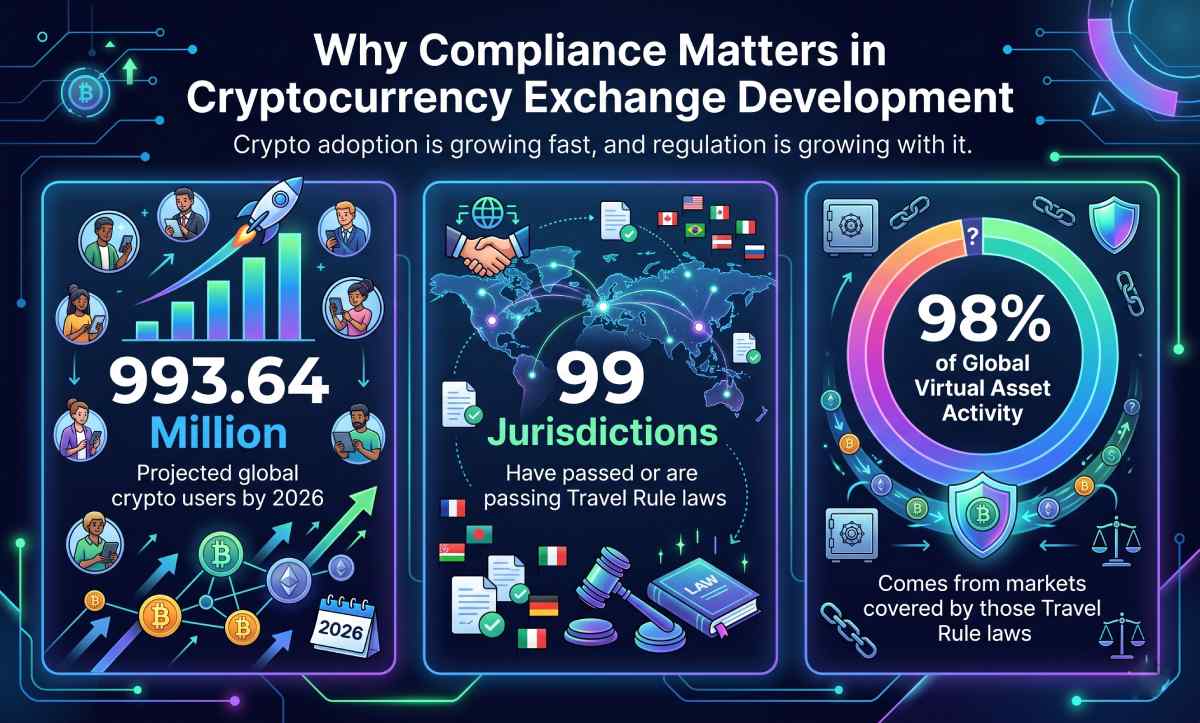
The demand for regulated crypto trading platforms is rising fast. Statista projects global crypto users will reach 993.64 million in 2026. At the same time, FATF reports that 99 jurisdictions have passed or are passing Travel Rule laws, and these markets account for about 98% of global virtual asset activity. This shows a clear shift toward licensed, transparent, and compliance-ready exchanges. For businesses planning cryptocurrency exchange development, KYC, AML, licensing, wallet screening, and transaction monitoring are now core parts of the build. A compliance-first exchange helps protect users, meet regulatory checks, and build trust with banks, investors, and institutional traders.
Why Compliance Matters for Crypto Exchanges
Compliance gives a crypto exchange credibility before the first trade happens. Users want to know their funds, data, and withdrawals are protected. Investors want proof that the business can operate without sudden legal trouble.
Banks and payment providers also look for strong KYC and AML controls. A licensed exchange with clear reporting, audit logs, and wallet screening has a better chance of securing fiat rails and institutional partners.
Compliance also lowers business risk. It helps prevent fraud, blocked transactions, enforcement action, and forced market exits. For businesses that plan to expand across regulated markets, compliance is not just a legal task. It is a growth asset.
Core Regulatory Requirements for Cryptocurrency Exchanges
KYC Requirements
A cryptocurrency exchange must prove who its users are before they trade, deposit, or withdraw funds. KYC starts this process. The platform verifies the customer’s name, address, identity documents, and live face match. This step blocks fake accounts, stolen IDs, and repeat fraud attempts. For business accounts, the exchange checks company records, directors, and beneficial owners.
AML Requirements
AML controls go deeper. The exchange reviews each user’s risk level, screens sanctions lists, checks politically exposed persons, and watches transaction patterns. High-risk users need enhanced due diligence. Large withdrawals, rapid wallet hops, mixer exposure, and links to flagged wallets need review. A strong AML system creates alerts, assigns cases, and stores each action in an audit trail.
Licensing Requirements
Licensing turns these controls into a legal operating model. Most regulated markets ask for a registered entity, named compliance officer, AML and KYC policies, cybersecurity rules, custody procedures, capital records, and regular filings. These requirements help regulators confirm that the exchange can protect users and manage financial crime risk.
Travel Rule Compliance
Travel Rule compliance adds one more layer. For qualifying transfers, the exchange collects sender and receiver data, checks the counterparty VASP, shares details through a secure channel, and keeps records without exposing private user data.
Global Crypto Exchange Regulatory Frameworks
FATF Guidelines
Crypto exchange rules now follow a clear global pattern. FATF sets the base standard for virtual asset service providers. Its guidance pushes risk-based AML checks, customer screening, transaction monitoring, and Travel Rule data sharing. Many national regulators use this model for local crypto exchange laws.
MiCA Regulation in the European Union
The European Union’s MiCA regulation gives crypto-asset service providers a single rule set across EU markets. CASPs need authorization, governance controls, custody rules, user protection measures, and market abuse controls. This gives serious exchange operators a clearer path to serve EU users under one licensed structure.
United States Crypto Compliance
The United States uses a more layered model. FinCEN treats many crypto exchangers as money services businesses. They need MSB registration, an AML program, recordkeeping, and suspicious activity reporting. State money transmitter licensing and OFAC screening add more duties.
Singapore Crypto Exchange Regulations
Singapore regulates digital payment token service providers through MAS rules. These cover licensing, AML and CFT controls, customer checks, and user protection. The country’s strict compliance model makes it a trusted base for fintech and digital asset businesses.
Dubai and UAE Crypto Licensing
Dubai uses VARA licensing for exchange, broker-dealer, advisory, and custody activity. Businesses must meet rules for governance, market conduct, cybersecurity, client asset protection, and regulatory reporting before they operate under a licensed model.
Hong Kong Crypto Exchange Licensing
Hong Kong requires SFC licensing for virtual asset trading platforms. The rules cover custody, token admission, cybersecurity, retail access, and ongoing supervision. This makes Hong Kong a strong market for exchanges that want regulated access to Asian crypto users.
KYC and AML Compliance Framework for Crypto Exchange Development
User Onboarding Workflow
A compliant crypto exchange starts with a controlled user onboarding flow. The process begins with registration, then email and phone checks. After that, users submit identity proof, address proof, and biometric checks. The exchange then assigns a risk score before account approval. This score shapes trading access, withdrawal limits, and review frequency.
Customer Due Diligence
Customer Due Diligence gives the exchange a clear view of each user. Regular traders pass standard checks. High-risk users need Enhanced Due Diligence, which reviews fund sources, transaction behavior, and links to risky regions. Corporate clients need KYB checks. This verifies company records, directors, owners, and trading purpose.
AML Transaction Monitoring
AML monitoring works after onboarding. The exchange tracks transactions in real time, screens wallets, flags suspicious activity, and sends alerts to compliance teams. Blockchain analytics tools help detect exposure to mixers, sanctioned wallets, darknet markets, and stolen funds. Each alert needs case records, review notes, and final action logs.
Technical Compliance Features Every Crypto Exchange Should Include
KYC and KYB Verification Module
A crypto exchange needs compliance tools built into its core system. The KYC and KYB module should verify users, companies, documents, and approval levels. This reduces manual review time and keeps onboarding consistent.
AML Monitoring System
The AML monitoring system should track deposits, withdrawals, trades, wallet history, sanctions matches, and risk alerts. It should produce clear reports for audits and regulator reviews.
Secure Wallet and Custody Infrastructure
Wallet and custody controls protect user assets. Hot wallets support daily transactions. Cold wallets store most funds offline. Multi-signature or MPC security adds approval layers. Withdrawal whitelisting, client asset segregation, and private key protection reduce theft risk.
Compliance Admin Dashboard
A compliance admin dashboard gives teams one place to manage user scores, KYC status, AML alerts, transaction reports, audit logs, and staff permissions.
Cybersecurity and Data Protection
Cybersecurity completes the structure. Encryption protects user data. Penetration testing finds weak points. DDoS protection keeps the exchange online. Access controls limit staff misuse. Data retention rules and disaster recovery plans keep the business prepared for audits, outages, and security events.
Here’s the same content with clearer subheadings added:
Compliance-First Crypto Exchange Development Process
Regulatory Planning
A compliant crypto exchange starts with clear regulatory planning. The business team must choose target markets, check license rules, define fiat support, and select a custody model. These choices shape the full product build. A spot exchange with fiat deposits faces different checks than a crypto-only P2P platform.
Compliance Architecture Design
The next step is compliance architecture design. KYC, AML, Travel Rule, reporting, custody, and data protection workflows must sit inside the product plan from day one. This prevents costly rebuilds after launch. It also helps the exchange pass bank reviews, investor checks, and regulator questions.
Platform Development and Compliance Integration
During platform development, compliance controls must appear across user onboarding, wallet management, the trading engine, payment systems, and the admin panel. KYC providers verify users. AML tools screen names, wallets, and transactions. Blockchain analytics tools flag mixer exposure, sanctioned wallets, and high-risk fund movement.
Testing, Launch, and Ongoing Compliance
Testing comes next. The team must run security audits, penetration tests, compliance checks, and user acceptance tests. After launch, compliance work continues through alert reviews, policy updates, case records, reporting, and transaction monitoring.
Disaster Recovery Planning
Disaster recovery planning protects the exchange during outages, cyberattacks, data loss, and wallet access failures. A strong plan covers backup systems, recovery time targets, incident roles, cold wallet access rules, and customer communication. The exchange must test this plan often. A written plan means little until the team proves it works under pressure.
Conclusion
A compliant crypto exchange needs more than trading features. It needs strong KYC, AML checks, licensing support, secure custody, transaction monitoring, and disaster recovery planning from the start. These controls help businesses build trust, reduce legal risk, and serve users across regulated markets. For startups and enterprises planning cryptocurrency exchange development, cryptocurrencyexchangescript offers a practical path to build a secure, scalable, and compliance-ready trading platform with the right technical features and business support.