
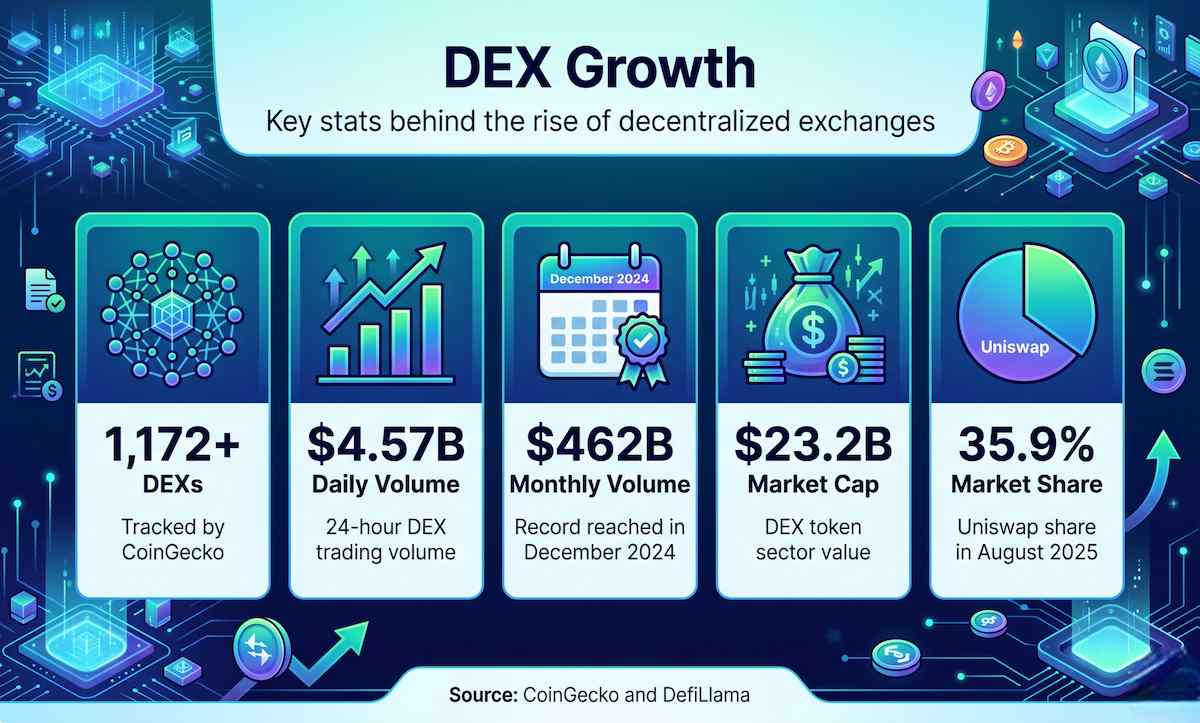
Decentralized exchanges now sit at the center of crypto trading growth. CoinGecko tracks more than 1,172 DEX platforms, and their combined 24-hour trading volume stands near $4.57 billion. The market moved even faster in December 2024, when monthly DEX volume hit a record $462 billion. DEX tokens now hold a market cap of about $23.2 billion, and Uniswap captured 35.9% of top DEX market share in August 2025. These numbers show a clear shift in trader behavior. Users want direct wallet control, open pricing, and on-chain settlement. For businesses, a decentralized exchange offers a practical path to serve that demand, open new revenue streams, and enter DeFi with a model built on self-custody and transparency.
What Is a Decentralized Exchange?
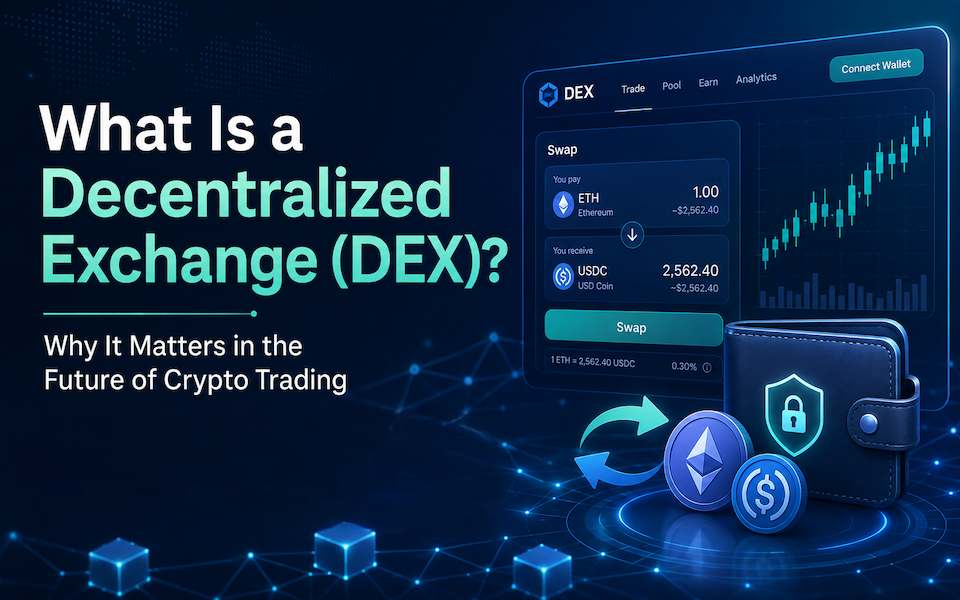
A decentralized exchange, or DEX, lets users trade crypto from their own wallets. It does not hold customer funds. Smart contracts handle the trade and record it on the blockchain.
A centralized exchange controls accounts, deposits, and withdrawals. A DEX gives more control to the user. Traders keep their private keys and approve each transaction themselves.
Most DEXs are built on self-custody, open access, and clear on-chain records. Platforms like Uniswap, Curve, PancakeSwap, and dYdX helped prove this model. For businesses, a DEX can support new trading products, DeFi services, and direct access to global crypto liquidity.
How Does a Decentralized Exchange Work?
A decentralized exchange lets users trade crypto from their own wallets. No central company holds the funds. The trade runs through blockchain code, and the user approves each action.
Blockchain-Based Trading Explained
A DEX records trades on a blockchain. This gives each transaction a public trail. Businesses gain clearer proof of trade activity, asset movement, and settlement history.
Role of Smart Contracts
Smart contracts handle the trade rules. They check balances, calculate prices, move tokens, and complete swaps. The exchange does not need a broker or manual approval.
Automated Market Makers
Many DEX platforms use automated market makers. An AMM replaces a traditional order book with a pool of tokens. The pool sets prices through a formula tied to token supply.
Liquidity Pools and Liquidity Providers
Liquidity providers deposit token pairs into pools. Traders swap against those pools. Providers earn trading fees, but they face price movement risk.
Wallet-to-Wallet Transactions
Users connect wallets such as MetaMask or Trust Wallet. The assets stay under user control until the trade executes.
Token Swaps and Trade Execution
A token swap starts with a quote. The user approves the swap, pays the network fee, and receives the new token.
Transaction Settlement on Blockchain Networks
Settlement happens on-chain. This creates a clear record and reduces counterparty risk for traders, fintech firms, and Web3 platforms.
Key Components of a Decentralized Exchange
A strong DEX needs more than a swap screen. It needs secure code, deep liquidity, clear pricing, and fast network support.
Smart Contracts
Smart contracts form the trading engine. They must be audited, tested, and monitored. Poor code can expose funds to theft.
Liquidity Pools
Liquidity pools give traders access to tokens without a central market maker. Deeper pools reduce slippage and create better trade execution.
Governance Tokens
Governance tokens let token holders vote on fees, upgrades, and protocol rules. This model gives users a role in platform control.
Crypto Wallet Integration
Wallet support shapes the user experience. A business-grade DEX needs support for popular wallets, mobile users, and secure transaction signing.
Oracle Networks
Oracles bring outside price data onto the blockchain. They help DEX platforms check market prices, reduce manipulation risk, and support advanced trading tools.
Cross-Chain Bridges
Cross-chain bridges help users move assets across networks. This matters for DEX platforms that serve Ethereum, BNB Chain, Solana, Polygon, Arbitrum, and Base users.
Layer-2 Scaling Solutions
Layer-2 networks process trades faster and at lower cost than many base chains. For businesses, this means better user retention, lower fees, and higher trading volume.
Types of Decentralized Exchanges
Decentralized exchanges use several trading models. Each model serves a different business need. The right choice affects liquidity, speed, cost, user trust, and long-term platform revenue.
Automated Market Maker DEX
An automated market maker DEX uses liquidity pools instead of buyers and sellers matched by an order book. Users trade against pooled assets funded by liquidity providers. Uniswap and PancakeSwap use this model. AMMs work well for token swaps, new asset launches, and retail DeFi trading.
Order Book-Based DEX
An order book DEX lists buy and sell orders on-chain or partly off-chain. Traders get more control over price, trade size, and order timing. dYdX and Hyperliquid show how this model suits derivatives, high-volume trading, and professional users.
DEX Aggregators
DEX aggregators search many exchanges for better prices. 1inch is a common example. Aggregators reduce slippage and route trades across several pools. Businesses can use this model to improve execution quality inside wallets, fintech apps, and trading tools.
Cross-Chain DEX Platforms
Cross-chain DEX platforms let users trade assets across blockchains. They help businesses reach users on Ethereum, BNB Chain, Solana, Polygon, Arbitrum, and Base without forcing all activity onto one network.
Hybrid Decentralized Exchanges
Hybrid DEX platforms combine self-custody with faster trade matching. This model suits enterprises that need better speed, cleaner user flows, and more control over compliance features.
DEX vs CEX: Centralized Exchange
A DEX gives users control of funds through self-custody. A CEX holds user assets and manages trading inside its own platform. That difference shapes risk, trust, and business strategy.
Decentralized exchanges and centralized exchanges serve the same trading goal, but they handle control, risk, and access in different ways.
Custody and Control
A DEX keeps custody with the user, so traders connect a wallet and approve each transaction on-chain. A CEX holds user funds inside platform accounts, which can make account recovery and managed trading easier, but it adds custody risk.
Security and Privacy
A DEX gives users more privacy and clear transaction records. Activity appears on the blockchain. A CEX often requires KYC and stores user data, so privacy is lower.
Liquidity, Fees, and Speed
A CEX often has deeper liquidity and faster off-chain trading. A DEX has growing liquidity, but trading speed follows blockchain capacity. DEX fees change with network use, and CEX platforms charge platform fees.
Business Use
For businesses, a DEX suits self-custody, DeFi access, and transparent settlement. A CEX suits fiat access, managed accounts, and high-speed order execution.
Which Exchange Model Is Better for Businesses?
A CEX fits businesses that need fiat support, account recovery, and high-speed order matching. A DEX fits businesses that value self-custody, global access, token swaps, and transparent settlement. Many crypto firms now study both models, then pick the one that matches their users and revenue plan.
When Should Enterprises Choose DEX Platforms?
Enterprises should choose DEX platforms for DeFi products, tokenized assets, wallet-based trading, DAO treasury tools, and cross-chain liquidity access. A DEX gives the business a stronger trust layer. It reduces custody risk and gives users direct control of their assets.
Advantages of Decentralized Exchanges
Full Asset Ownership
A decentralized exchange keeps users in control of their crypto. Traders connect a wallet, approve a trade, and keep custody of their funds. The platform never holds the assets. This model matters for businesses that manage treasury funds, customer tokens, or Web3 payment flows.
Enhanced Security
DEXs reduce the risk tied to exchange-held wallets. A hacker cannot drain one central account full of user deposits. Smart contracts still need audits, but the custody risk changes. Security teams can track contract behavior on-chain and test each major function.
No Central Authority
A DEX runs through code, liquidity pools, and user wallets. No single company approves every trade. This helps crypto projects list tokens faster and reach buyers without a long exchange review cycle.
Improved Transparency
Every swap, pool balance, fee, and contract call appears on public blockchains. Teams can verify liquidity depth, trading volume, and wallet activity without waiting for private reports.
Lower Trading Costs
Many DEXs cut account fees and middlemen. Costs still include gas and pool fees, so chain choice matters. Layer-2 networks help reduce trade costs for active users.
Global Accessibility
A user with a wallet and internet access can trade on a DEX. This opens markets for global users, small crypto teams, and token issuers that need wider reach.
Increased Privacy
Most DEX trades do not require a full exchange account. Users trade through wallets, which lowers data collection at the platform level.
Permissionless Innovation
Developers can build swaps, vaults, aggregators, and trading tools on top of public DEX contracts. For businesses, this creates faster product testing and new revenue paths.
How to Launch Your Own Decentralized Exchange
Launching a decentralized exchange starts with a clear trading goal. A business must decide what it wants to support: simple token swaps, stablecoin trading, derivatives, cross-chain swaps, or a full DeFi trading hub. This choice shapes the blockchain, smart contracts, liquidity plan, fees, wallet support, and security budget.
Define the Business Model
A DEX earns through swap fees, liquidity pool fees, premium trading tools, token listings, or white-label exchange services. The model must match the target users. Retail traders need fast swaps and low costs. Institutions need deeper liquidity, audit reports, reporting tools, and risk controls.
Choose the Right Blockchain
Ethereum gives access to deep liquidity and mature DeFi tools. BNB Chain and Polygon reduce user costs. Arbitrum, Base, and Optimism fit teams that want Ethereum security with lower fees. Solana suits fast trading, but development needs different skills. The right chain must match speed, cost, liquidity, wallet support, and user demand.
Select the Trading Model
Most new DEX platforms use an automated market maker model. AMMs work well for token swaps and liquidity pools. Order book models suit professional trading, derivatives, and high-volume markets. Aggregator models route trades across several DEXs to improve price execution.
Build Smart Contracts
Smart contracts control swaps, liquidity pools, fees, rewards, and governance. Each contract must be simple, tested, and audited. A small error can freeze funds or expose pools to attacks. Teams should test contracts on public testnets, run formal reviews, and fund bug bounty programs before launch.
Plan Liquidity Before Launch
A DEX with weak liquidity creates poor pricing and high slippage. Teams can attract liquidity through launch rewards, market maker partnerships, treasury-funded pools, and token incentives. A balanced plan protects traders and liquidity providers.
Add Wallets, Analytics, and Compliance Checks
A strong DEX needs wallet support, clean charts, trade history, pool data, and clear fee displays. Business users need admin tools, risk tracking, and reporting. Legal review matters from day one, since token trading rules vary by market.
Launch, Monitor, and Improve
The launch should start with limited pools, capped exposure, and live contract monitoring. After traffic grows, the team can add more tokens, bridges, chain support, and advanced trading tools. A successful DEX grows through trust, liquidity, security, and a clear reason for traders to return.
Popular Decentralized Exchange Platforms
Choosing the right decentralized exchange depends on the asset type, user base, trading model, and target chain. Some DEX platforms serve retail token swaps. Others support stablecoin markets, derivatives, aggregation, or custom liquidity pools. For a business, the right choice comes down to liquidity depth, fees, developer support, security history, and user trust.
Uniswap
Uniswap is one of the most used DEX platforms for token swaps and liquidity pools.
- Primary blockchain: Ethereum, with support across Base, Arbitrum, Optimism, Polygon, Unichain, and other networks.
- Trading model: Automated market maker.
- Key features: Token swaps, concentrated liquidity, liquidity pools, permissionless token markets, and developer tools.
- Best use cases: ERC-20 token swaps, new token launches, liquidity programs, and DeFi app integrations.
- Business suitability: Uniswap fits startups, Web3 apps, wallets, and DeFi teams that need deep liquidity and wide market reach.
PancakeSwap
PancakeSwap is a strong choice for low-fee retail trading and multichain DeFi products.
- Primary blockchain: BNB Chain, with support for Ethereum, Solana, Base, Arbitrum, Aptos, ZKsync, Linea, Monad, and opBNB.
- Trading model: Automated market maker.
- Key features: Token swaps, low trading fees, liquidity farms, staking, launch tools, and multichain access.
- Best use cases: Retail swaps, DeFi campaigns, token rewards, and community-led trading markets.
- Business suitability: PancakeSwap fits consumer crypto apps, gaming tokens, meme token projects, and businesses targeting cost-sensitive users.
Curve Finance
Curve Finance focuses on stable assets and low-slippage swaps.
- Primary blockchain: Ethereum, with deployments across several EVM networks.
- Trading model: StableSwap automated market maker.
- Key features: Stablecoin pools, liquid staking token pools, low-slippage swaps, veCRV governance, and deep liquidity for paired assets.
- Best use cases: Stablecoin trading, treasury swaps, liquid staking assets, and DeFi yield products.
- Business suitability: Curve fits DeFi protocols, DAOs, treasury teams, and institutions that trade stable or closely priced assets.
SushiSwap
SushiSwap offers multichain swaps and liquidity tools for broad DeFi access.
Primary blockchain: Ethereum, with support across many chains.
- Trading model: Automated market maker and aggregator.
- Key features: Token swaps, cross-chain swaps, liquidity pools, aggregator routing, and yield tools.
- Best use cases: Multichain token swaps, DeFi rewards, community trading, and cross-chain asset movement.
- Business suitability: SushiSwap fits Web3 teams that need flexible chain coverage and a familiar trading interface.
dYdX
dYdX serves advanced traders who need derivatives and professional trading tools.
- Primary blockchain: dYdX Chain.
- Trading model: Order book and perpetual contracts.
- Key features: Perpetual futures, API access, mobile and desktop trading, deep liquidity, and real-time on-chain rewards.
- Best use cases: Derivatives trading, pro trading desks, API-based trading, and high-volume crypto markets.
- Business suitability: dYdX fits trading firms, fintech platforms, and crypto businesses focused on advanced market products.
Balancer
Balancer gives teams more control over liquidity pool design.
- Primary blockchain: Ethereum and select EVM chains.
- Trading model: Weighted automated market maker.
- Key features: Weighted pools, stable pools, custom token weights, multi-token pools, and liquidity management tools.
- Best use cases: Portfolio-style pools, token launches, liquidity bootstrapping, and custom DeFi products.
- Business suitability: Balancer fits advanced DeFi teams that need custom pool structures and more control over asset weights.
1inch Network
1inch helps users find better swap routes across many DEX platforms.
- Primary blockchain: Ethereum and several EVM networks, with cross-chain swap support.
- Trading model: DEX aggregator.
- Key features: Smart routing, split trades, MEV protection, cross-chain swaps, and access to many liquidity sources.
- Best use cases: Price-sensitive swaps, wallet swaps, fintech app routing, and large trades with lower slippage.
- Business suitability: 1inch fits wallets, trading apps, fintech tools, and businesses that need swap routing rather than a single liquidity pool.
Trader Joe
Trader Joe, now known as LFJ, is known for its Liquidity Book model.
- Primary blockchain: Avalanche, Monad, and other major chains.
- Trading model: Liquidity Book automated market maker.
- Key features: Liquidity bins, concentrated liquidity, low-slippage trading, fee capture tools, and active liquidity design.
- Best use cases: Avalanche trading, liquidity strategies, active market making, and DeFi reward programs.
- Business suitability: Trader Joe fits DeFi teams, liquidity providers, and projects that need active pool design with tight pricing control.
Industry Use Cases of DEX Technology
Cryptocurrency Trading Platforms
DEX technology lets exchanges offer wallet-to-wallet trading. Users keep control of funds, and the platform earns from swap fees, routing, and liquidity services.
FinTech Applications
FinTech firms use DEX rails for token swaps, stablecoin payments, and in-app crypto trading. This creates new revenue without full custody risk.
Tokenized Asset Exchanges
DEXs can support tokenized bonds, funds, real estate shares, and commodities. Smart contracts manage transfers, pricing, and settlement rules.
NFT Marketplaces
NFT platforms can use DEX models for instant token swaps, creator tokens, and collection liquidity. This gives buyers and sellers more flexible payment options.
Web3 Gaming Economies
Games use DEXs for in-game tokens, player rewards, and asset trading. Players trade directly from wallets, and studios gain a liquid market for game assets.
DAO Treasury Management
DAOs use DEXs to rebalance treasuries, swap governance tokens, and manage stablecoin reserves with public records.
Institutional Digital Asset Trading
Institutions use DEX tools for transparent settlement, programmable controls, and access to DeFi liquidity. Risk teams still need audits, reporting, and policy controls.
Cross-Border Payments
DEXs support stablecoin swaps across markets. Businesses can reduce settlement delays, lower transfer costs, and serve users in regions with weak banking access.
Conclusion
Decentralized exchanges are shaping the next stage of crypto trading by giving users more control, better transparency, and direct access to DeFi markets. For businesses, a DEX is more than a trading platform. It can support new revenue models, token liquidity, global market access, and faster blockchain-based settlement. As demand grows for self-custody and on-chain finance, companies that act early can build stronger trust with traders and investors. Cryptocurrency Exchange Script provides Decentralized Exchange Development for startups, enterprises, and crypto trading firms that want to launch secure, scalable, and feature-rich DEX platforms with smart contracts, wallet connectivity, liquidity pools, token swaps, and cross-chain trading support.