
Key Takeaways
- Tier 1 crypto exchanges lead in liquidity, trading volume, security, and user trust.
- Traders choose Tier 1 exchanges for faster execution, lower slippage, and stronger fund protection.
- Businesses gain better token visibility, investor confidence, and global market access through Tier 1 exchange listings.
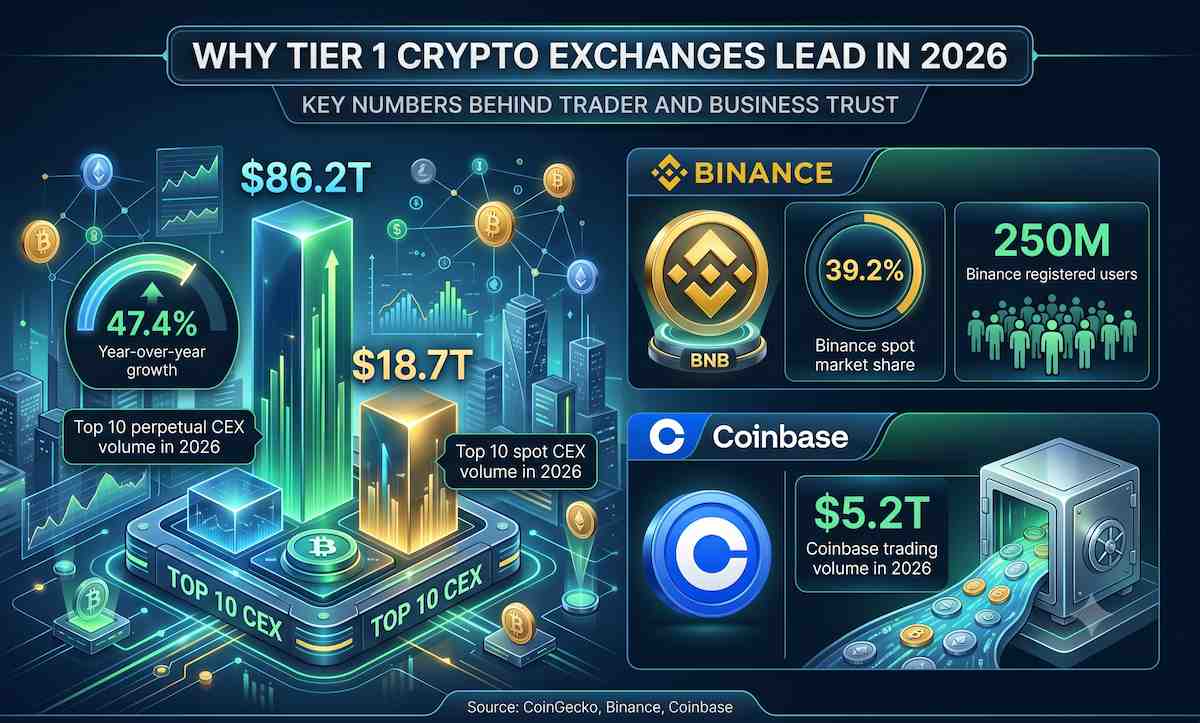
Tier 1 crypto exchanges now drive a huge share of global crypto trading. CoinGecko reported that the top 10 perpetual centralized exchanges processed $86.2 trillion in trading volume in 2025, up 47.4% from 2024. The same report showed that the top 10 centralized spot exchanges reached $18.7 trillion in annual volume. Binance alone held 39.2% of that spot market share, which shows how strongly trading activity concentrates on top-tier platforms.
These numbers explain why traders and businesses prefer Tier 1 exchanges. Deep liquidity helps traders place orders with less slippage. Large trading volume supports better price discovery and tighter spreads. Big platforms bring trust, visibility, and access to a wider user base. Binance reported 250 million registered users by January 2026, and Coinbase reported $5.2 trillion in annual trading volume for 2026, up 156% year over year. For token projects, fintech firms, and exchange operators, these figures point to one clear fact. Tier 1 exchanges do more than handle trades. They shape market access, investor confidence, and long-term business growth.
What Are Tier 1 Crypto Exchanges?
Tier 1 crypto exchanges are leading global platforms with high trading volume, deep liquidity, strong security, and broad market trust. They support spot, futures, margin, staking, APIs, and advanced order types.
These exchanges stand out through deep order books, fast matching engines, asset transparency, proof-of-reserves reports, strong cybersecurity, compliance checks, and reliable uptime during volatile markets.
The term “Tier 1” is not a legal label. Traders, investors, market makers, and token teams use it to judge exchange quality, credibility, liquidity, and risk. For traders, it affects execution and fund safety. For businesses, it affects listing value, user trust, and long-term market reach.
Why Tier 1 Crypto Exchanges Are Better for Crypto Traders
Tier 1 crypto exchanges give traders a stronger base for fast trades, safer fund control, and cleaner market access. Traders care about price, speed, and trust. A weak exchange can damage all three. Poor liquidity creates price gaps. Slow systems delay orders. Weak security raises fund risk. This is why active traders, whales, arbitrage desks, and institutions favor high liquidity crypto exchanges with strong order books and proven controls.
For businesses, the lesson is clear. A crypto trading platform must compete on more than design. It needs deep liquidity, strong security, clear fees, and steady uptime. These factors shape trader trust and long-term revenue.
High Liquidity Enables Faster Trade Execution
Liquidity shows how easily traders can buy or sell crypto without pushing the price too far. Tier 1 exchanges attract millions of users, market makers, and large trading desks. This creates deeper order books and tighter bid-ask spreads.
A trader placing a large BTC or ETH order gets better execution on a liquid exchange. The order matches faster, and the final price stays closer to the quoted price. This matters for day traders, arbitrage teams, funds, and token projects that need steady markets.
Crypto exchange businesses need liquidity aggregation, market-making support, and strong order book depth from launch. Without these layers, even a good trading app can lose serious traders.
Lower Slippage Improves Trading Profitability
Slippage happens when an order executes at a different price than expected. For example, a trader clicks buy at $100, but the final trade completes at $101. That $1 gap looks small, but it can cut profits across hundreds of trades.
Low-liquidity exchanges create more slippage. Their order books have fewer buyers and sellers, so large orders move through weaker price levels. Tier 1 exchange liquidity protects trader margins by keeping spreads tight and order depth strong.
Institutional crypto trading needs strict slippage control. Funds, brokers, and high-volume traders measure every basis point. Market-making services and crypto liquidity providers help maintain fair pricing, faster matching, and stronger confidence across the market.
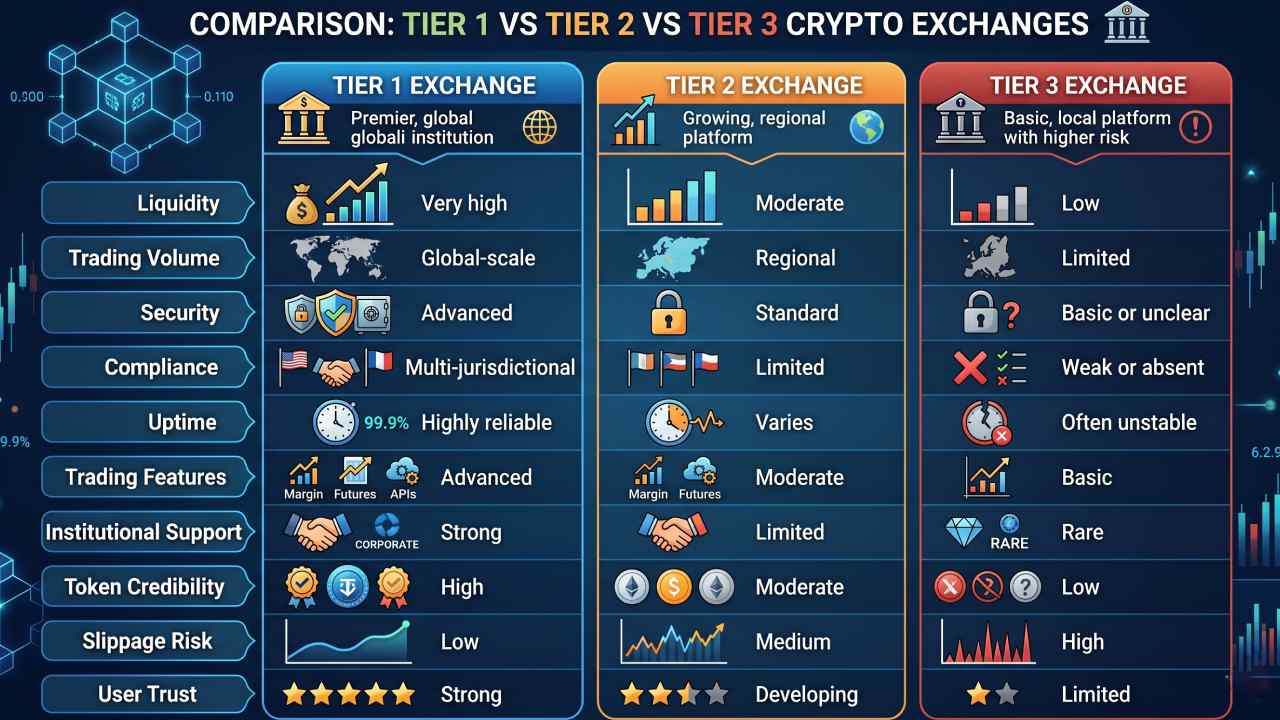
Tier 1 vs Tier 2 vs Tier 3 Crypto Exchanges: Business and Trading Comparison
Comparison Overview
Tier 1 crypto exchanges set the highest market standard for liquidity, security, uptime, and trader trust. These platforms serve global traders, market makers, funds, and token teams that need deep order books and fast execution. Tier 2 exchanges often serve strong regional markets. Tier 3 exchanges work for small projects, but they carry higher trading risk.
Why Token Projects Benefit from Tier 1 Exchange Listings
Tier 1 Listings Increase Token Visibility
A Tier 1 exchange listing places a token in front of a much larger trader base. It can attract retail buyers, professional desks, media coverage, and institutional awareness. For a token project, this exposure changes how the market sees the brand.
Tier 1 exchange listing services, token listing services, and a crypto exchange listing agency help projects prepare the documents, audits, and market plans needed for review.
Tier 1 Listings Improve Liquidity and Market Stability
Major exchanges attract market makers, liquidity providers, and active traders. This creates deeper order books and tighter spreads. Investors can enter and exit positions with less price impact.
Better liquidity supports cleaner price discovery. It can reduce sharp moves caused by thin trading. It also gives communities more confidence in the token’s market health.
Tier 1 Listings Build Investor and Community Trust
Major exchanges review tokenomics, smart contract audits, legal opinions, project background, community traction, market demand, security records, liquidity readiness, and compliance status. A successful listing signals that the project has passed serious checks.
Commercial Impact of Tier 1 Exchange Listings
The business impact can be strong. Projects gain stronger brand authority, higher trading activity, better investor confidence, new partnership chances, greater fund interest, stronger fundraising credibility, and long-term ecosystem growth.
Best Tier 1 Crypto Exchanges in 2026
Tier 1 crypto exchanges stand out through trading depth, user trust, security controls, and global reach. CoinGecko and CoinMarketCap rank leading exchanges through trust score, trading volume, liquidity, traffic, and market confidence. These signals help traders and token teams compare platforms with more clarity.
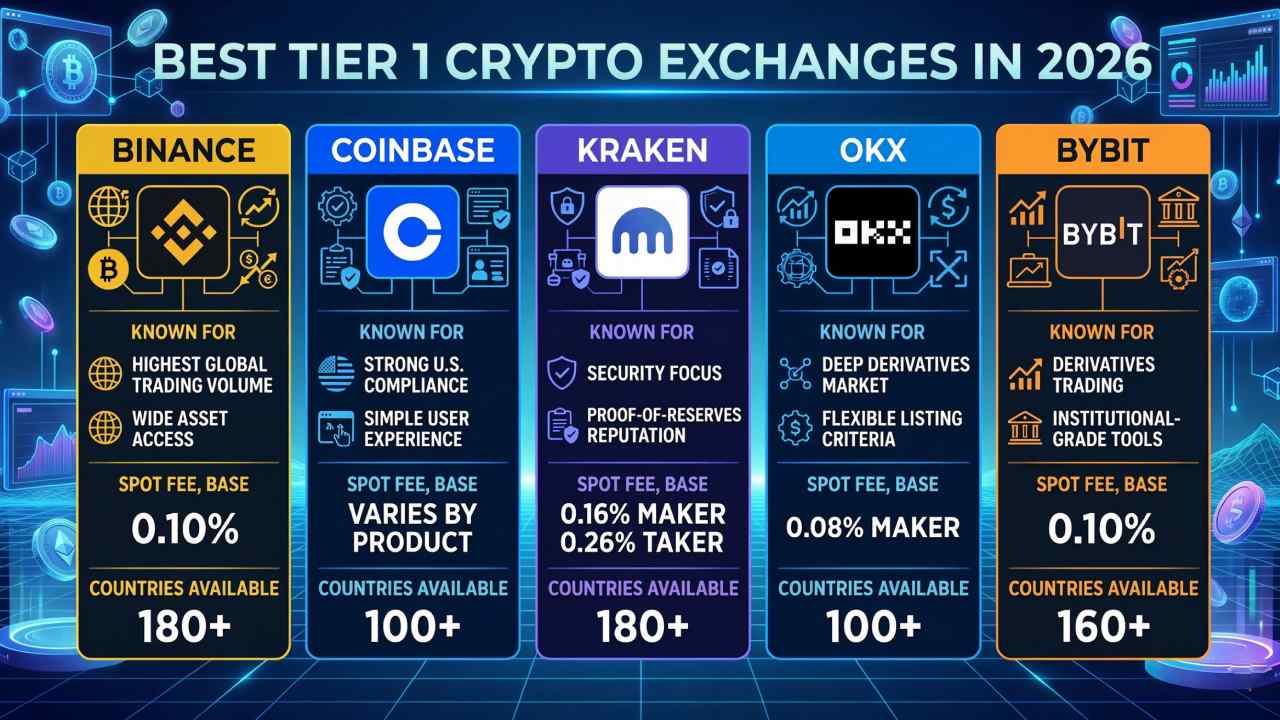
Each platform serves a different type of trader. Binance attracts users who need high volume, broad token access, and deep liquidity. Coinbase works well for users who value regulatory clarity, simple buying flows, and strong U.S. market presence. Kraken appeals to traders who place security and reserve transparency at the center of their decision.
OKX and Bybit suit traders who focus on derivatives, futures, and advanced order types. These platforms draw active traders, funds, and market makers that need speed, depth, and flexible trading products.
The right exchange choice comes from three factors: trading style, location, and risk priority. A retail user needs a simple interface. A fund needs deep order books and fast APIs. A token project needs listing access, liquidity support, and market credibility. Businesses can study Tier-1 Exchange Listings to compare listing standards, access rules, and growth value across these major platforms.
Industry Use Cases of Tier 1 Crypto Exchange Platforms
Tier 1 crypto exchange platforms support token launches, fintech trading apps, enterprise desks, market makers, and institutional investors. Each group needs liquidity, security, compliance, and reliable trade execution.
Web3 Startups Seeking Token Liquidity
Web3 startups use Tier 1 exchange listing strategies to build deeper liquidity and reduce thin trading. A strong listing plan can attract investors, support market makers, and make the token easier to buy, sell, stake, or use.
Fintech Companies Launching Crypto Trading Platforms
Fintech firms can build crypto trading platforms with Tier 1-like features. These include KYC, AML checks, wallet security, fiat on-ramp integrations, clear fees, and access to deep liquidity. This helps them serve users with safer and smoother crypto trading.
Market Makers and Liquidity Providers
Market makers rely on Tier 1 exchanges for deep order books, stable APIs, and fast execution. These tools help them manage spreads, quote prices, support token launches, and keep markets active during volatility.
Institutional Investors and Asset Managers
Institutions prefer exchanges with compliance controls, custody standards, liquidity depth, and reliable reporting. These features support audits, risk reviews, fund operations, and large-volume trades.
Crypto Projects Preparing for Global Expansion
Crypto projects use Tier 1 exchange readiness to reach global traders and build stronger market credibility. Audit reports, tokenomics, legal opinions, liquidity plans, and market-making support help projects prepare for wider adoption.
Conclusion
Tier 1 crypto exchanges have become the preferred choice for traders and businesses that need deep liquidity, strong security, reliable uptime, and wider market reach. For token projects, a Tier 1 listing can improve visibility, trading activity, investor trust, and long-term growth. Businesses planning to enter this space need more than a basic trading platform. They need exchange infrastructure built for speed, compliance, liquidity, wallet security, and user confidence. CryptocurrencyExchangeScript provides Tier 1 Crypto Exchange Development for startups, enterprises, and crypto businesses that want to launch a secure, scalable, and market-ready trading platform with the features needed to compete with leading global exchanges.