
Key Takeaways
- Perpetual DEX volume reached $6.7T in 2025, showing strong market demand for decentralized derivatives.
- Polygon offers low fees, fast trades, and active stablecoin usage, which makes it a strong chain for perp DEX development.
- Businesses can earn through trading fees, liquidity programs, institutional tools, and DeFi investment products.
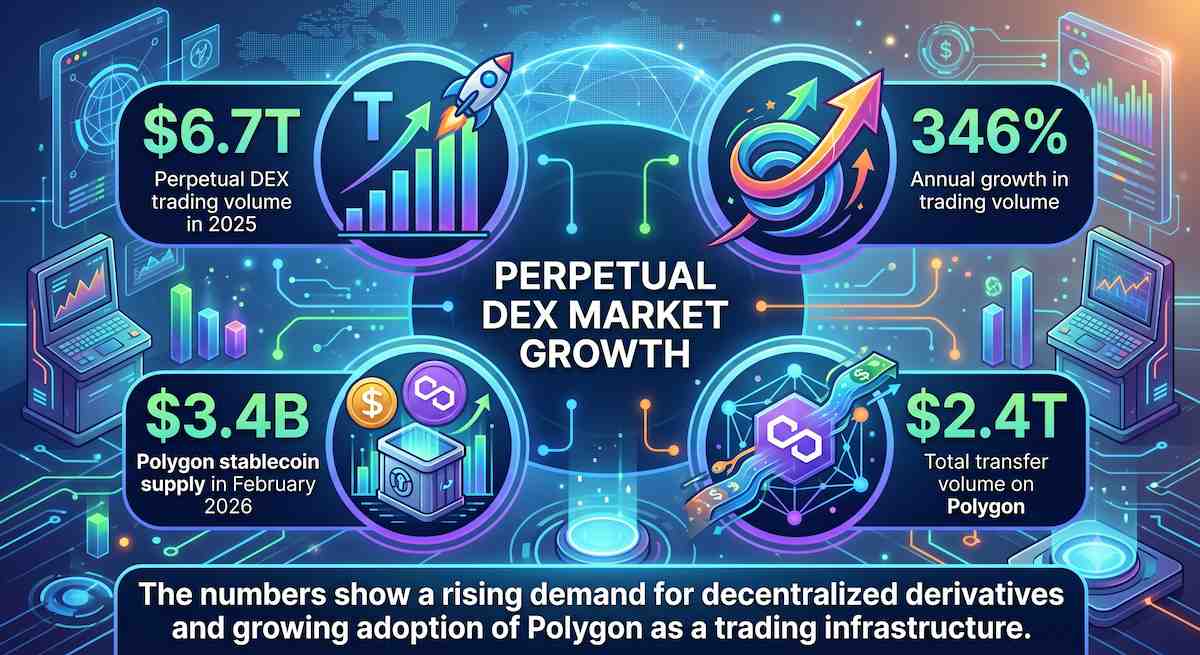
Perpetual DEX trading has moved into the mainstream of crypto markets. CoinGecko reported $6.7 trillion in perpetual DEX volume in 2025, which marked a 346% jump from the prior year. The same report found that the top 10 perpetual DEXs grew from $1.8 trillion in Q3 2025 to $3.2 trillion in Q4 2025, which reflected 80.8% quarter-on-quarter growth. Polygon gives this market a strong base for expansion. Polygon reported $3.4 billion in stablecoin supply in February 2026, up from $1.64 billion at the start of 2025, along with $2.4 trillion in total transfer volume. For businesses, these figures point to a clear market shift. Demand for decentralized derivatives is rising fast, and Polygon offers the speed, low transaction cost, and active on-chain economy needed to launch a perpetual DEX with strong commercial potential.
What is a Perpetual DEX?
A perpetual DEX is a decentralized derivatives platform where users trade contracts that track crypto asset prices. These contracts do not expire. A trader can open a Bitcoin long position, short Ether, or trade other supported assets through margin.
Funding rates keep the contract price close to the spot market. Long traders pay short traders, or short traders pay long traders, based on market demand. This keeps price gaps under control and protects the trading venue from one-sided exposure.
How Perpetual DEXs Differ from Traditional Crypto Exchanges
A centralized exchange holds user funds and runs the order system internally. A perpetual DEX uses smart contracts, wallets, oracle feeds, and visible trading rules. Users trade from their own wallets, so custody risk drops.
This is the main reason on-chain perpetual trading keeps gaining demand. DeFiLlama tracks more than 50 perpetual DEX and futures protocols. Monthly volumes have already reached hundreds of billions of dollars, with March 2026 perp DEX volume reported near $699 billion.
Core Components of a Decentralized Perpetual Exchange
A strong DeFi derivatives exchange needs margin contracts, a liquidation engine, funding rate logic, liquidity pools or an order book, oracle pricing, trading charts, wallet support, and admin risk controls. Each part must work under heavy market stress.
Traders prefer perpetual DEX platforms for control, speed, transparency, and 24/7 access. Businesses prefer them for fee revenue, global reach, token utility, and strong user retention.
Why Choose Polygon for Perpetual DEX Development?
Polygon gives perp DEX teams a practical base: EVM code, low fees, quick blocks, and broad wallet support. Polygon PoS uses Heimdall and Bor, anchors checkpoints to Ethereum, and supports sub-5 second finality, 3,800 TPS, and about $0.002 average transaction cost. For Polygon blockchain development, this mix keeps trades, margin updates, liquidations, and fee claims affordable.
Polygon Architecture Explained
PoS fits fast retail trading and lower launch costs. Polygon zkEVM fits teams that want stronger proof-based settlement. A trading venue can start on PoS, then add zkEVM markets later.
High Throughput and Low Gas Fees
Perp trading creates many actions: deposits, orders, position edits, funding payments, and withdrawals. Low gas helps active traders stay engaged.
Ethereum Compatibility and Ecosystem Support
Teams can reuse Solidity contracts, Ethereum tools, audit patterns, wallets, and indexers. This reduces build time for Polygon DeFi development.
Improved User Experience Through Fast Finality
Traders need quick position updates. Fast finality makes the app feel closer to a central exchange.
Polygon zkEVM vs PoS for Perpetual Trading Platforms
PoS suits cost-sensitive products. zkEVM suits brands that need stronger Ethereum alignment.
Benefits for Businesses Launching DeFi Trading Platforms
Teams that build DEX on Polygon get lower entry costs, faster release cycles, and access to a large EVM user base. Polygon Layer 2 development gives founders a strong path for trading, staking, and treasury products.
How Does a Perpetual DEX Work on Polygon?
A perpetual DEX lets users trade long or short contracts with no expiry date. On Polygon, smart contracts hold collateral, track positions, calculate funding, and close risky trades.
Wallet Connection and User Authentication
Users connect MetaMask, WalletConnect, or a smart wallet. The wallet acts as identity and signing tool.
Margin Trading Mechanism
Traders deposit collateral, often USDC. The protocol assigns margin to each position.
Leverage Trading Workflow
A trader opens a 5x BTC position with $1,000 collateral. The system records $5,000 exposure.
Funding Rate Mechanism
Funding payments keep perp prices close to spot prices. Longs pay shorts, or shorts pay longs.
Position Management
Users add margin, reduce size, close trades, or set stop orders through the trading interface.
Liquidation Engine
The liquidation engine closes weak positions before losses reach the liquidity pool.
Settlement Process
Smart contracts settle profit, loss, fees, and funding with transparent on-chain records.
Oracle Integration for Price Feeds
Price feeds from networks such as Pyth or Chainlink help the DEX price trades and trigger liquidations with lower manipulation risk.
Step-by-Step Blueprint to Build a Perpetual DEX on Polygon
Step 1 – Define Business Objectives and Trading Model
A perpetual DEX starts with a clear business plan. The team must decide target users, fee model, supported assets, leverage limits, margin rules, and risk controls. A retail-first platform needs simple trading flows. An institutional platform needs deeper liquidity, API access, and stricter reporting.
Step 2 – Choose Between AMM, vAMM, CLOB, or Hybrid Architecture
The trading model shapes speed, liquidity, and cost. AMMs suit pool-based trading. vAMMs reduce direct liquidity pressure. CLOBs give traders familiar order book control. A hybrid model works well for teams that want deep liquidity and a smoother trading experience.
Step 3 – Design Protocol Architecture
The architecture should connect trading contracts, margin accounts, price feeds, liquidations, fee logic, and treasury controls. Polygon helps reduce gas costs, so traders can open, modify, and close positions with fewer cost barriers.
Step 4 – Smart Contract Development
Smart contracts handle deposits, withdrawals, trades, funding payments, liquidations, staking, and governance. A skilled Perpetual DEX Development Company writes modular contracts, so upgrades and audits stay manageable.
Step 5 – Develop Matching Engine
A CLOB or hybrid exchange needs a fast matching engine. It must process market orders, limit orders, cancellations, and partial fills with low delay.
Step 6 – Liquidity Management System
Liquidity drives trust. The platform can use market makers, liquidity pools, vaults, or protocol-owned liquidity. Strong liquidity reduces slippage and helps attract active traders.
Step 7 – Oracle Integration
Price feeds must be accurate and hard to manipulate. Chainlink and Pyth are common choices for DeFi derivatives.
Step 8 – Wallet Integration
Wallet support should include MetaMask, WalletConnect, Coinbase Wallet, and smart contract wallets. Easy onboarding helps businesses Build decentralized exchange products for wider user groups.
Step 9 – Trading Dashboard UI/UX
The dashboard should show charts, margin ratio, liquidation price, open positions, order history, and fees. Traders need clear risk data before each trade.
Step 10 – Testing, Audit, and Mainnet Deployment
Testing must cover smart contracts, APIs, liquidation flows, oracle failures, and market stress. Security audits, bug bounty plans, and staged launch phases reduce launch risk. Polygon DEX development services often include testnet deployment before mainnet release.
Essential Features of a Modern Perpetual DEX on Polygon
A modern perpetual DEX on Polygon must give traders speed, control, and clear risk data. Low gas fees help users place frequent trades without high network costs. Fast settlement supports active markets, which matters for derivatives trading.
Multi-Asset Trading Support
The platform should support major crypto pairs such as BTC, ETH, MATIC, SOL, and stablecoin markets. More trading pairs help the exchange serve retail traders, funds, and Web3 businesses.
Cross Margin and Isolated Margin
Cross margin shares collateral across open positions. Isolated margin limits risk to one trade. Both options give users better control over capital and exposure.
Advanced Trading Charts
Charts should show candlesticks, volume, funding rates, liquidation price, and open interest. Traders need this data before they enter or exit a position.
Multiple Order Types
Market, limit, stop-loss, take-profit, and conditional orders make the platform more useful for active traders. These tools support better trade planning.
Liquidity Pools
Liquidity pools reduce slippage and support faster execution. Rewards can attract early liquidity providers and market makers.
Automated Liquidation System
The liquidation engine protects the protocol during sharp price moves. It closes risky positions before losses affect pooled funds.
Staking and Rewards
Staking rewards can support user retention. Token holders gain a reason to stay involved after launch.
Referral Programs
Referral programs lower user acquisition costs. Clear rewards can turn active traders into growth partners.
Governance Module
Governance lets token holders vote on fees, listed assets, rewards, and treasury use.
DAO Integration
DAO tools help the community guide long-term protocol decisions. This builds trust across traders, partners, and liquidity providers.
Technology Stack Required for Perpetual DEX Development
Blockchain Layer
A perpetual DEX on Polygon needs a chain layer that can process frequent trades, margin updates, liquidations, and funding payments without high fees. Polygon PoS suits trading products that need fast execution and low user cost. Polygon zkEVM suits teams that want stronger Ethereum alignment and easier reuse of Ethereum-based contracts, tools, and wallets.
The chain choice shapes the full product. A retail trading app needs speed and low fees. An institutional platform needs stronger audit trails, risk controls, and predictable settlement logic.
Smart Contract Languages
Solidity remains the main language for Polygon perpetual DEX development. It supports margin contracts, vaults, staking contracts, liquidation logic, fee routing, and governance modules. Vyper can support smaller contract modules that need strict readability.
The smart contract layer must handle open positions, collateral, funding rates, and liquidations with clear rules. One weak contract can drain liquidity or break trader trust.
Frontend Frameworks
React, Next.js, and TypeScript help teams build trading screens that feel close to centralized exchanges. The interface must show charts, order forms, margin health, open positions, funding rates, and liquidation prices in real time.
A poor interface costs money. Traders leave fast when a position screen loads slowly or shows unclear risk data.
Backend Infrastructure, Data, and DevOps
The backend powers the parts that do not belong fully on-chain. This includes price indexing, trade history, order routing, alerts, risk checks, and admin dashboards. PostgreSQL works well for structured records. Redis supports live trading data. Subgraphs or custom indexers help read contract events.
Oracle networks such as Chainlink feed external prices into the protocol. Wallet tools such as MetaMask, WalletConnect, and Coinbase Wallet help users connect and sign trades. Analytics tools track volume, active traders, fees, failed trades, and liquidation events.
A strong CI/CD pipeline tests contracts, frontends, APIs, and deployment scripts before release. For a perpetual DEX, every update must pass unit tests, fork tests, audit checks, and staging reviews.
Enterprise Use Cases of Perpetual DEX Platforms
Crypto Trading Platforms
Crypto exchanges can add perpetual trading without taking full custody of user funds. This model helps them serve active traders who want leverage, transparent settlement, and direct wallet access. Polygon lowers trade cost, so smaller traders can open and close positions more often.
Institutional DeFi Products
Funds, market makers, and treasury teams use perpetual DEX platforms for hedging and market access. They need strong risk dashboards, private reporting, wallet controls, and deep liquidity. A business-grade perp DEX can offer permissioned access, API trading, and custom market creation.
Web3 Financial Products
Web3 firms can use perpetual contracts to build structured products, index exposure, synthetic assets, and hedging tools. For example, a token launchpad can offer hedging markets for listed assets. A wallet app can add perp access through an embedded trading module.
Asset Tokenization Ecosystems
Tokenized real estate, commodities, bonds, and equity products need price discovery and risk tools. Perpetual markets can support hedging for tokenized assets, especially in markets with limited spot liquidity. This creates more activity around the asset and improves capital use.
DAO Treasury Management
DAOs hold large token treasuries. Price drops can hurt grants, payroll, and runway. A perpetual DEX gives DAO treasuries a way to hedge exposure without selling core assets. Governance can set trade limits, collateral rules, and reporting duties.
Cross-Border Hedging Platforms
Businesses with crypto income face price swings across markets. Perpetual DEX platforms can support hedging for BTC, ETH, stablecoin pairs, and tokenized assets. This is useful for payment firms, exporters, gaming platforms, and DeFi lenders.
DeFi Investment Platforms
Investment apps can add managed perp vaults, copy trading, market-neutral products, and yield strategies. The key is risk control. The platform must define max leverage, collateral rules, stop-loss logic, and liquidation buffers before launch.
Conclusion
Building a perpetual DEX on Polygon gives businesses a practical path to enter decentralized derivatives trading with lower fees, fast execution, and strong Ethereum compatibility. The right platform needs secure smart contracts, reliable oracle feeds, clear margin rules, deep liquidity, and a trader-friendly interface that supports real market activity. For startups, exchanges, fintech brands, and Web3 firms, this model can open new revenue from trading fees, liquidity programs, institutional access, and advanced DeFi products. CryptocurrencyExchangeScript provides Perpetual DEX Development services for businesses that want to launch a secure, scalable, and market-ready decentralized trading platform on Polygon.