
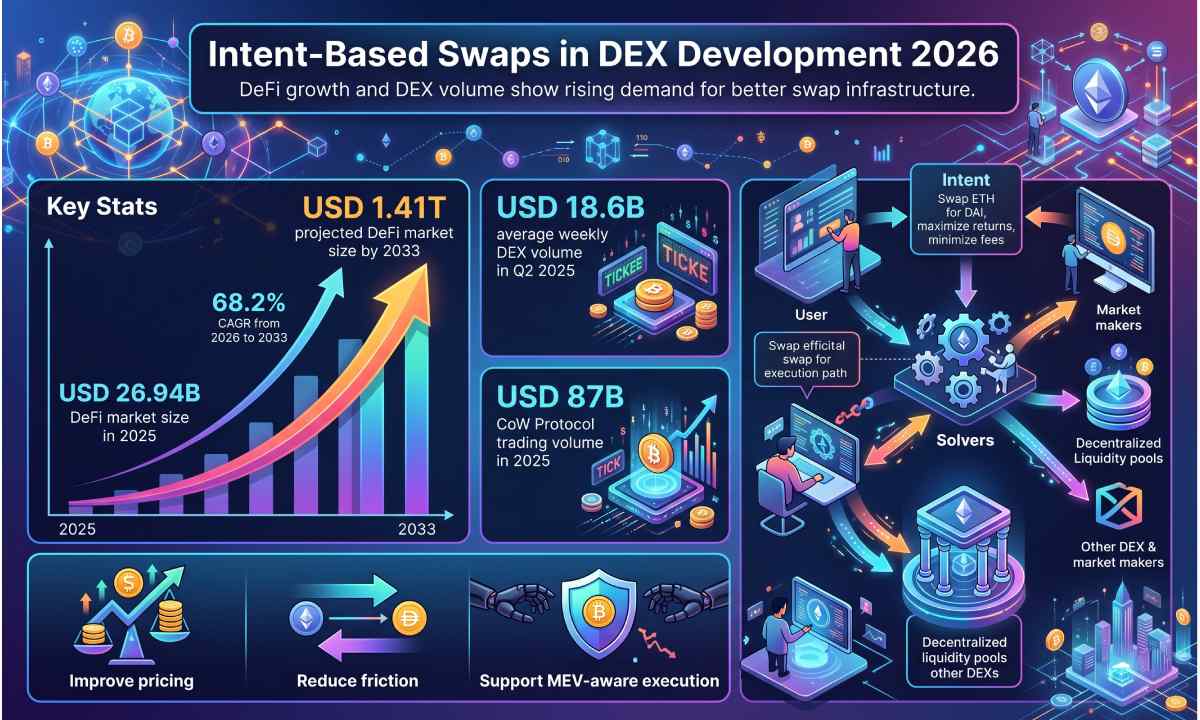
DeFi is growing at a pace that few financial sectors can match. Grand View Research valued the global DeFi market at USD 26.94 billion in 2025. The same report projects the market will reach USD 1.41 trillion by 2033, with a 68.2 percent CAGR from 2026 to 2033. Trading activity backs up that growth. Average weekly DEX volume reached USD 18.6 billion in Q2 2025, up 33 percent year over year. Intent-based trading is also gaining real traction. CoW Protocol processed USD 87 billion in trading volume in 2025, which shows strong demand for solver-based execution and better swap design.
These numbers send a clear signal to businesses building in DeFi. Users want better pricing, lower friction, and safer execution. Intent-based swaps meet that demand by letting users state the result they want, not the route they must manage. A solver network then finds the best way to complete the trade. This model reduces failed transactions, improves price discovery, and cuts exposure to MEV risks. For DEX operators, wallets, and Web3 platforms, intent-based swaps create a stronger product and new fee opportunities at the same time.
What is Intent-Based Swaps?
Intent-based swaps are decentralized trading systems where users simply state what they want to achieve for example, “swap 1 ETH for the best possible amount of USDC” without needing to handle technical details like routing, slippage, or bridging. Independent participants known as solvers or resolvers then compete to fulfill these requests in the most efficient way, often delivering better prices, gas-free transactions, and protection against MEV (Maximal Extractable Value) attacks.
What Are Intent-Based Swaps in Modern DEX Development?
Intent-based swaps let users describe what they want, not how to get it. A user says, “Swap X token for the best possible Y token output.” Solvers or fillers compete to execute that request. The final settlement happens on-chain, and trade planning often happens off-chain.
UniswapX follows this pattern with off-chain signed orders and competitive execution across liquidity sources. This gives traders better price paths without asking them to manage each step.
How Intent-Based Swaps Differ from Traditional AMM Swaps
Traditional AMM swaps place more work on the user. The user selects the pair, route, slippage, gas settings, and approval flow. Intent-based swaps remove much of that burden. The user signs an intent, then solvers handle execution.
For businesses, this improves the product funnel. Fewer failed transactions mean more completed swaps. Better execution supports stronger retention. A simpler interface helps new users trade with less fear.
Why Businesses Are Moving Toward Intent-Centric DEX Architecture
Intent-centric DEX architecture gives platforms a sharper market position. It improves trade quality, reduces technical friction, expands liquidity access, and adds stronger transaction protection.
DeFi startups can use it to stand apart from basic AMM clones. Wallets can add easier in-app swaps. Aggregators can offer better routes. Institutional trading platforms can support larger orders with lower execution risk. For 2026, intent-based swaps are becoming a serious upgrade for businesses that want a safer, cleaner, and more profitable DeFi trading product.
Key Components of an Intent-Based DEX Swap System
User Intent Layer
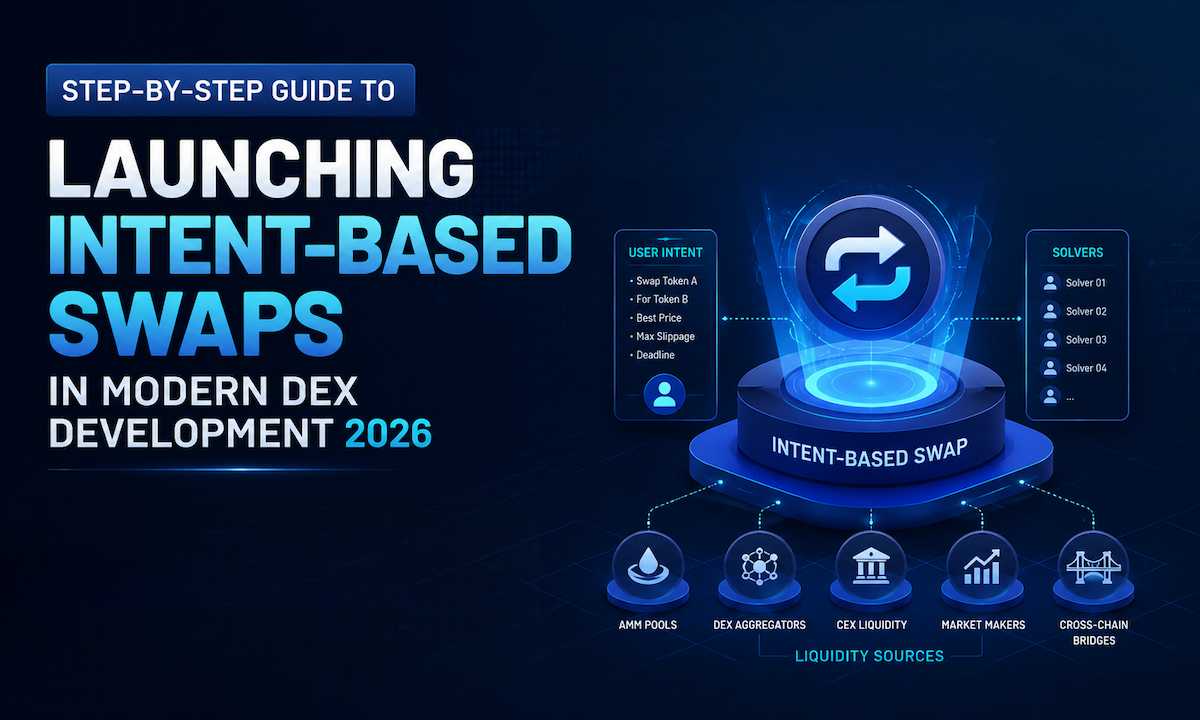
An intent-based DEX starts with the user intent layer. The trader does not build the route manually. The trader signs a clear order that states the input token, output token, minimum received amount, expiry time, slippage limit, receiver address, chain ID, and signature approval. This layer turns a swap into a goal, not a list of manual steps.
Solver or Filler Network
The next layer is the solver or filler network. Solvers compete to execute the signed order at the best possible result. They can pull liquidity from AMMs, private market makers, aggregators, RFQ desks, cross-chain bridges, or internal inventory. CoW Protocol states that independent solvers compete to give users better execution and higher user surplus.
Auction Mechanism
The auction mechanism decides who wins the right to fill the trade. UniswapX uses auction parameters and price tolerance in user orders, with chain-specific auction methods. CoW Protocol uses batch auctions, where solvers compete to settle grouped trades and protect users from MEV exposure.
Smart Contract Settlement Layer
The smart contract settlement layer completes the trade. It verifies the signature, checks limits, moves tokens, applies slippage rules, and records the final execution on-chain. This layer protects both the user and the platform from invalid orders, replay attacks, and poor execution.
Liquidity Aggregation Layer
The liquidity aggregation layer supports better pricing by connecting AMMs, market makers, private liquidity, DEX routes, CEX-linked routing, and cross-chain liquidity sources. A strong liquidity layer helps the DEX serve retail traders, whales, wallets, and institutional desks with fewer failed swaps.
Technology Stack for Intent-Based DEX Development
Blockchain Networks
Intent-based swaps need chains with deep liquidity, low fees, and strong developer support. Ethereum works well for high-value DeFi trades and trusted settlement. Arbitrum, Optimism, Base, and Polygon fit retail swaps, faster execution, and lower gas costs. BNB Chain gives access to large trading volume. Solana suits apps that need fast confirmation and high throughput. Some businesses build app-specific chains for more control over fees, order flow, and compliance rules.
Smart Contract Tools
Solidity remains the main choice for EVM-based DEX development. Foundry helps teams test contracts faster and catch errors early. Hardhat supports deployment, debugging, and local testing. OpenZeppelin gives audited contract modules for access control, token standards, and security checks. Permit-based approvals reduce user friction. Traders sign permissions without repeated approval transactions, so swap flows feel cleaner.
Backend Infrastructure
The backend carries the core value of intent-based swaps. The solver engine searches for the best execution path. The order relayer collects signed intents. The quote engine compares available liquidity. The auction manager selects the best solver bid. The risk engine checks price movement, failed routes, and suspicious activity. The indexing service tracks orders, trades, wallet activity, and settlement events.
Frontend Stack
React and Next.js give teams a fast interface for swap screens, dashboards, and admin panels. WalletConnect supports broad wallet access. Account abstraction SDKs reduce gas friction. A real-time swap status UI helps users track quotes, solver matching, execution, and settlement without confusion.
Analytics and Monitoring
A serious intent-based DEX needs live reporting. Teams track solver win rates, trade execution reports, MEV exposure, liquidity depth, failed orders, and error logs. These metrics guide pricing, revenue, and user trust.
Step-by-Step Process to Launch Intent-Based Swaps in a DEX
Define the Business Model and Swap Use Case
Start with the business model. A DeFi startup, wallet, aggregator, or institutional trading desk must decide whether it needs spot swaps, cross-chain swaps, limit orders, gasless swaps, or OTC-style DeFi execution. This choice shapes the full custom DEX development plan.
Choose the Right Intent Architecture
Next, choose the intent architecture. A single-chain model works for simple swaps. A cross-chain model fits wallets and bridge platforms. A batch auction model suits MEV protection. A Dutch auction model suits competitive filler pricing. A hybrid AMM plus intent routing model gives a DEX more control over liquidity and fees.
Design the Intent Schema
Then design the intent schema. It must include token details, minimum output, deadline, receiver, chain ID, permit, signature, and execution rules. A clear schema helps solvers read the order, price the trade, and settle it without confusion.
Build or Integrate a Solver Network
After that, build the solver network. Teams can use an internal solver, a third-party solver marketplace, whitelisted professional solvers, or open solver competition with staking and slashing rules. The right model depends on trade volume, risk limits, and the level of control the business wants.
Implement Smart Contracts for Secure Settlement
The next build stage covers settlement contracts. These contracts verify signatures, check replay protection, process token movement, apply slippage checks, and support emergency pause controls. They form the trust layer for the full intent-based DeFi platform.
Add MEV Protection and Private Execution
MEV protection must sit close to execution. Private mempool routing, batch settlement, solver risk transfer, and sandwich attack prevention help protect users from poor fills. This matters most for high-value trades and institutional DeFi flows.
Integrate Liquidity Sources
The platform then needs deep liquidity access. AMM pools, DEX aggregators, RFQ liquidity, market makers, cross-chain bridges, and private liquidity providers all improve execution quality. Better liquidity gives the platform stronger pricing and higher trade completion rates.
Build a User-Friendly Swap Interface
The user interface should make complex execution feel simple. It should support one-click swaps, gasless flows, best-price quote display, fee visibility, slippage transparency, and live transaction tracking. Clear UX helps wallets and DEXs convert more users.
Test, Audit, and Refine the System
Before launch, test every part. Run smart contract audits, solver simulations, auction tests, failed swap handling checks, gas benchmarks, MEV tests, and cross-chain recovery drills. Careful testing reduces loss risk and protects brand trust.
Launch, Monitor, and Grow the Platform
After mainnet deployment, track solver performance, liquidity depth, trade success rate, revenue, and governance upgrades. These metrics help the team improve pricing, reduce failed trades, and grow volume. This gives intent-based DeFi platforms stronger differentiation in 2026.
Industry Use Cases for Intent-Based DEX Development
DeFi Trading Platforms
Trading platforms use intent-based swaps to offer MEV protection, better price discovery, and solver-based execution. This helps traders avoid poor routing and failed transactions.
Crypto Wallets
Wallets can add gasless swaps inside the app. Users sign a trade intent, and the solver handles the execution work. This improves token exchange for new users.
Cross-Chain Bridge Platforms
Bridge platforms can combine asset movement and swapping into one intent. A user can send USDC on one chain and receive ETH on another with fewer steps.
Institutional DeFi Platforms
Institutions need privacy, better pricing, and lower execution risk. Intent-based DEX systems support larger trades, private order flow, and controlled settlement.
GameFi and Web3 Apps
GameFi apps can let players swap tokens without leaving the product. This keeps the experience simple and supports in-app economies.
Real-World Asset Tokenization Platforms
RWA platforms can support trades between stablecoins, tokenized assets, and DeFi tokens. Intent-based execution helps these markets manage liquidity, compliance checks, and settlement quality.
Conclusion
Intent-based swaps give businesses a clear path to build faster, safer, and more user-friendly DEX platforms in 2026. They improve pricing, reduce user effort, support MEV-aware execution, and create new revenue options through swap fees, solver fees, and premium trading tools. A strong launch needs secure smart contracts, trusted solver infrastructure, multi-chain support, live monitoring, and a clean trading interface. For startups, enterprises, wallets, and Web3 platforms ready to enter this market, Cryptocurrency Exchange Script provides Decentralized Exchange Development services to build scalable DEX platforms with modern swap features, secure architecture, and business-ready trading flows.