
What Is Avantis? Understanding the Business Model
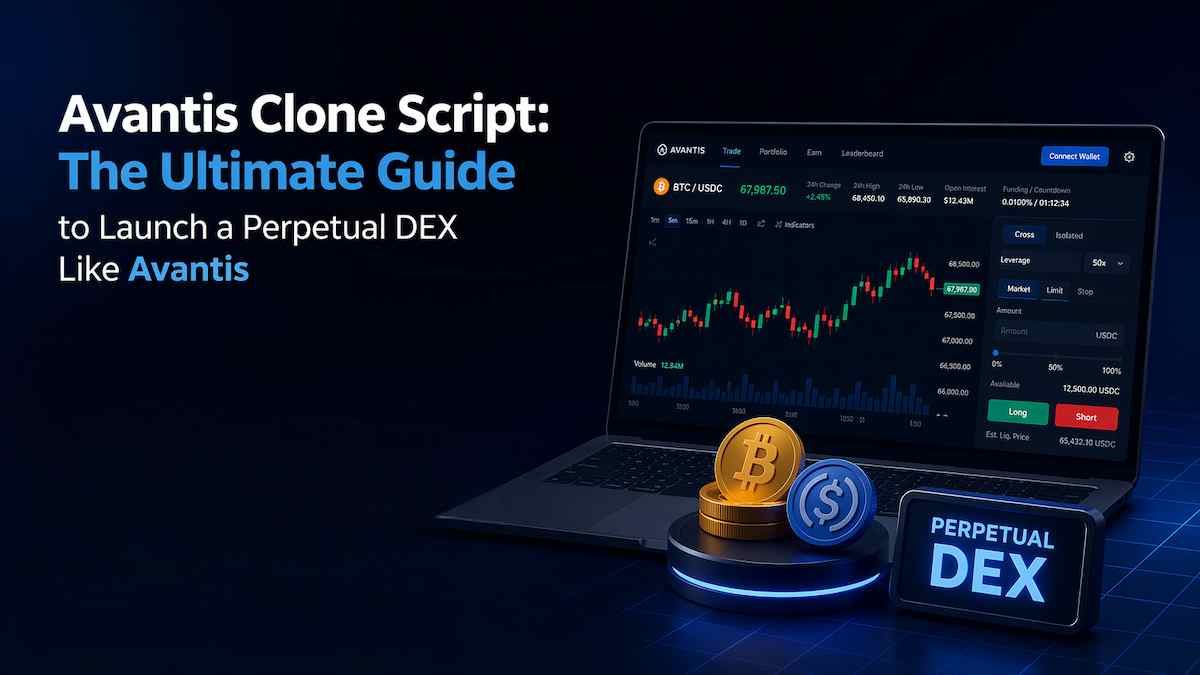
Avantis is a decentralized perpetual exchange that runs on the Base Layer 2 network. It focuses on leveraged trading through a non-custodial setup, so users keep wallet control instead of handing assets to a centralized exchange. The platform stands out for one reason. It brings together crypto markets and real world asset exposure in the same terminal. Avantis documentation and third party research describe access to assets such as BTC, gold, forex pairs, and equity or index linked products through a synthetic trading structure.
Core Features of Avantis
The product design is built for active trading. Avantis highlights a zero-fee leverage model in its docs for key trading flows, with fees taken from profits in certain structures rather than through the standard high-friction setup many traders know. The platform uses USDC liquidity vaults, which pool stablecoin capital for market making and trade settlement. It runs a synthetic leverage engine, and it uses oracle driven pricing to support asset coverage beyond native onchain pairs. Avantis materials also promote positive slippage and loss rebates on certain skew balancing trades, which can improve trader retention and help manage order flow across the book.
How Avantis Generates Revenue
The revenue model is stronger than a simple trading fee layer. Avantis earns from trading activity tied to position size, profit capture, spread mechanics, and margin related charges across asset classes. At the same time, liquidity providers deposit USDC into vaults and earn yield linked to trader activity. The native token adds another commercial layer through staking, governance, and protocol security roles. For a business studying an Avantis clone script, this matters a lot. The model creates more than one income stream, and that gives founders room to build a platform around fees, vault participation, token utility, and long term user retention.
Market Opportunity for Avantis Clone Platforms
Growth of the DeFi Derivatives Market
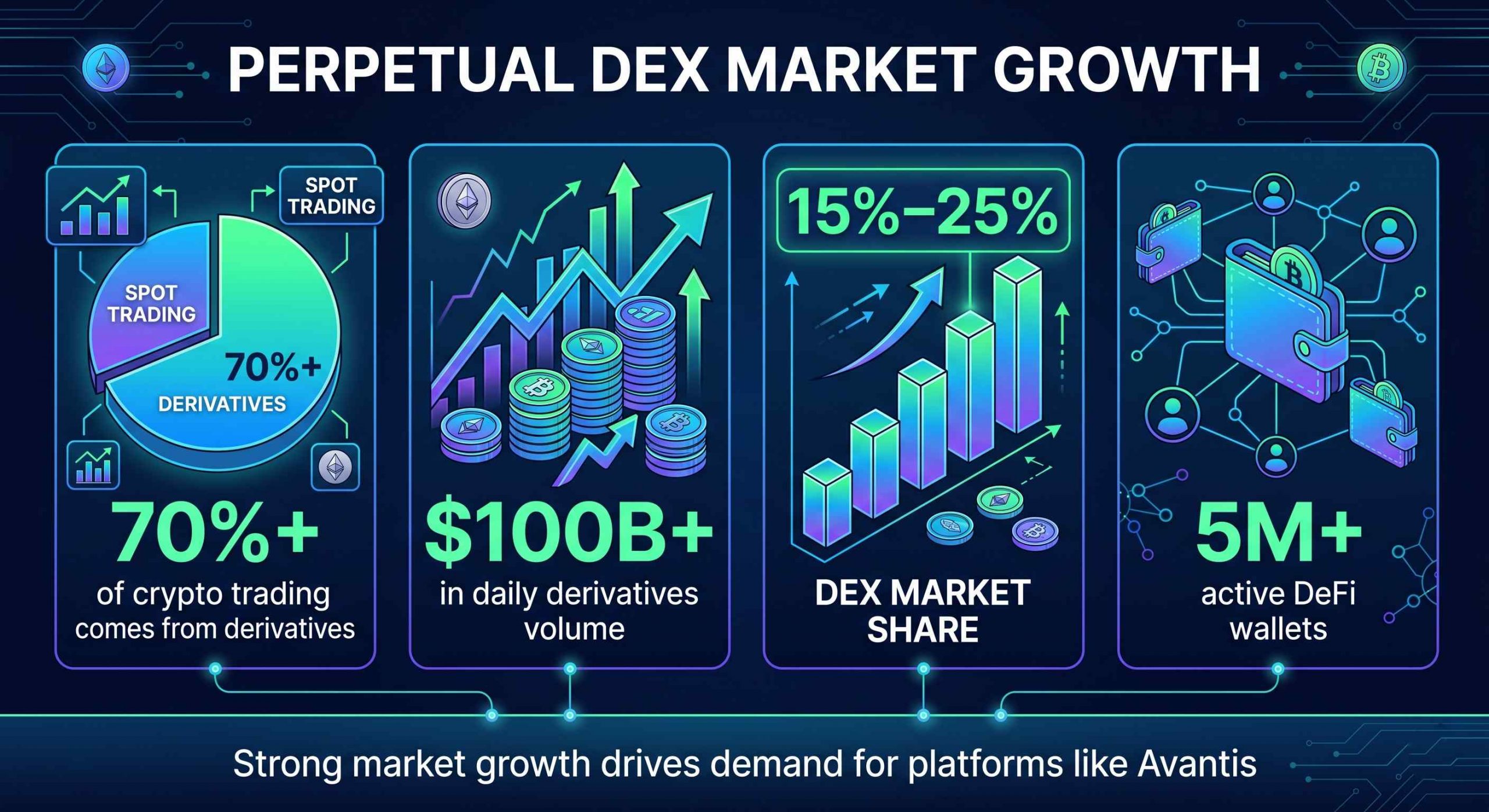
The market case for an Avantis clone script is clear. DeFi perpetual trading grew fast in 2025, and the pace changed how traders use onchain markets. CoinGecko reports that the top 10 perpetual DEXs handled $6.7 trillion in volume in 2025, up 346 percent from $1.5 trillion in 2024. The same report shows the perp DEX to perp CEX ratio rising from 2.5 percent to 7.8 percent in one year. That shift points to a larger user base, deeper trading habits, and stronger demand for non-custodial derivatives platforms.
A big reason sits in the product itself. Perpetual contracts let traders hold long or short positions without an expiry date, so they can react to fast price moves and hedge risk with less locked capital than spot trading needs. CoinGecko notes that the top 10 centralized and decentralized perpetual exchanges processed $92.9 trillion in 2025, up 64.6 percent year over year. Businesses watch this trend and see a real opening. Traders want crypto exposure, but they want forex, metals, commodities, and indices in the same account too. Avantis built its brand on that cross asset model, with onchain markets for crypto, forex, metals, commodities, and indices on Base.
Business Use Cases
This demand creates several clear business paths. A crypto exchange can use an Avantis style product to add perpetuals and new fee streams. An institutional trading venue can use the same model for non-custodial access, transparent pricing, and USDC based collateral. Brokerage firms can add synthetic access to global markets without building a full prime brokerage stack. DeFi startups can launch faster with a clone script, then focus on branding, liquidity, and user growth. Avantis even offers an SDK for teams building trading bots, macro asset tools, and automated strategies, which shows that the model already supports business-to-business product extensions.
Revenue Potential
Revenue can come from several channels. Avantis documents fixed opening and closing fees on position size for standard perpetuals, plus profit sharing on its zero fee product. Its public materials state that traders can pay no upfront fee on zero fee perps, then share part of profits on winning trades. The protocol runs junior and senior vaults for liquidity providers, and Avantis says its LPs have earned more than $1 million in USDC fees. Token programs add one more income and retention layer through staking, rewards, and community incentives. For founders, that means trading fees, vault income, and token driven growth can work together inside one platform.
Key Features to Include in an Avantis Clone Script
Core Functional Modules for a Scalable Trading Platform
A reliable Avantis clone script depends on a set of core modules that control trading, liquidity, security, and user access. Each module must work with low delay and handle high trade volume without errors. The trading engine sits at the center. It processes orders, manages leverage, and updates positions in real time. A delay of even one second can affect user trust, so speed and accuracy matter.
Trading Engine and Execution Layer
The trading engine handles order matching and position updates. It must support high frequency trades and large volumes without failure. Real time execution helps traders react to price moves within seconds. The system should support both long and short positions with flexible leverage settings.
Liquidity and Risk Control System
The liquidity system supports trade execution through shared vaults. These vaults supply capital for traders and earn fees from activity. Risk tranching splits funds into low and high risk pools. This structure helps protect capital and offers different return levels for liquidity providers. Automated liquidation rules close risky positions before losses grow beyond collateral.
Smart Contract and Security Layer
Smart contracts manage trading rules, collateral, and settlements. Each contract must go through strict audits before deployment. Multi-layer encryption protects user data and transaction details. Anti-DDoS systems block malicious traffic and keep the platform stable during peak usage.
User Access and Wallet Integration
Users connect through non-custodial wallets such as MetaMask or WalletConnect. This setup keeps user funds under direct control. It reduces the need for centralized custody and builds trust among traders. Fast wallet connection and smooth onboarding improve user retention.
Data Feeds and Price Accuracy
Real time price feeds guide every trade on the platform. Oracle services provide market data across crypto, forex, and commodities. Backup data sources reduce the risk of incorrect pricing. Accurate feeds protect both traders and liquidity providers from unfair execution.
User Interface and Trading Experience
The interface should present charts, positions, and balances in a clear format. A simple layout helps users place trades without confusion. Mobile compatibility is key, as many traders use phones for daily activity. Fast loading dashboards and responsive design improve engagement and trading frequency.
Technology Stack Behind Avantis Clone Script
Blockchain Infrastructure
A strong Avantis clone script starts with Ethereum compatibility and low-cost execution. Avantis runs on Base, which is an Ethereum Layer 2 rollup. Base states that it is built as an open stack for onchain apps, and its early launch notes describe it as a low-cost Ethereum Layer 2 built on the OP Stack. Avantis also states in its user terms that the protocol is available on Base and that users bridge assets from Ethereum to Base before trading.
That matters for founders. A perpetual exchange needs fast settlement, low gas fees, and stable smart contract behavior. Ethereum still gives the trust layer, but Layer 2 networks cut friction for active traders. Arbitrum and Optimism fit the same logic. Arbitrum documents describe Nitro as the software that powers Arbitrum chains, with transaction ordering and execution built for higher throughput. Optimism documents describe the OP Stack as a standard framework for Ethereum Layer 2 rollups.
Solidity remains the main smart contract language for this type of build. It gives teams a familiar path for margin logic, vault accounting, liquidation rules, and fee routing across EVM networks. Avantis itself centers trading around USDC collateral and LP vaults, so a clone script needs contracts that can track collateral, open interest caps, and vault payouts with little room for error. Avantis docs state that traders post USDC as collateral and LPs deposit USDC into market-making vaults.
Backend & Trading Engine
The backend does the hard work that users never see. It reads wallet actions, checks margin, calculates fees, watches price moves, and sends orders to the right contract path. For an Avantis-like product, that engine must support high trade volume and near real-time risk checks. Avantis uses open interest controls and fee formulas tied to utilization and skew, which shows how much backend math sits behind each market.
Order execution can follow two broad models. One is an AMM-based path. The other is a synthetic model backed by protocol vault liquidity. Avantis docs describe the avUSDC vault as the counterparty to all trades, with trader losses going into a protocol buffer and trader profits paid from that buffer first. That design reduces the need for a standard order book and shifts the core engine toward pricing, exposure control, and vault health.
Frontend Development
Most teams build the user layer with React or Next.js. That stack works well for live charts, wallet state changes, order panels, and portfolio views. A trading page has to load fast and stay readable during market stress. Small delays can cost real money.
The interface should center on clarity. Users need margin data, liquidation price, open positions, funding or fee data, and vault status in one place. Avantis supports cross-asset trading in crypto, forex, and commodities, so a clone script should present those markets in a way that feels familiar to both retail users and pro traders. Avantis describes itself as an onchain exchange for synthetic crypto, forex, and commodities with long and short trading.
Integration Components
Wallet access is a core part of the product. MetaMask Connect supports connections across the browser extension and mobile app. WalletConnect provides chain-agnostic wallet access across apps and platforms. Those tools help a clone exchange support self-custody from day one.
Price data is just as critical. Chainlink says its Data Feeds connect smart contracts to real-world data such as asset prices and L2 sequencer health, and its Price Feeds aggregate data from many sources through independent node operators. That makes oracle design a board-level issue, not a minor feature.
Fiat access closes the loop. Avantis says its USDC on-ramp uses Fun.xyz for cards, bank transfers, and exchange deposits into the trading wallet. For a business launch, that kind of payment layer cuts drop-off at signup and gets new users funded faster.
Step-by-Step Process to Launch an Avantis-Like Crypto Exchange
Step 1: Market Research & Business Planning
Start with the buyer, not the code. Some firms want a crypto-only perpetual DEX. Others want a wider product that covers forex, commodities, and tokenized market exposure. Avantis built interest by offering cross-asset leverage, not just crypto pairs, so founders should decide early whether they want a narrow niche or a broader trading desk model. Avantis docs and brand material describe markets across crypto, forex, and commodities, with leverage up to 500x.
Step 2: Choose the Right Clone Script Provider
The provider should offer audited contracts, EVM support, admin controls, fee settings, and post-launch maintenance. Look for proof of stress testing, uptime, and upgrade history. A flashy demo means little if the vendor cannot explain how the vault model handles trader profit spikes or skewed open interest.
Step 3: Platform Customization
Branding is the easy part. Real customization lives in fee rules, market selection, referral logic, risk limits, and the user flow from wallet connect to first trade. A business that targets prop-style traders will need a different interface than one that targets first-time DeFi users.
Step 4: Smart Contract Development & Deployment
Deploy contracts only after test coverage and third-party audits. This stage should lock down collateral logic, liquidation triggers, oracle fallback rules, and vault accounting. Avantis puts major weight on LP risk management and vault sustainability, which shows why audit scope must go past a simple code scan.
Step 5: Liquidity Setup
No exchange works without usable liquidity. Teams can seed internal USDC vaults, bring in market makers, or mix both. Avantis states that LP vaults power trading and that traders bet against that pool. That model gives founders a direct path to launch, but it also demands strict treasury controls.
Step 6: Compliance & Legal Setup
Legal work starts before launch. The business needs KYC and AML flows where required, clear terms of use, restricted region handling, and a formal review of derivatives rules in each target market. Payment rails and wallet onboarding should match that legal plan.
Step 7: Testing & Launch
Run a beta with real users, limited caps, and live monitoring. Check failed orders, slippage, liquidations, wallet sessions, and support tickets. Then push to mainnet in phases. That staged release cuts risk and gives the team time to fix weak points before volume rises.
Cost Breakdown of Developing an Avantis Clone Script
Launching a crypto exchange like Avantis requires a clear view of costs. Many businesses enter this space with strong ideas but lack cost clarity. A well-planned budget reduces risk and speeds up execution. The total cost depends on technical depth, security level, and the scale of the platform.
Development Cost Factors
Feature complexity plays a major role in pricing. A basic platform with core trading functions may cost between $25,000 and $40,000. Adding perpetual contracts, multi-asset trading, and advanced dashboards can push costs beyond $80,000. Each feature adds development hours, testing cycles, and maintenance work.
Blockchain selection also affects cost. Building on Ethereum often leads to higher gas fees and deployment expenses. Layer-2 networks like Base or Arbitrum reduce transaction costs and improve speed. Many startups now choose Layer-2 chains to lower long-term operational costs and improve user experience.
Security requirements demand serious investment. Smart contract audits alone can cost $5,000 to $20,000 per audit. Platforms that handle leveraged trading need strict risk controls, secure wallet systems, and protection against attacks. Skipping security steps often leads to major losses, which can damage brand trust within days.
Estimated Pricing Models
Businesses can choose between white-label scripts and custom development. White-label solutions range from $15,000 to $50,000. These come with ready-made features and allow faster deployment within a few weeks. They suit startups that want to enter the market quickly.
Custom enterprise development starts from $60,000 and can exceed $150,000. This option allows full control over features, design, and integrations. Large firms prefer this model to build unique platforms and support high trading volumes.
ROI Analysis
Time to profitability depends on user growth and trading volume. Many platforms recover initial costs within 6 to 12 months through trading fees and liquidity incentives. High-volume exchanges can reach break-even even faster.
Scalability drives long-term returns. A well-built platform can handle thousands of users and expand into new markets like forex or commodities. This flexibility increases revenue streams and strengthens market position over time.
Conclusion
An Avantis clone script gives businesses a practical way to enter the crypto exchange market with lower development time, clearer cost planning, and stronger revenue potential. The final budget depends on features, blockchain network, and security depth, but the long-term value comes from building a platform that can attract traders, handle growth, and support new asset categories over time. Companies that choose the right pricing model, invest in strong security, and plan for scale from day one place themselves in a better position to recover costs faster and build a profitable trading business in a highly active market.