

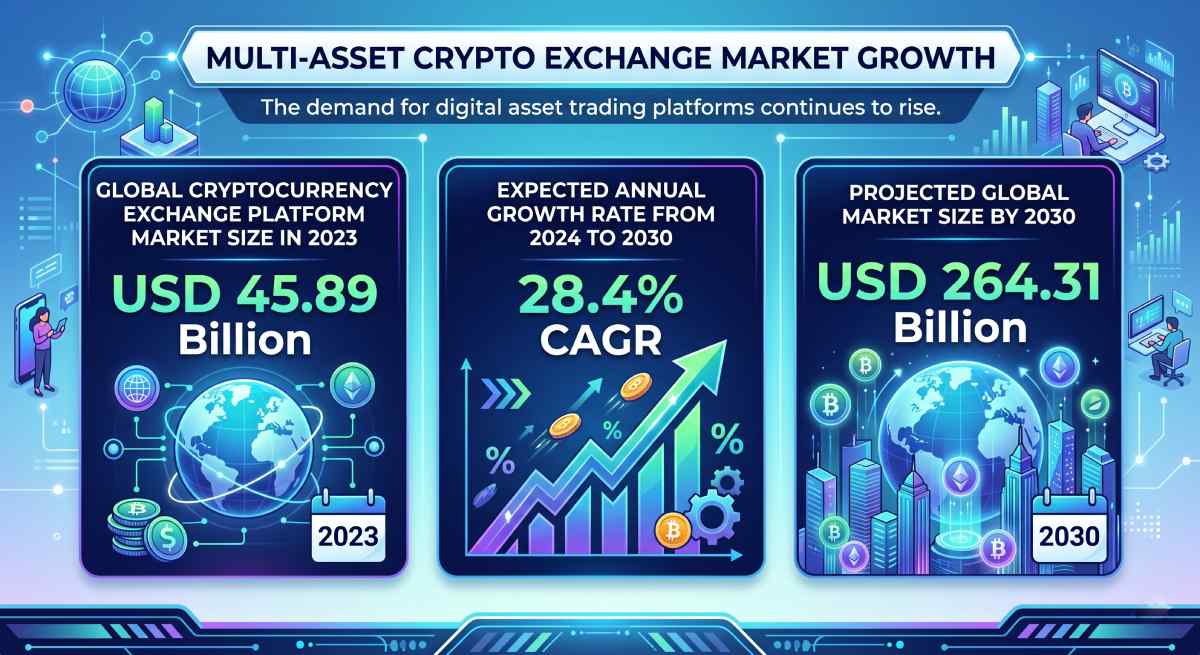
The global cryptocurrency exchange platform market was valued at USD 45.89 billion in 2023. It is expected to reach USD 264.31 billion by 2030, with a 28.4% CAGR during the forecast period. Those numbers show strong demand for digital asset trading infrastructure. Businesses no longer look at crypto exchanges as simple buy and sell platforms. They see them as revenue-driven products that can support cryptocurrencies, stablecoins, NFTs, tokenized assets, and advanced trading features in one place. A multi-asset crypto exchange helps companies serve more users, open new revenue channels, and build a stronger position in a fast-growing market.
What Is a Multi-Asset Crypto Exchange?
A multi-asset crypto exchange lets users buy, sell, swap, and manage several asset classes through one account. It combines wallets, order books, charts, compliance checks, and payment tools in one system.
Assets Supported by a Multi-Asset Crypto Exchange
A well-built platform can support:
- Cryptocurrencies such as BTC, ETH, SOL, BNB, and altcoins
- Stablecoins such as USDT, USDC, and fiat-backed tokens
- Tokenized real-world assets
- Security tokens
- Utility tokens
- NFTs
- Crypto futures, options, and perpetual contracts
- Tokenized commodities
- DeFi assets
- Governance tokens
How Multi-Asset Exchanges Differ from Traditional Crypto Exchanges
Traditional crypto exchanges often focus on coin and token spot trading. Multi-asset exchanges support more markets and more revenue channels.
They can improve trading volume, liquidity, user retention, and institutional adoption. They also need stronger compliance, asset checks, and security. For serious businesses, the value is clear: the platform can grow into a full digital asset business.
Why Businesses Are Investing in Multi-Asset Crypto Exchange Development
Investors no longer want a platform that supports only Bitcoin or a few altcoins. They want one account for crypto, stablecoins, NFTs, tokenized real estate, bonds, commodities, and private market assets. This shift gives businesses a clear reason to launch a multi-asset crypto exchange development project.
A multi-asset trading platform keeps users active for longer. Traders can move from Bitcoin to USDT pairs, then into tokenized gold or real estate shares. They do not need to leave the app. That raises trading volume, improves retention, and opens more fee channels.
Stablecoins now play a central role in global crypto trading. They support fast settlement, cross-border transfers, liquidity routing, and fiat-like trading pairs. For brokers, fintech firms, and asset managers, this creates demand for regulated crypto exchange software with KYC, reporting, custody, and risk controls.
Early movers gain a stronger market position. A crypto-only exchange competes on limited pairs. A multi-asset exchange can serve retail users, institutions, token issuers, NFT traders, and RWA investors from one platform.
Core Features of a Multi-Asset Crypto Exchange Platform
User Registration and KYC/AML Verification
A strong platform starts with smooth user registration, KYC checks, AML screening, risk scoring, and clear compliance workflows. Users need fast onboarding, but the business still needs strong identity checks.
Multi-Asset Wallet Integration
The wallet system must support hot wallets, cold storage, MPC wallets, custodial accounts, non-custodial access, and multiple blockchains. This gives users safe access to crypto, stablecoins, NFTs, and tokenized assets from one place.
Advanced Trading Engine
The trading engine must process orders fast, match trades with low delay, and manage large order books during peak demand. A weak engine can cause failed trades, price gaps, and user loss.
Spot Trading Module
Spot trading remains the core of most crypto exchanges. The platform should support trading pairs, market orders, limit orders, stop-limit orders, and real-time charts.
Margin and Derivatives Trading
Margin and derivatives modules support futures, options, perpetual contracts, margin accounts, liquidation engines, and risk controls. These features attract advanced traders and raise trading volume.
NFT Trading and Marketplace Integration
NFT marketplace features let users mint, list, bid, buy, and sell digital assets. Royalty tools help creators earn from secondary sales.
Tokenized Asset Trading
Tokenized asset trading supports real estate, bonds, commodities, security tokens, and fractional ownership products. Transfer rules and compliance checks help control who can buy, sell, or hold restricted assets.
Fiat On-Ramp and Off-Ramp Integration
Fiat access makes the platform easier for new users. Bank transfers, card payments, UPI, SEPA, ACH, SWIFT, and payment gateways help users move between fiat and digital assets.
Liquidity Management System
Liquidity decides how well trades execute. A platform can use internal liquidity, market makers, external liquidity providers, liquidity APIs, and cross-exchange aggregation.
Admin Dashboard
The admin panel controls users, asset listings, fees, liquidity, reports, and flagged transactions. It gives the business team a clear view of platform health and revenue.
Mobile Trading App
Mobile apps bring real-time charts, alerts, and push messages to iOS and Android users. They also help exchanges acquire and retain active traders.
Security Architecture
Security sits at the center. Two-factor checks, anti-phishing codes, DDoS protection, encryption, withdrawal whitelists, multi-signature wallets, and penetration testing reduce platform risk.
AI-Powered Trading and Risk Monitoring
AI tools can detect fraud, track odd behavior, send trading alerts, read market patterns, and support risk teams. This gives the exchange faster controls during heavy trading or suspicious activity.
Advanced Features That Add Commercial Value
Staking and Yield-Earning Modules
Staking and flexible earn products give users a reason to keep assets inside the exchange. A trader who earns rewards on idle tokens is less likely to move funds elsewhere. For the business, this creates steady fee income from staking commissions, validator rewards, and managed yield programs. It also turns the exchange from a trading site into a broader crypto wealth platform.
Launchpad for Token Sales
A launchpad helps new crypto projects raise funds and reach active investors. The exchange earns through listing fees, launch fees, marketing packages, and trading volume after launch. This model works best with strict project checks, clear token data, and fair sale rules.
Copy Trading and Social Trading
Copy trading brings new users into the market faster. Beginners can follow skilled traders instead of building every strategy alone. The exchange can charge performance fees, subscription fees, or trader ranking fees.
OTC Trading Desk
An OTC desk serves institutions, family offices, and high-net-worth clients. These clients need large trades with less price impact. The exchange earns from spreads, private execution, and account management.
API Trading for Professionals
REST APIs and WebSocket APIs help traders connect bots, market tools, and algorithmic systems. This feature attracts funds, brokers, and high-volume traders.
Multi-Language and Multi-Currency Support
Local language, local fiat, and regional payment methods help an exchange enter new markets. This reduces signup friction and builds trust.
Referral and Affiliate Program
Referral rewards cut user acquisition costs. Affiliate dashboards, tracking links, and commission reports help partners promote the exchange with clear earnings data.
Crypto Payment Gateway Integration
A payment gateway adds merchant services to the exchange. Businesses can accept crypto payments, settle in stablecoins, and use the platform beyond trading.
Types of Multi-Asset Crypto Exchanges Businesses Can Launch
Centralized Multi-Asset Crypto Exchange
A centralized exchange suits businesses that need deep liquidity, fast order matching, admin control, and custodial wallets. It gives the operator full control over fees, listings, compliance, support, and risk checks.
Decentralized Multi-Asset Exchange
A decentralized exchange runs through smart contracts, liquidity pools, and AMM models. Users trade from their own wallets, so asset control stays with them. This model fits DeFi users who value self-custody.
Hybrid Crypto Exchange
A hybrid exchange blends fast centralized trading with decentralized asset control. It gives users better speed than most DEX platforms and more control than a standard custodial exchange.
White Label Multi-Asset Crypto Exchange
White label crypto exchange software helps businesses launch faster with ready modules for trading, wallets, KYC, admin control, and liquidity. It suits companies with strict budgets or short launch plans.
P2P Multi-Asset Crypto Exchange
A P2P exchange connects buyers and sellers directly. Escrow, dispute handling, local payments, and trader ratings make this model useful in regions with limited banking access.
Institutional Crypto Trading Platform
Institutional platforms serve brokers, banks, asset managers, and trading desks. They need OTC access, custody links, reporting tools, APIs, and strict compliance controls.
A Step-by-Step Guide to Launching a Multi-Asset Crypto Exchange
Step 1: Business Model and Market Research
A multi-asset crypto exchange starts with a clear business plan. The team must define its target users, such as retail traders, pro traders, institutions, or token issuers. Market research helps choose trading pairs, asset types, fee models, and target regions. Competitor analysis also shows gaps in pricing, liquidity, features, and user experience.
Step 2: Regulatory and Compliance Planning
Compliance must be planned before development starts. The exchange needs licensing research, KYC checks, AML screening, Travel Rule support, data privacy controls, and reporting systems. Rules change by region, so each target market needs a separate compliance plan.
Step 3: Platform Architecture Design
The architecture includes the trading engine, wallet system, user accounts, admin panel, liquidity links, payment gateways, and risk controls. The system must support fast trades, safe wallet storage, clean records, and traffic spikes during market activity.
Step 4: UI/UX Design for Traders and Admins
Traders need simple dashboards, live charts, portfolio views, order forms, and transaction history. Admins need tools for user checks, trade tracking, wallet control, asset listings, alerts, and support. A mobile-first design helps users trade and monitor assets from any device.
Step 5: Blockchain and Smart Contract Integration
The platform can connect with Ethereum, BNB Chain, Polygon, Solana, Avalanche, Bitcoin, Tron, and other networks. Smart contracts support tokens, staking, NFTs, and asset rules. Each contract needs testing and audits before launch.
Step 6: Liquidity and Market Maker Integration
Liquidity keeps trading smooth. The exchange can connect with market makers, liquidity APIs, and external exchanges. Strong liquidity improves order book depth, reduces spreads, and gives users better trade execution.
Step 7: Security Testing and Compliance Audits
Security checks include smart contract audits, penetration testing, wallet reviews, API testing, and transaction monitoring. Cold storage, MPC wallets, multi-signature approvals, and withdrawal limits help protect user funds.
Step 8: Beta Launch and User Testing
A beta launch tests the platform with a small user group. The team can check trades, deposits, withdrawals, charts, payments, and app speed. User feedback helps fix errors before the public launch.
Step 9: Full-Scale Launch and Growth Marketing
The public launch should include listing campaigns, referral programs, SEO, PR, paid ads, social media, and community building. Trust pages, security details, fee pages, and asset policies help users feel confident.
Step 10: Maintenance, Upgrades, and Scaling
After launch, the team must update security, add assets, improve speed, manage compliance changes, and monitor uptime. Growth needs stronger servers, deeper liquidity, and better support.
Technology Stack for Multi-Asset Crypto Exchange Development
Front-End Technologies
React.js, Next.js, Angular, and Vue.js work well for web platforms. Flutter and React Native support mobile apps. The interface should show charts, balances, trades, deposits, withdrawals, and alerts in a clear way.
Back-End Technologies
Node.js, Java, Python, and Go can power accounts, orders, payments, wallets, APIs, and risk checks. Microservices help separate major platform functions for better control and faster updates.
Blockchain Networks
A multi-asset exchange can support Ethereum, BNB Chain, Polygon, Solana, Avalanche, Arbitrum, Optimism, Bitcoin, Tron, and custom blockchain networks. Network choice affects fees, speed, asset support, and user reach.
Database and Infrastructure
PostgreSQL, MongoDB, Redis, and Kafka help manage users, orders, balances, sessions, and real-time trade data. Docker, Kubernetes, AWS, Azure, and Google Cloud support deployment, hosting, monitoring, and traffic control.
Trading Engine Infrastructure
The trading engine handles order matching, order routing, trade settlement, risk checks, and live market data. It must process market orders, limit orders, stop orders, and cancellations with low delay.
Wallet and Custody Technologies
MPC wallets, multi-signature wallets, HSMs, cold storage, and custody links help protect assets. Strong wallet design is key for both retail users and institutional clients.
Compliance and Monitoring Tools
KYT tools, blockchain analytics, transaction monitoring, fraud detection, sanctions screening, and reporting dashboards help the exchange track user and transaction risk. These tools support safer daily operations.
Benefits of Launching a Multi-Asset Crypto Exchange
Multiple Revenue Streams
A multi-asset crypto exchange creates several income paths. Businesses can earn from trading fees, token listing fees, withdrawals, staking, launchpads, API access, premium accounts, and OTC spreads. This gives the platform revenue beyond basic spot trading.
Broader User Acquisition
Multi-asset support attracts different user groups. Traders come for crypto pairs. NFT users come for collectibles and gaming assets. Institutions need custody, APIs, and reports. Token issuers need listing access. Stablecoin users need fast transfers.
Higher User Retention
Users stay longer when they can trade, stake, hold, and track many assets in one place. Portfolio tools, charts, alerts, and asset variety keep users active.
Global Market Expansion
A multi-asset exchange can enter many markets with local payment methods, fiat pairs, and multilingual apps. Regional compliance and clear onboarding build user trust.
Institutional-Grade Business Positioning
Enterprise clients need secure custody, audit trails, APIs, tax reports, and risk controls. These features help exchanges attract brokers, funds, fintech firms, and payment companies.
Future-Ready Digital Finance Infrastructure
A multi-asset exchange can grow into a wider finance platform. It can add payments, staking, token launches, NFT markets, and real-world asset trading under one brand.
Business Opportunities in Multi-Asset Crypto Exchange Development
Crypto Brokerage Platform
A brokerage platform helps retail users buy and sell crypto with simple screens and clear pricing. Businesses earn from spreads, fees, and fiat payment charges.
Tokenized Real Estate Marketplace
Tokenized real estate lets users buy fractions of property-backed assets. Platforms earn from listings, trades, custody, and partner services.
Stablecoin Trading and Payment Platform
Stablecoins support trading, remittances, merchant payments, and cross-border settlement. Exchanges can build strong volume through USDT, USDC, and fiat pairs.
NFT and Gaming Asset Exchange
Gaming assets, collectibles, and creator NFTs create new marketplace revenue. Platforms earn from minting, listings, royalties, and resale fees.
Institutional Digital Asset Exchange
Funds, brokers, and family offices need deep liquidity, OTC desks, custody, and API trading. This creates a high-value B2B market.
RWA and Security Token Exchange
Bonds, commodities, funds, and real-world assets can become tradable tokens under regulated models. Licensed platforms can serve this growing market.
DeFi-CeFi Hybrid Trading Platform
A hybrid exchange can combine simple centralized trading with decentralized liquidity and self-custody options.
Regional Crypto Exchange Business
Regional exchanges can serve local users with fiat support, native languages, and familiar payment systems. This works well in markets with strong remittance and mobile payment use.
Conclusion
A multi-asset crypto exchange gives businesses a strong base to serve traders, investors, token issuers, NFT users, and institutions from one platform. It opens revenue from trading fees, listings, staking, launchpads, OTC services, and digital asset payments. It also helps brands enter global markets with local fiat support, stronger security, and clear compliance controls. For startups, fintech firms, and enterprises ready to build a digital asset business, cryptocurrencyexchangescript provides Multi-Asset Crypto Exchange Development with the tools, features, and technical support needed to launch a secure, scalable, and revenue-focused trading platform.