

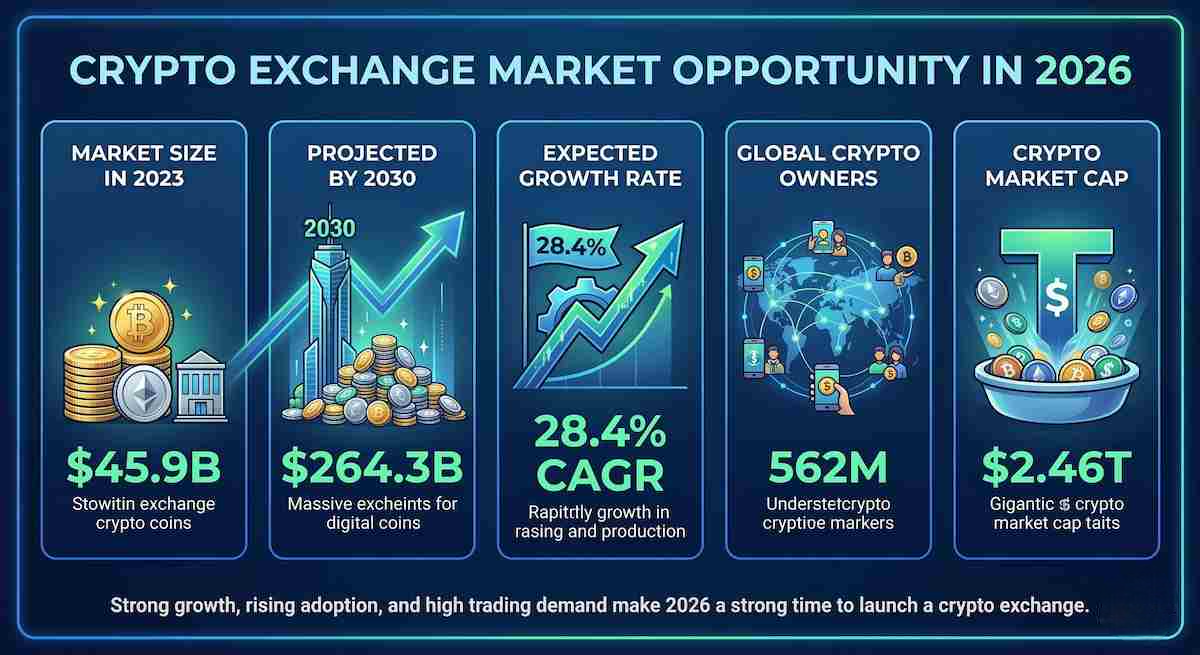
Crypto exchange businesses look far more attractive in 2026 than they did a few years ago. Market data shows why. Grand View Research estimates that the global cryptocurrency exchange platform market will rise from $45.9 billion in 2023 to $264.3 billion by 2030, with a 28.4% CAGR. Global crypto ownership has already reached 562 million people, or about 6.8% of the world’s population. CoinGecko places the broader crypto market at about $2.46 trillion in total value. Binance Research also reported that stablecoin market value moved past $305 billion in 2025. These numbers point to the same thing. Demand is growing, liquidity is deeper, and the market now has far more room for new exchange businesses.
Institutional capital adds even more weight to that trend. Grayscale reported that U.S.-listed crypto ETPs and digital asset treasuries held about $220 billion as of December 12, 2025. For business owners, that creates a real opening. A well-built exchange can earn from spot trading, futures, margin activity, token listings, staking products, and launchpad campaigns. KuCoin shows how broad that model can become, with products such as spot trading, margin trading, futures, OTC trading, Earn products, and Spotlight token launches under one brand. That is why so many fintech startups, brokerage firms, investment groups, and blockchain companies now study the KuCoin model. They are not looking at a simple buy and sell app. They are looking at a trading business with recurring fee income, stronger user retention, and room to expand into Web3 payments and digital asset services.
What a Cryptocurrency Exchange Platform?
A cryptocurrency exchange is an online trading platform for digital assets. Users buy, sell, and swap cryptocurrencies such as Bitcoin, Ethereum, and stablecoins. The platform processes trades, manages order books, and stores user balances in connected wallets.
Most exchanges connect several core systems. These include user accounts, trading engines, wallet infrastructure, and payment gateways. Together they allow users to deposit funds, place trades, and withdraw assets without friction.
For businesses, the exchange becomes the center of the trading activity. Every transaction passes through the platform. This flow creates revenue and builds a steady user base that returns to trade again.
Types of Crypto Exchanges Businesses Can Build
Centralized Exchanges (CEX)
A centralized exchange runs under a company that manages operations and security. The platform stores user funds and processes trades internally. KuCoin follows this model. CEX platforms support fast order execution, advanced trading tools, and strong liquidity.
Decentralized Exchanges (DEX)
A decentralized exchange runs through smart contracts on a blockchain. Users keep control of their funds in private wallets. Trades execute directly on the chain without a central operator.
Hybrid Exchanges
Hybrid exchanges combine features from both models. The platform offers fast trading like a centralized exchange. Users still retain stronger asset control through decentralized elements.
How Crypto Exchanges Make Money
Trading fees generate most exchange revenue. Each market order, limit order, futures trade, or margin position includes a small fee. For example, some KuCoin futures maker fees start near 0.02%. Low fees attract traders, and higher trading volume increases income.
Exchanges earn from other channels as well. Many platforms charge token listing fees and offer staking or lending products. Some run launchpads that host new token sales.
Founders often build revenue in layers. Spot trading drives daily activity. Futures and margin trades increase fee volume. Staking services keep assets on the platform. Launchpads and listings bring income from token projects that want market exposure. Together, these streams turn an exchange into a long-term trading business.
Why Launch a Crypto Exchange Like KuCoin?
Crypto trading is now a serious business category. In 2026, users want more than a basic buy and sell app. They want spot trading, futures, staking, new token access, and strong security in one place. That is why many businesses look at the KuCoin model.
A KuCoin-style exchange gives you more ways to earn. Revenue can come from trading fees, listing fees, futures, margin products, staking, and token launches. This gives the business a wider income base and stronger long-term value.
KuCoin grew by serving different user groups at once. New users get simple trading. Advanced users get more tools and more markets. Token teams get listing exposure. That mix helps an exchange grow faster and keep users active for longer.
Key Features That Make KuCoin Successful
Large selection of digital assets and trading pairs
Users want choice. They look for major coins, stablecoins, altcoins, and new listings. More trading pairs bring more activity and more fee income.
High-speed trading infrastructure
Speed matters in trading. Users expect fast order execution and stable performance. A slow platform loses trust and trading volume.
Margin and derivatives trading
Spot trading brings traffic, but margin and futures bring higher revenue potential. These features attract active traders and increase platform usage.
Advanced charting and trading tools
Experienced traders need live charts, indicators, and flexible order types. Better tools keep them on the platform.
Global liquidity integration
Liquidity keeps spreads tighter and trades smoother. Without it, even a well-built exchange will struggle to retain users.
Core Components of a Scalable Cryptocurrency Exchange Platform
A crypto exchange is not one piece of software. It is a group of tightly linked systems that must work at the same time with little room for failure. Traders see the front end, but the real strength sits in the engine, wallet layer, liquidity setup, order system, and admin controls. If one part breaks, the whole platform suffers.
A scalable exchange needs to handle growth without slowing down. That means more users, more markets, more API calls, and more transactions without service gaps. This is where careful platform design pays off.
High-Performance Matching Engine
The matching engine is the core of the exchange. It reads incoming buy and sell orders, checks price and quantity, matches them in real time, and updates the order book. Every active trade depends on it.
A weak engine causes delays, bad fills, and price issues. A strong one can process thousands or even millions of order events per second, based on system design. It keeps latency low and trade flow stable during sudden market spikes.
For business owners, this engine affects both user trust and market reputation. Traders notice slippage. They notice lag. They notice failed orders. A fast engine keeps those problems low and keeps trading volume healthy.
Cryptocurrency Wallet Infrastructure
Wallet infrastructure protects funds and supports deposits, withdrawals, and internal transfers. It must work across many blockchain networks and token standards. This is one of the most sensitive parts of the platform.
Hot Wallets
Hot wallets stay connected to the internet. They process daily withdrawals and support quick fund movement. They help the exchange serve users without delay.
Still, hot wallets carry more risk than offline storage. That is why exchanges usually keep only a small share of total assets in hot wallets. Limits, alerts, and transaction checks help reduce exposure.
Cold Storage Wallets
Cold wallets stay offline. They store most user funds away from active network access. This lowers the risk of remote attacks and large asset losses.
For a growing exchange, cold storage is a trust feature. Users want to know their funds are not sitting in one always-online wallet. Businesses want the same control for internal risk management.
Liquidity Management System
Liquidity management keeps the market active and usable. It connects the exchange to outside liquidity providers, internal market makers, and trading partners that help maintain order book depth. Without that support, even a well-built exchange can feel empty.
This system affects spread size, execution quality, and price stability. New exchanges often use external liquidity bridges early on. Then they build stronger internal depth as user volume rises.
Market-making tools matter here too. They help seed books, tighten spreads, and improve the trading experience for new and active users alike.
Order Book and Trade Execution System
The order book records live buy and sell interest for each pair. It shows price levels, trade depth, and current market activity. The execution system works with the matching engine to process market, limit, and stop orders.
This area must stay accurate at all times. A small pricing error can create user losses and support issues. Real-time updates are critical. So is clear price discovery. Traders need to see current market depth and act on it with confidence.
Order controls are a major trust point too. Users want to set entry prices, stop losses, and take profit targets with no guesswork. Good execution tools support that need.
Admin Dashboard and User Interface
The admin dashboard gives operators control over the exchange. It helps teams manage listings, users, deposits, withdrawals, fee rules, reports, and system alerts. It is the command center for day-to-day exchange activity.
The user interface plays a different role. It shapes first impressions and daily retention. A clean interface helps users sign up, complete KYC, fund their account, and place trades with less friction. A cluttered interface pushes people away.
A strong admin layer often includes:
- User account controls and access reviews
- Trading analytics and volume reports
- Compliance checks and flagged activity tracking
- Asset management tools
- Support ticket visibility
- Fee and pair management settings
Launchpads and token sales
Many KuCoin-style exchanges add launchpads and token sale features to expand revenue. These modules let the platform host early-stage token offerings for selected projects. Users get access to new assets. The exchange gets listing demand, fee income, and stronger community attention.
This feature works best with strict vetting. Low-quality token sales can hurt trust fast. Strong screening, legal review, user caps, and project transparency help protect the platform and its users.
Send the next two segments, and I’ll continue the blog in the same style.
Essential Features of a Modern Crypto Exchange in 2026
A modern crypto exchange in 2026 needs more than a polished interface and a long list of tokens. It needs trust, speed, compliance, and room to grow. Users expect fast trades, strong protection for their assets, and access to many digital currencies. Business owners expect stable uptime and systems that can support growth without constant disruption. These expectations shape the features that every serious exchange must include.
Security and Risk Protection
Security forms the base of any crypto exchange. Multi-signature wallets require more than one approval before funds move, which lowers the risk tied to a single compromised key. Two-factor authentication adds another layer of account protection during login and withdrawals. Anti-DDoS systems help the platform stay online during heavy traffic or attack attempts, and encryption protects user data and transaction records. Proof of reserves and regular audits help show that user funds are properly backed and handled with transparency.
Compliance and Regulatory Monitoring
Compliance tools protect both users and the business. KYC verification checks user identity before trading or accessing higher limits. AML monitoring tracks suspicious transactions, risky wallets, and unusual account behavior. Automated reporting tools help exchanges maintain accurate records for regulators and financial partners. These systems reduce manual work and support long-term legal stability.
AI-Based Trading and Fraud Detection
Artificial intelligence now supports many exchange operations. Trading bots help users run automated strategies without constant monitoring. Predictive analytics study trading behavior, order flow, and liquidity patterns to improve market activity. Machine learning tools monitor unusual patterns and help detect fraud attempts before they grow into major losses.
Cross-Chain Trading Support
Crypto traders rarely stay on one blockchain. Many move between Ethereum, Solana, BNB Chain, and major layer-2 networks. Cross-chain support allows users to deposit, trade, and withdraw assets across several networks without friction. This expands asset availability and increases trading opportunities.
Advanced Trading Products
Advanced trading features help attract experienced traders and increase platform revenue. Margin trading allows users to borrow funds and open larger positions. Futures and derivatives trading attract high-volume traders who rely on hedging and speculation. Copy trading and automated bots allow beginners to follow experienced traders and participate in the market with less effort.
Step-by-Step Process to Develop a Crypto Exchange Like KuCoin
Launching a crypto exchange requires careful planning across business, legal, and technical areas. Strong teams start with market research before writing a single line of code.
Step 1: Market Research and Target Audience
The first step is defining the market and user group. Some exchanges focus on retail traders, while others serve professional traders or token startups. Regional focus also matters. Payment habits, compliance rules, and trading demand vary widely across regions. A clear niche helps shape product design and marketing.
Step 2: Choosing the Exchange Development Model
Founders must decide how the exchange will be built. White-label software allows a faster launch with lower development cost. Custom exchange development offers full control over design, infrastructure, and future upgrades. A hybrid approach blends both models, allowing teams to launch quickly and improve systems over time.
Step 3: Legal Licensing and Regulatory Approval
Legal preparation plays a major role in exchange success. The chosen jurisdiction affects licensing requirements, taxes, and banking access. Regions such as the UAE, Singapore, Lithuania, and Seychelles often appear in early comparisons. Compliance rules like MiCA in Europe or FCA guidance in the UK influence how the exchange operates and expands.
Step 4: Platform Architecture Design
Once legal groundwork is complete, teams design the platform architecture. Microservices architecture divides core functions into separate services such as trading, wallet management, payments, and compliance tools. API integrations connect the platform with liquidity providers, blockchain nodes, payment gateways, and identity verification systems.
Step 5: Core Exchange Development
Core modules form the heart of the platform. The matching engine processes buy and sell orders in real time. The wallet system manages deposits, withdrawals, and asset storage through hot and cold wallets. The trading interface displays charts, order books, and balances so users can trade efficiently.
Step 6: Liquidity and Payment Integration
Liquidity and payment systems bring the exchange to life. Fiat on and off ramps allow users to deposit or withdraw money through bank transfers or payment gateways. Stablecoin integration supports faster transfers and settlement. External liquidity providers supply market depth during the early growth phase.
Step 7: Testing, Launch, and Scaling
Before launch, the platform must undergo security audits and technical testing. Beta testing with early users reveals usability issues and system weaknesses. After launch, gradual scaling and infrastructure monitoring help maintain uptime and stability as trading activity grows.
Technology Stack for Building a Scalable Crypto Exchange
The technology stack behind a crypto exchange determines how fast it performs and how well it handles growth.
Backend Development
Backend systems manage trading logic, wallet operations, and user data. Languages such as Node.js support real-time APIs, Python supports analytics and automation tools, and Go powers high-performance services. A microservices structure divides platform functions into manageable components.
Frontend Development
Frontend technology shapes the trading experience. Frameworks such as React.js and Angular help developers build responsive trading dashboards. Real-time interfaces display order books, charts, balances, and trade activity without delay.
Blockchain Integration
A successful exchange supports multiple blockchain networks. Ethereum remains a major network for tokens and stablecoins. Solana attracts users who want faster transactions and lower fees. BNB Chain supports many altcoins and lower-cost transfers. Layer-2 networks such as Arbitrum, Base, and Optimism improve transaction speed and reduce costs.
Cloud Infrastructure and Deployment
Crypto exchanges require stable infrastructure to manage constant trading activity. Cloud platforms such as AWS, Google Cloud, and Azure provide global servers, data storage, and security tools. Kubernetes helps manage containers, automate scaling, and support service recovery during heavy traffic.
A strong technology stack allows a crypto exchange to process trades quickly, protect user funds, and remain stable even during periods of intense market activity.
Real-World Use Cases for Crypto Exchange Platforms
Crypto exchanges now serve many types of businesses, not only trading communities. Financial firms, startups, and institutional investors use exchange platforms to expand services, attract new users, and build digital asset ecosystems.
Fintech Companies Expanding into Digital Assets
Many fintech companies now add crypto trading to their existing financial services. A payment app or digital banking platform can include cryptocurrency buying and selling inside the same interface. This allows users to manage fiat and digital assets in one place. It helps fintech companies attract younger users and increase transaction activity within their apps.
Investment Firms and Brokerage Platforms
Investment firms and online brokerages often launch their own crypto trading platforms. This gives them direct control over trading fees, asset listings, and user experience. A proprietary exchange can support spot trading, derivatives, and automated trading tools. It also helps brokerage firms serve clients who want both traditional investments and digital assets on the same platform.
Blockchain Startups
Blockchain startups use exchange platforms to support their token ecosystems. A dedicated exchange can host token listings, community trading, and launchpad events for new projects. This helps startups raise funds, build active communities, and increase token visibility across the market.
Institutional Crypto Marketplaces
Large financial institutions use crypto exchange infrastructure to build marketplaces for institutional trading. These platforms support high-value transactions, deep liquidity pools, and advanced trading tools. Institutional exchanges often include custody services, compliance monitoring, and reporting systems designed for hedge funds, asset managers, and corporate investors.
Conclusion
Launching a scalable cryptocurrency exchange in 2026 requires careful planning, strong security measures, reliable technology, and a clear compliance strategy. Businesses that combine these elements can build platforms that support growing user demand, fast trade execution, and multi-chain asset support. A successful exchange must protect user funds, maintain regulatory standards, and offer advanced trading features that attract both retail and institutional traders. With the rapid growth of the digital asset market, companies that invest in cryptocurrency exchange development today can create platforms that generate long-term trading activity and revenue. Partnering with an experienced development company can also speed up the process and help businesses launch secure, scalable exchanges that compete with leading platforms in the global crypto market.