
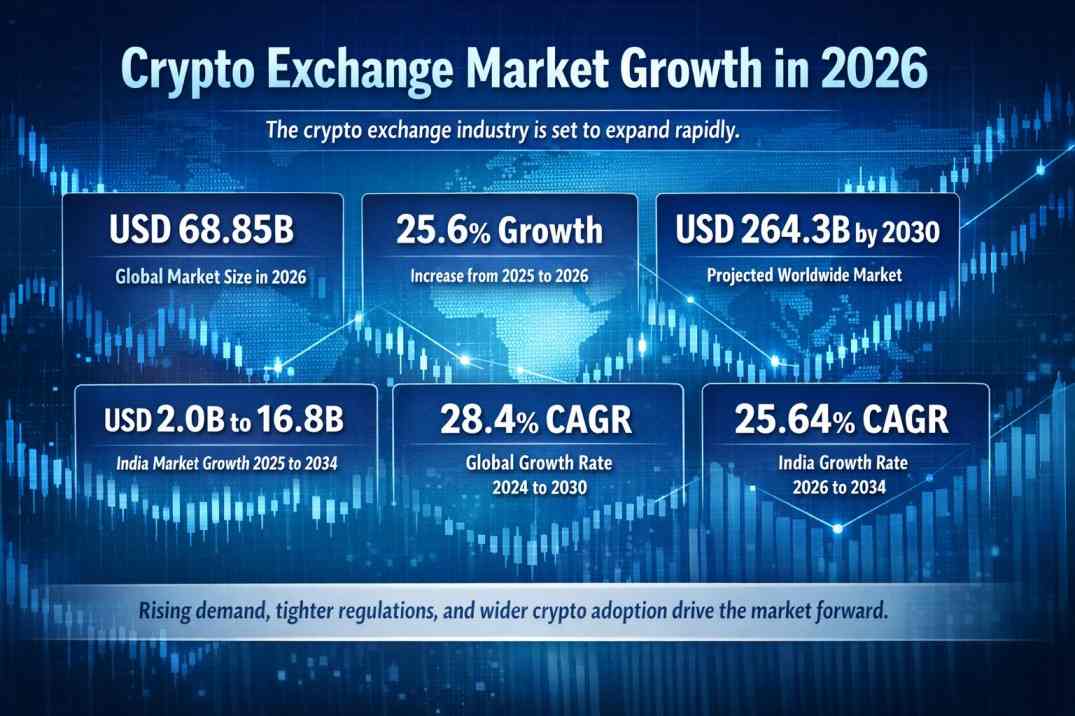
Crypto exchange demand remains strong in 2026, and market estimates show clear growth. Grand View Research projects the global cryptocurrency exchange platform market to grow from USD 45.9 billion in 2023 to USD 264.3 billion by 2030, with a 28.4 percent CAGR. The Business Research Company estimates the market at USD 68.85 billion in 2026, up from USD 54.8 billion in 2025. In India, IMARC Group projects growth from USD 2.0 billion in 2025 to USD 16.8 billion by 2034. These figures show why startups, brokers, and fintech firms still see crypto exchange development as a strong business move.
User expectations have grown just as fast. Traders now want speed, liquidity, strong custody, clear verification, and professional-grade trading tools from day one. Kraken reflects that standard with spot, margin, futures, OTC, API trading, staking, proof of reserves, and institutional custody. A Kraken clone script helps businesses enter this market faster with a ready exchange framework for trading, wallets, compliance, admin tools, and user apps. It cuts development time, reduces technical rework, and creates more room for revenue through trading fees, spreads, listings, staking, custody, and premium services.
What Is a Kraken Clone Script?
A Kraken clone script is a ready-to-customize software base for a centralized crypto exchange. It gives businesses a faster way to launch by covering core exchange functions such as trading, wallets, compliance, and admin controls. The team can then adjust the design, trading pairs, fees, workflows, and rules to match its business model.
In 2026, users expect more than basic buy and sell features. They look for fast execution, strong wallet security, smooth onboarding, advanced orders, and clear platform trust. So a Kraken clone script works as a launch-ready exchange framework, not just a code package.
What businesses usually get with a Kraken-like exchange setup
A Kraken-like exchange setup often includes:
Spot trading engine
Handles order matching, pricing, trade history, and fees.
Margin and futures support
Adds advanced trading options for active users.
Wallet and custody system
Manages deposits, withdrawals, hot wallets, and cold storage.
KYC and AML workflows
Supports identity checks and compliance screening.
Admin dashboard
Controls users, fees, reports, and risk settings.
Liquidity tools
Help keep trading active and spreads tighter.
API access
Supports pro traders and institutional users.
Web and mobile apps
Give users access across desktop and mobile devices.
Why Kraken is a benchmark for founders and exchange operators
Kraken is often used as a reference point since it shows what a mature exchange business looks like. Its public product mix includes spot, margin, futures, OTC, API trading, staking, proof of reserves, and institutional custody. That helps founders understand what serious users expect from a modern exchange.
Kraken stands out not only for features, but for trust. Its focus on security, compliance, and proof of reserves shows that exchange success depends on strong operations as much as trading tools. That is why many businesses use a Kraken-like model as a base for crypto exchange app development.
Why Launch a Crypto Exchange Like Kraken in 2026?
Market timing and business opportunity
The market still offers room for new exchanges in 2026, but only for platforms that look credible from day one. Chainalysis published its 2025 Global Crypto Adoption Index in September 2025, which points to continued real-world use across many countries. Coinbase Institutional’s 2026 market outlook points to rising institutional participation and more specialized digital asset models. Reuters reported in March 2026 that ICE invested in OKX, which shows that large finance players still see exchange infrastructure as a serious business.
Regulation is shaping that demand in parallel. PwC’s Global Crypto Regulation Report 2026 points to stronger custody, resilience, and payment system links. New policy debates in India are pushing the same issue into public view, with a fresh GNLU report calling for a clearer crypto-asset framework on March 11, 2026. That climate favors platforms built with identity checks, transaction monitoring, reporting, and structured governance from the start.
Shift from basic exchanges to full-service trading ecosystems
A plain buy and sell interface is not enough now. Users expect advanced order types, leverage products, staking or earn features, API trading, fast execution, and clear onboarding. Kraken Pro lists advanced order types like stop loss, take profit, IOC, reduce-only, and trigger options. Kraken’s API docs promote direct order book access and more than 99 percent uptime. Kraken staking materials show an active earn layer tied into the main platform.
That matters for revenue too. A broader platform can earn from spot fees, derivatives fees, spread capture, premium accounts, custody, OTC desk services, and staking activity. A white label cryptocurrency exchange software model gives new entrants a faster path to that wider product mix.
Why clone-based development is often a strategic shortcut
Building a full exchange from zero takes a long path. You need a matching engine, wallet logic, risk rules, admin tools, identity flows, liquidity access, mobile apps, and production security. A prebuilt Kraken clone script trims that path. It reduces development time, lowers product guesswork, and cuts waste from rebuilding standard modules that the market already expects.
That is why many firms start with white label crypto exchange or crypto exchange development company models. They get a usable base, then spend their time on what sets the brand apart. That may be local compliance, fiat support, better UI, niche asset listings, institutional APIs, or regional growth plans. In practical terms, clone-based crypto exchange platform development is not a shortcut in quality. It is a shortcut in repetition.
Key Features Every Kraken Clone Script Should Include
High-performance trading engine
The trading engine is the core of the exchange. It should support low-latency order matching, real-time order book updates, high transaction throughput, and smart execution logic. These features help reduce lag, cut slippage, and keep trading smooth during heavy market activity.
Multi-market trading support
A Kraken-like exchange should support more than spot trading. It should include spot, margin, futures, and OTC trading for large-volume users. This gives the platform wider appeal and helps serve both retail and professional traders.
User wallet management system
The wallet system should support multiple currencies and major blockchain networks. It should include hot and cold wallet architecture, deposit and withdrawal tracking, internal transfers, and network fee controls. This helps the platform manage both security and daily fund movement.
Security features
Security plays a major role in user trust. A strong Kraken clone script should include two-factor authentication, withdrawal whitelist tools, device tracking, data encryption, cold storage support, DDoS protection, and role-based access controls. Proof-of-reserves readiness adds more trust and transparency.
Admin and operations panel
The admin panel helps manage the exchange from one place. It should cover user verification, risk alerts, liquidity controls, asset listing management, fee settings, reports, and support tickets. This gives the team better control over operations and compliance.
API and institutional trading support
APIs are a core part of a modern exchange. The platform should support REST and WebSocket APIs for market data and order execution. Institutional support should include algorithmic trading access, liquidity integrations, and business account onboarding.
Staking or earn modules
Staking and earn features can improve user retention and create extra revenue. A Kraken clone script can include flexible staking, bonded staking, and earn programs where local rules allow them. These features give users more reasons to keep funds on the platform.
Core Technology Stack Behind a Kraken-Like Exchange
Front-end architecture
The front end is what users see and use every day. It should include a web dashboard, a mobile-responsive trading interface, and native mobile app support if needed. The design should give quick access to charts, order books, portfolio views, and wallet balances.
A clean trader-focused interface improves user trust and lowers drop-off during trading or onboarding.
Back-end and exchange engine layer
The back end handles the main exchange functions. This includes the matching engine, wallet services, user account management, authentication, compliance checks, market data, and notification tools.
Each service should work smoothly with the others. That keeps the exchange stable, easier to manage, and ready for growth.
Database and infrastructure
A Kraken-like exchange needs strong infrastructure. High-availability databases help keep platform records safe and available. Containerized deployment supports better testing and smoother updates.
The infrastructure should include load balancing, failover systems, backups, and monitoring tools. Cloud servers, dedicated servers, or a mixed setup can be used based on business size and performance goals.
Blockchain integration layer
This layer connects the exchange to blockchain networks. It handles node integrations, wallet support, deposit confirmations, withdrawals, and token transfers. It should support the main coins and networks planned for the exchange.
For token assets, the system should support smart contract interaction and chain event tracking. That helps the platform manage token deposits and withdrawals with fewer manual steps.
Third-party integrations
Most exchanges need outside services to run well. A Kraken clone script should support KYC providers, AML monitoring tools, liquidity providers, fiat on and off-ramp services, payment gateways, and custody partners.
These integrations help the platform verify users, monitor transactions, improve market depth, and support fiat payments. They also help new exchanges launch faster with fewer internal development demands.
Compliance and Licensing Requirements for 2026
Why regulation is now a core product requirement
Crypto exchange development is no longer only a software job. It is a legal and operational build too. In 2026, a new exchange needs trading tools, wallet systems, user verification, risk checks, reporting, and audit logs from the start.
This shift is clear across major markets. FATF continues to push countries to license or register virtual asset service providers and apply AML and CFT controls. For founders, that changes the whole launch plan. You are not just building an exchange. You are building a regulated business system.
AML, KYC, and transaction monitoring
A Kraken clone exchange needs strong AML and KYC controls at launch. These should cover customer identification, sanctions screening, suspicious activity detection, transaction monitoring, recordkeeping, and travel rule support where required.
Key compliance layers include:
Customer identification
Collect user identity details, proof documents, and account data during onboarding.
Sanctions screening
Screen users and wallets against blocked lists and restricted entities.
Suspicious activity detection
Flag risky behavior such as unusual deposits, fast withdrawals, or repeated failed logins.
Transaction monitoring
Track wallet flows, asset movement, and transaction patterns across accounts.
Recordkeeping
Store identity data, transaction logs, and review history for audits and legal checks.
Travel rule support
Support required data-sharing flows for qualifying transfers.
This is why crypto exchange compliance solutions and KYC AML integrated exchange software are now core product features.
Licensing strategy by region
Licensing strategy shapes the full launch plan. Founders need to decide where the exchange will start, how it will expand, and what legal structure will support that growth.
A single-jurisdiction launch is often easier. It helps the team focus on one legal regime, one banking route, and one compliance process. A multi-region plan gives wider reach, but it adds more legal work and operational cost.
The offshore versus regulated market choice matters too. Offshore entry can look faster, but regulated entry often supports better banking access, payments, and user trust. Legal entity structure matters just as much, so founders should plan this early.
MiCA, FATF, and regional compliance trends
2026 exchange planning needs to account for MiCA, FATF, and local consumer rules. In the EU, MiCA created a common rule set for crypto-asset businesses. That means EU-facing exchanges need stronger controls for authorisation, governance, reporting, and user protection.
FATF travel rule duties still matter across many markets. Stablecoin handling needs attention too, especially for listing, custody, payments, and reporting. These rules affect exchange planning from day one.
Compliance-by-design best practices
A strong exchange should build compliance into the platform from the start, not add it later.
A good setup should include:
Modular compliance architecture
Keep KYC, AML, sanctions screening, and reporting tools separate but connected.
Audit trails
Store actions, approvals, alerts, and user activity in clear logs.
Configurable risk scoring
Set risk levels by user type, asset type, country, and transaction behavior.
Regional rules engine
Apply country-specific onboarding checks and asset restrictions.
Policy update workflows
Let admins update screening rules and review steps as laws change.
This structure gives better control and smoother expansion into new markets.
Development Process: How to Build and Launch a Kraken Clone Exchange
Step 1: Define your business model
Start with the business model. This step shapes the rest of the build. You need to decide what kind of exchange you want to run.
Common models include a retail exchange, pro trading platform, institutional exchange, regional exchange, or niche asset marketplace. A retail platform focuses on simple onboarding and easy trading. A pro platform targets chart-heavy trading and advanced orders. An institutional model needs APIs, OTC flows, custody support, and deeper account controls.
This first choice affects product scope, budget, team size, and legal planning.
Step 2: Select your feature scope
The next step is feature selection. Most founders should split features into launch phase and growth phase. That keeps the first release focused and easier to test.
An MVP works well for market validation. It usually includes user signup, KYC, spot trading, wallets, admin controls, and basic reporting. Then the second phase can add margin, futures, OTC, staking, and stronger API tools.
This helps teams launch faster and reduce early product drag.
Step 3: Design the architecture and UI/UX
Your exchange will serve more than one type of user. So the architecture and interface should match real user groups from the start.
Beginners want simple signup, clear buy and sell screens, and easy wallet views. Active traders want charts, order books, fast execution, and account depth. Institutions want APIs, reporting tools, and account permissions. Market makers want direct data feeds, rate limits, and fast execution paths.
A clear UX plan cuts friction and lowers support load after launch.
Step 4: Build, customize, and integrate
This is the main build stage. The team customizes the exchange engine, sets up wallets, connects liquidity, installs compliance tools, links payment systems, and builds the web and mobile interface.
The core workstreams often include:
Exchange engine customization
Adjust pairs, order logic, fee rules, and market settings.
Wallet setup
Add supported coins, token standards, and transfer controls.
Liquidity integration
Connect internal or external market depth tools.
Compliance tools
Add KYC, AML screening, transaction review, and reporting tools.
Payment integration
Support bank rails, card options, or local fiat methods.
Mobile and web front end
Build the user-facing experience across devices.
Step 5: Test for security, performance, and compliance
Testing should cover more than app bugs. A crypto exchange needs deep checks across security, speed, wallet movement, and legal flows.
The launch team should test:
Penetration testing
Find weak points in login, API, and admin systems.
Load testing
Check how the platform behaves under high trading volume.
Wallet testing
Review deposits, withdrawals, address handling, and transfer states.
Withdrawal controls
Test whitelist rules, limits, and review flows.
KYC and AML flow testing
Check user onboarding, screening logic, and alert handling.
Disaster recovery rehearsal
Run backup and recovery drills before production launch.
This step reduces launch-day risk and helps the team fix weak areas early.
Step 6: Launch and scale
The final step is launch planning. Most teams should not open every market at once. A beta rollout gives room to test live activity with lower risk. Geographic launch sequencing helps the company match local legal and payment conditions market by market.
Customer support setup matters from day one. So do liquidity improvement plans, partner onboarding, and live monitoring. After launch, the real work continues through product updates, risk reviews, and market expansion.
A strong Kraken clone exchange does not win only at release. It wins through stable operation, user trust, and steady growth.
White Label vs Custom Exchange Development: Which Is Better?
White label advantages
A white label exchange gives a faster path to launch. The base product is already built, tested, and structured for exchange operations. That cuts early build time and lowers initial cost.
It can speed up revenue too. A business can enter the market sooner, list assets sooner, and start fee collection sooner. Pre-tested modules for wallets, trading, admin controls, and user onboarding reduce development pressure and make deployment simpler.
This model works well for teams that want speed, lower upfront risk, and a clearer release path.
Custom development advantages
Custom development gives deeper control over the product. The business can shape the exchange around its own trading flow, user interface, risk tools, and backend logic. That creates more room for brand identity and long-term product separation.
It gives more freedom for proprietary features too. A team can build custom compliance rules, private market tools, special account models, or region-specific workflows that a ready-made script may not support well. It can fit a broader scale plan too, especially for firms with strong internal engineering teams.
When a Kraken clone script makes the most sense
A Kraken clone script makes the most sense for businesses that want to enter the market fast and launch with a proven exchange model.
It is a strong fit for:
Startups entering quickly
They need a shorter path from idea to launch.
Brokerages expanding into exchange services
They already know trading and want to add crypto markets.
Fintech platforms adding crypto markets
They want digital asset trading without building every layer from zero.
Entrepreneurs testing a region-specific exchange model
They want to validate demand in one market before a larger rollout.
This route gives a practical middle ground. It offers faster deployment than full custom work, and more control than a basic plug-and-play product.
Decision framework for business leaders
Business leaders should compare both models across a few core factors.
Budget
White label products often cost less at the start. Custom builds need more capital.
Timeline
White label launch cycles are shorter. Custom builds take longer.
Licensing target
A regulated market may need custom compliance flows and legal controls.
Technical team maturity
A small team can manage a clone script more easily. A strong internal team can support custom work better.
Scale expectations
A regional launch can work well with white label software. A large multi-market plan may need deeper custom structure.
User segment
Retail-first products fit white label well. High-end institutional products often need more custom depth.
Business Models and Revenue Streams for a Kraken-Like Exchange
Trading fees and maker-taker structure
Trading fees are the core revenue stream for most exchanges. A maker-taker model is one of the most common structures. Makers add liquidity to the order book. Takers remove liquidity by filling existing orders. Kraken’s public fee pages show volume-based maker and taker pricing across trading products, which makes this a useful model for commercial planning.
This structure rewards active users and market makers with lower fees at higher volume. It helps the platform attract liquidity and keep trading activity healthy. For a new exchange, this is a strong base for a cryptocurrency exchange business plan.
Margin and futures revenue
Margin and futures products create extra revenue beyond spot trading. Margin trading can generate borrowing fees and liquidation-related charges. Futures markets can bring in contract trading fees and premium tools for active traders.
Kraken’s public futures fee pages show a separate volume-based fee schedule for derivatives, and its futures pages confirm fees tied to those markets.
These products can raise revenue per user and attract higher-volume traders. They can increase platform risk too, so strong risk controls need to sit beside the revenue plan.
Listing fees and token onboarding services
Listing fees can add one more income stream, but this area needs careful legal review. An exchange cannot treat token listings as a simple pay-to-list program without thinking about compliance, asset review, disclosure, and market risk.
A safer model focuses on token onboarding services tied to legal review, technical review, wallet setup, and market-readiness checks. This creates a cleaner process and supports better asset standards on the platform.
Staking, custody, and institutional services
Staking, custody, and OTC services can turn an exchange into a broader financial business. Kraken promotes institutional staking, custody, and OTC trading for larger clients, which shows how these services fit commercial growth. Its OTC desk targets trades above $50,000, and its custody page promotes regulated custody with segregated and verifiable assets.
This opens several revenue paths:
Staking revenue share
The exchange keeps a portion of staking rewards or service fees.
Custody services
Institutions and large holders pay for protected asset storage.
OTC desk margins
The business earns from private large-volume trade execution.
Premium institutional access
Clients pay for better service levels, account management, or special trading access.
This model supports stronger crypto exchange monetization across retail and business segments.
Subscription and premium analytics
An exchange can earn recurring revenue through paid tools and premium access. This works well for advanced traders, market makers, and professional users.
Common paid features include:
Advanced charts
More trading tools, indicators, and screen layouts.
API tiers
Higher limits and stronger data access for active traders.
VIP accounts
Lower fees, priority support, and account benefits.
Trading bots
Built-in automation tools or bot-friendly tools.
Data feeds
Real-time market data for desks, analysts, and institutions.
These products can strengthen the exchange revenue model and reduce reliance on spot trading fees alone.
Conclusion
A Kraken clone script gives businesses a faster and more practical way to launch a crypto exchange in 2026 with the features users now expect, from advanced trading and wallet management to compliance, security, and scalable operations. It helps reduce development time, lowers technical risk, and creates stronger opportunities for revenue through trading fees, staking, custody, and premium services. For startups, brokerages, and fintech platforms that want to enter the market with a serious product, this model offers a strong foundation for growth. CS company provides Kraken Clone Script built to support modern crypto exchange business goals.