

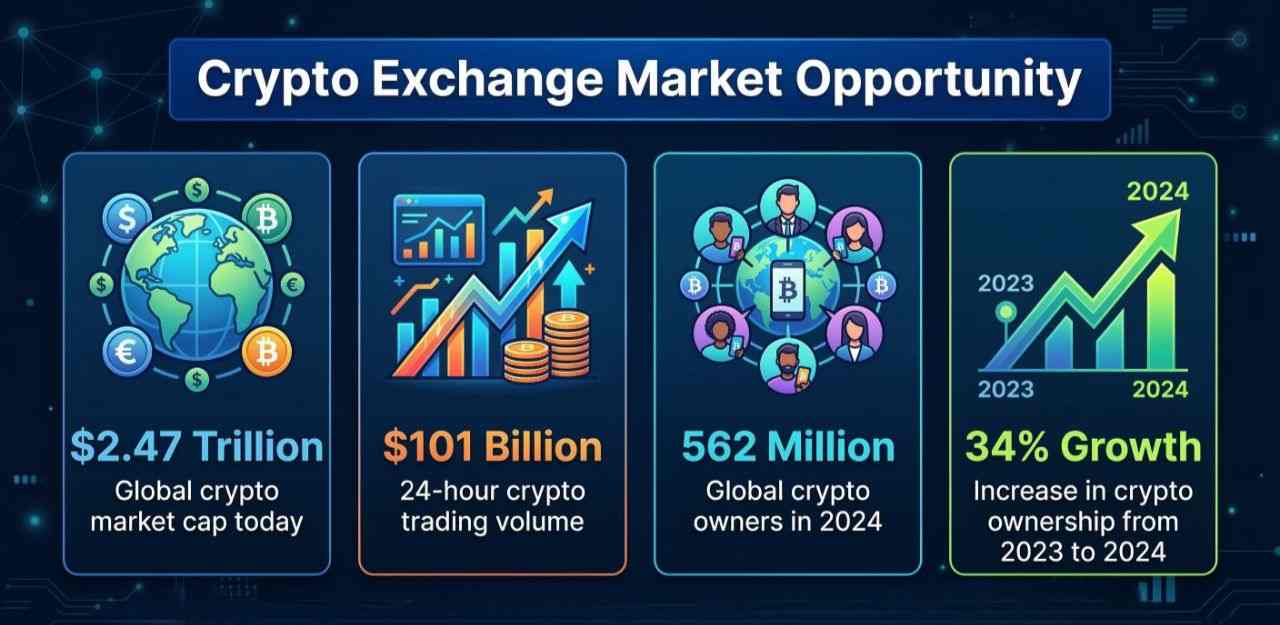
Crypto trading is no longer a niche business. It has become a strong revenue channel for startups, brokerages, fintech companies, and large financial firms. The size of the market explains the growing interest. The global crypto market cap is about $2.47 trillion, and daily crypto trading volume often exceeds $100 billion. Millions of users trade digital assets every day, and global crypto ownership has reached about 562 million people, growing more than 34 percent from the previous year. Many companies want to enter this market, but building a crypto exchange from the ground up requires deep technical expertise, large budgets, long development cycles, and higher operational risk.
This is where a Bitstamp Clone Script becomes valuable. It allows businesses to launch a crypto exchange with the essential components already built. The trading engine, user dashboard, wallet system, admin controls, and security framework come integrated into the platform. Companies can focus on branding, customization, and market growth instead of spending years on development. The Bitstamp-style model provides a professional trading interface, real-time market activity, mobile access, and transparent fee structures. For startups, brokerages, and enterprises, this approach creates a faster path to enter the crypto market, reduce early development costs, and start generating revenue through trading fees, token listings, and premium services.
What Is a Bitstamp Clone Script?
A Bitstamp clone script is a ready-made crypto exchange platform built to mirror the core setup of an exchange like Bitstamp. It is not a simple front-end theme or a basic trading page. It is a full software product that includes the tools needed to run a centralized crypto exchange.
At its core, the script covers the main parts of exchange operations. It includes user registration, identity verification, crypto wallets, fiat handling options, order matching, trading charts, transaction records, and an admin panel. It gives business owners a working exchange structure that they can brand and adjust for their market.
This matters for one clear reason. Building these systems from zero takes time and money. A pre-built script shortens that process. The business gets a working base product first, then adds custom features, design changes, market pairs, payment methods, and local compliance flows.
Why Businesses Search for Bitstamp Clone Script Options
Most companies that enter crypto trading want speed, control, and a clear return on investment. A Bitstamp clone script supports all three goals. It cuts months of product planning and development work. It lowers the technical burden at the launch stage. It gives founders something real to present to investors, partners, or internal stakeholders.
There is a branding advantage too. A company does not need to promote another exchange. It can launch under its own name, set its own fee model, choose its own markets, and shape the customer experience around its target users. That makes the script useful for startups that want fast traction and for established firms that want a new revenue stream.
This model fits several business types:
Startups and new crypto brands
- Launch a trading platform with lower entry cost
- Test market demand with a live product
- Start earning from trading activity sooner
Brokerage firms
- Add crypto trading to an existing financial service line
- Serve clients through a private branded platform
- Control fees, user onboarding, and account management
Fintech companies
- Expand from payments or digital finance into crypto
- Add wallet, trading, and asset management features
- Keep users inside one branded ecosystem
Regional exchange operators
- Offer local fiat support
- Add language and currency settings for a target region
- Build a user base around local trading demand
Bitstamp Clone Script vs Generic Crypto Exchange Script
A generic crypto exchange script covers basic trading needs. It often includes wallets, token listings, and spot trading. That works for a simple launch.
A Bitstamp clone script offers more. It supports fiat-based trading, API access, advanced order types, stronger security, and compliance features. It is built for businesses that want a more reliable and professional exchange.
The difference is clear in daily use. Traders expect live market data, fast order execution, and a smooth trading experience. Business owners need admin control, risk tracking, and room to grow. A Bitstamp-style clone script supports both.
Core Modules Included in a Bitstamp Clone Script
A Bitstamp clone script needs more than a trading screen. It needs the core modules that run the exchange, protect user funds, and help the admin team manage daily operations. These modules shape the user experience and the business side of the platform.
User Panel
The user panel is where every customer starts. It should make sign-up simple and account access secure. Users need a fast registration and login flow, plus support for two-factor authentication.
KYC verification is another core part of this module. Most exchanges need identity checks before users can unlock full access. Bitstamp’s public KYC content shows how identity checks support trust and risk control on financial platforms.
The wallet dashboard should show available balance, locked funds, deposit history, and withdrawal status in one place. Deposit and withdrawal controls should stay simple and accurate. Trade history and portfolio tracking should give users a clear record of orders, balances, and account activity.
Trading Engine
The trading engine is the heart of the exchange. It matches buy and sell orders, updates balances, and processes trades in real time.
A strong Bitstamp clone script should support market, limit, and stop orders. These order types are standard for active traders. Bitstamp’s public trading resources highlight advanced order types and order-book trading as key parts of the user experience.
Order book management is just as important. Traders want to see live buy orders, sell orders, and market depth before they place a trade. Real-time execution and clear price charts help build trust in the platform.
Wallet Infrastructure
Wallet infrastructure handles asset storage and transfers across the exchange. This module should support multiple cryptocurrencies and fiat balances in one system.
Hot wallets handle daily transactions. Cold wallets store most funds offline for better security. Internal transfers help users move funds between wallet and trading accounts without delay. Withdrawal queues and approval rules add an extra layer of control for risky or high-value payouts.
Admin Dashboard
The admin dashboard gives your internal team control over the exchange. It should cover user management, transaction monitoring, KYC approval, and revenue tracking.
Admins should be able to review account details, monitor deposits and withdrawals, and manage trading pairs from one place. Risk and compliance alerts should flag suspicious actions early. Bitstamp’s compliance material shows that KYC and AML checks are central parts of exchange operations.
API and Integrations Layer
A Bitstamp clone script should connect with outside services through strong APIs. This includes public API access, trading API support, and WebSocket feeds for live market updates.
Bitstamp provides HTTP, FIX, and WebSocket access, which shows why API support is a major selling point for a Bitstamp-style exchange product.
Liquidity provider integrations help new exchanges offer tighter spreads and better execution. Payment gateway integrations support fiat deposits and withdrawals, which helps attract more users.
Must-Have Features in a Bitstamp Clone Script
Core modules make the platform functional. Must-have features make it market-ready. These features shape trading speed, account safety, compliance, and user retention.
High-Performance Order Matching
Order matching speed matters on every exchange. The engine should process orders with very low delay and handle many requests at the same time. This keeps the platform stable during heavy traffic and sharp market moves.
Multi-Currency and Multi-Pair Trading
A strong exchange script should support crypto-to-crypto, fiat-to-crypto, and stablecoin trading pairs. This gives the business room to serve both new users and active traders.
Advanced Security Architecture
Security must sit at the center of the product. Two-factor authentication, session monitoring, encryption, withdrawal whitelist controls, and anti-phishing measures all help protect user accounts and funds.
Bitstamp’s public security and compliance resources show that user protection is a constant part of exchange management.
Compliance and Verification Features
KYC onboarding, AML monitoring, suspicious activity detection, audit logs, and country-based restrictions are all key parts of a Bitstamp clone script. These tools help the exchange meet legal requirements and reduce fraud risk.
Mobile Exchange App Support
Mobile access is no longer optional. Users expect live charts, order book access, price alerts, and secure mobile login on both iOS and Android. Bitstamp’s mobile product pages highlight these features as part of modern exchange use.
Liquidity and Market Stability Tools
Liquidity tools help the exchange feel active and stable. External liquidity APIs, market-making support, spread monitoring, and slippage control all improve trade execution and user trust.
How a Bitstamp Clone Script Works
A Bitstamp clone script works through four main layers. The frontend manages what users see. The backend runs the exchange engine. Integrations connect outside services. Deployment keeps the platform live and monitored.
Frontend Layer
The frontend includes the trader dashboard, market pages, wallet screens, and admin interfaces. It should give users fast access to charts, balances, order forms, and transaction records. Bitstamp’s public trading content shows how real-time charts and order book views support active trading.
Backend Exchange Engine
The backend processes order routing, matching logic, ledger accounting, wallet synchronization, and trade settlement. This is the core system that keeps balances correct and trades accurate.
Integration Framework
This layer connects the exchange to blockchain nodes, banking rails, compliance APIs, OTP services, and analytics tools. Bitstamp’s API documentation shows how market access and payment connectivity work together in a professional exchange setup.
Deployment Workflow
The platform should move through development, QA, staging, and production in a structured way. After launch, the team needs ongoing monitoring for API performance, wallet status, failed logins, and unusual account activity.
Step-by-Step Process to Launch an Exchange Using a Bitstamp Clone Script
Launching a crypto exchange requires preparation before development begins. A Bitstamp clone script supplies the trading engine, wallet logic, and admin panel. The business structure decides how these tools will operate in the market. Teams that plan their model early reduce delays during development.
A structured launch process helps companies define the user base, payment methods, and compliance structure. Each stage in the process prepares the platform for real trading activity. Clear planning allows the exchange to enter the market with fewer operational risks.
Define Your Exchange Business Model
The first step is selecting a business model that matches the target market. The business model defines the users the exchange wants to attract and the type of services it will provide. A retail exchange usually focuses on everyday traders who want quick access to buying and selling crypto.
Other models serve more specialized markets. A regional fiat exchange supports local currency deposits and follows local regulations. A brokerage and exchange hybrid combines instant purchases with a trading dashboard. An institutional desk focuses on high volume traders who require deeper liquidity, reporting tools, and direct API access.
Choose the Right Bitstamp Clone Script Provider
Selecting the development provider plays a major role in the exchange’s stability. Businesses should review the technical stack behind the clone script. This includes the programming language, database structure, and trading engine performance.
Companies should also examine source code ownership, scalability capacity, and compliance features. The provider should deliver post launch support as well. A reliable support system helps fix technical issues and maintain the platform after deployment.
Customize Branding and User Experience
Branding transforms a clone script into a recognizable exchange platform. The brand identity includes the logo, color scheme, and typography used across the platform. Consistent design helps build user trust and strengthens brand recognition.
User experience also affects how traders interact with the exchange. The homepage should guide users through registration and verification. The trading dashboard should display charts, order books, and wallet balances in a clear layout that supports both beginner and advanced traders.
Integrate Wallets, Liquidity, and Payments
Integration connects the exchange with blockchain networks and payment channels. Wallet systems allow users to deposit, store, and withdraw digital assets. Each blockchain network requires transaction verification and address generation.
Payment channels allow users to deposit traditional money. Bank transfers and payment processors often support fiat deposits. Liquidity providers help maintain active order books and stable trading prices during early exchange growth.
Configure Compliance and Security
Compliance systems verify user identities and monitor financial activity. Identity verification procedures confirm that traders meet platform requirements before they begin trading. This process helps maintain regulatory compliance.
Security tools monitor account activity and transaction behavior. Geo restrictions limit access in restricted regions. Transaction monitoring systems track deposits, trades, and withdrawals to detect unusual activity.
Test the Exchange Before Launch
Testing confirms that the platform operates correctly before public release. Functional testing reviews each feature including account registration, deposits, trading, and withdrawals. These tests confirm that every function performs as expected.
Security testing examines the platform for vulnerabilities. Load testing measures performance during heavy traffic. Failover testing checks system stability if servers or network services stop working.
Go Live and Scale
The final stage introduces the exchange to real users. Many companies start with a soft launch that allows a small group of traders to access the platform. This stage reveals issues that may appear only during live trading.
Market makers often join the exchange during early operations to support liquidity. Customer support teams also prepare to handle account questions and verification issues. Growth strategies such as referral programs and partnerships help attract new traders.
Technology Stack for Bitstamp Clone Script Development
The technology stack determines how the exchange performs during live trading. A Bitstamp style exchange requires stable backend systems, responsive user interfaces, accurate transaction records, and real time data delivery. Reliable infrastructure ensures the platform remains operational during high trading activity.
Public information from Bitstamp shows that modern exchanges rely heavily on APIs and WebSocket connections for live trading data. These technologies allow traders to view price updates and order book changes instantly.
Backend Technologies
Backend technologies manage the core functions of the exchange. These systems process trades, update wallet balances, and record financial transactions. Programming languages such as Node.js, Python, Java, and Go commonly power these services.
Exchange architecture can follow two patterns. Microservices architecture divides the system into independent modules such as trading, wallet management, and notifications. Monolithic architecture keeps all services in a single application, which simplifies development for smaller teams.
Frontend Technologies
Frontend technologies shape the interface that traders interact with every day. Frameworks such as React, Vue, and Angular often power exchange dashboards. These tools help developers create responsive and interactive trading interfaces.
The user interface must adapt to different devices. A responsive design allows traders to access charts, order books, and wallet balances on desktop and mobile screens. Clear layout and fast loading improve the overall trading experience.
Database and Ledger Design
Database systems store user data and trading records. A relational database keeps structured information such as account details, trade orders, and transaction history. These systems maintain data accuracy and consistency.
Some systems also use in memory data storage for faster processing of temporary information. Immutable transaction logs record deposits, trades, and withdrawals permanently. These logs help maintain transparency and support financial audits.
Real Time Trading Infrastructure
Real time infrastructure delivers live market information to traders. WebSocket streaming allows the platform to send price updates and trade events without page refresh. This feature helps traders monitor market changes instantly.
Queue systems manage internal tasks such as notifications and transaction updates. Event driven architecture allows one system action to trigger several related updates. A trade execution can update account balances, record the transaction, and notify the user.
Cloud and DevOps Framework
Cloud infrastructure supports the daily operation of the exchange. Platforms such as Amazon Web Services, Microsoft Azure, and Google Cloud host the exchange servers and databases. These services allow the platform to scale as user traffic grows.
DevOps practices support continuous platform maintenance. Continuous integration and deployment pipelines help developers release updates safely. Backup systems and monitoring tools protect the platform from outages and track system performance.
Revenue Model of a Bitstamp Clone Script Business
A crypto exchange earns money from several service channels. A Bitstamp clone script includes trading tools, wallet systems, and admin controls that support these revenue streams. Once users begin trading, many activities on the platform can produce small fees.
Most exchanges combine multiple income sources instead of relying on one. Trading fees usually form the main revenue stream. Deposit charges, listing fees, and premium services add extra income and support long term growth.
Trading Fees
Trading fees are the primary income source for most exchanges. Each buy or sell order placed on the platform generates a small charge. This fee applies when traders execute orders through the exchange order book.
Many exchanges use a maker and taker fee model. Makers place limit orders that add liquidity to the market. Takers execute orders immediately and remove liquidity. Some exchanges also apply volume based fee tiers, where high volume traders receive lower fees. Bitstamp uses a volume based fee structure, which attracts active traders.
Deposit and Withdrawal Charges
Exchanges often charge fees when users move funds into or out of the platform. These charges help cover banking costs and blockchain transaction expenses.
Fiat deposits may include payment processing fees depending on the method used. Crypto withdrawals include network fees for processing transactions on blockchain networks. The exchange may add a small service charge as part of its revenue model.
Token Listing Fees
Crypto projects often request exchange listings to gain market exposure. Exchanges may charge a listing fee during the onboarding process.
This process includes technical integration, project review, and compliance checks. Listing fees can become a valuable revenue stream when new projects want access to the exchange’s trading market.
Spread Income and Liquidity Services
Spread income comes from the difference between buying and selling prices. Instant buy and sell features often include a small price margin set by the exchange.
Liquidity partnerships also support revenue generation. Market makers supply trading orders that keep markets active and help maintain stable price movement across trading pairs.
Premium and Institutional Services
Many exchanges offer advanced services for professional traders and institutions. These services create additional revenue streams beyond standard trading activity.
Examples include API trading access, OTC trading desks, and white label brokerage services. Some platforms also offer staking or lending features where regulations allow them. Bitstamp supports institutional connectivity and advanced trading tools, which shows how exchanges expand revenue beyond basic trading fees.