
Key Takeaways
- Polygon DEX development gives businesses a low-cost path to launch wallet-based token trading with active market demand.
- A Uniswap-style exchange on Polygon can earn from swaps, listings, staking, launchpads, analytics, and cross-chain fees.
- Strong liquidity, secure smart contracts, and clean UX decide how well a Polygon DEX attracts traders and token projects.
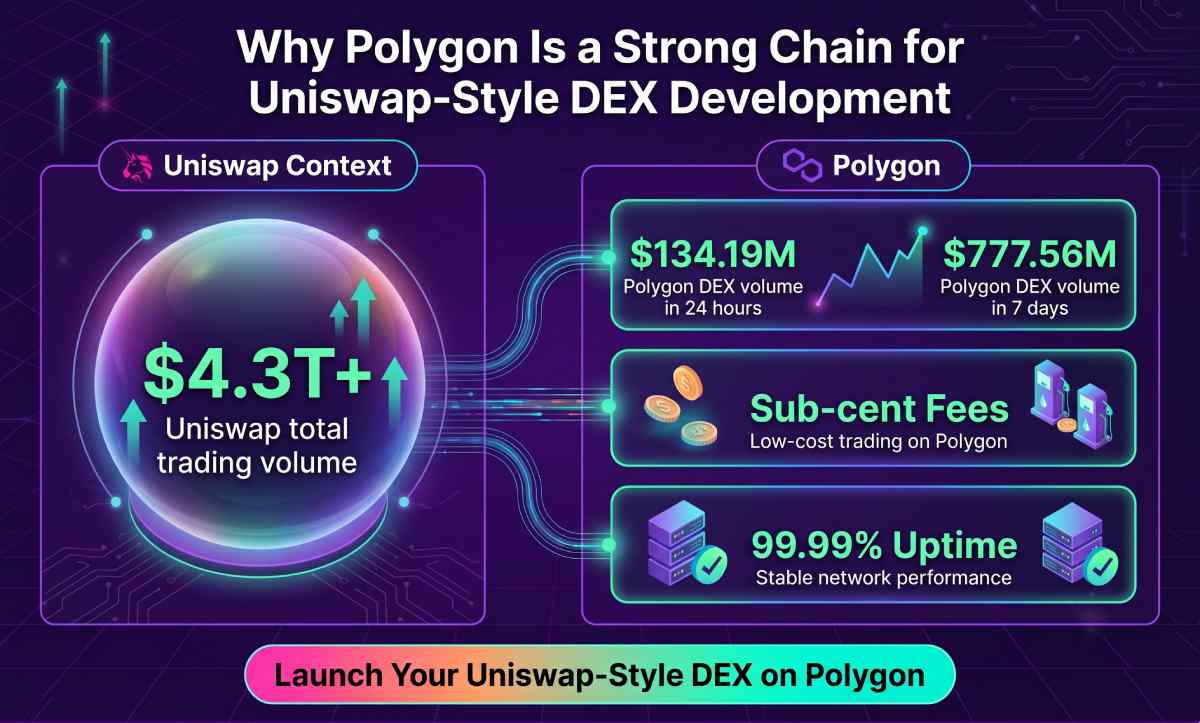
Decentralized exchange development has moved far beyond an early crypto experiment. It is now a real business model with proven demand. Uniswap alone has processed more than $4.3 trillion in cumulative trading volume across 18 chains and over 10 million assets. Polygon makes this model more practical for new entrants with sub-cent transaction fees and 99.99% uptime. Recent market data adds more weight to that case. Polygon recorded about $134.19 million in DEX volume in 24 hours and $777.56 million over seven days. These numbers show that users want low-cost, fast, on-chain trading. For businesses, this opens a clear path to launch a Uniswap-style exchange on Polygon with lower operating costs, faster settlement, and direct wallet-based access. A well-built Polygon DEX can generate fee income, attract liquidity, and support long-term ecosystem growth.
What is a Decentralized Exchange?
A decentralized exchange, or DEX, lets users trade crypto assets from their wallets. The platform does not hold user funds. Smart contracts process each swap and record it on-chain.
Most modern DEX platforms use an Automated Market Maker model. An AMM DEX uses liquidity pools instead of buyers and sellers placing orders. Each pool holds two tokens. Traders swap against that pool, and prices adjust based on the token reserves in the pool.
A Uniswap-style decentralized trading platform needs liquidity pools, router contracts, factory contracts, LP tokens, token swap logic, and price oracle support. These parts work together to create a fast, open, and business-ready Polygon DEX.
Why Choose Polygon for Decentralized Exchange Development?
Polygon’s Layer-2 Architecture Explained
Polygon gives businesses a practical base for decentralized exchange development. It works with Ethereum tools, so teams can build with Solidity, MetaMask, Hardhat, and Ethers.js. Its PoS chain processes trades away from Ethereum mainnet, then anchors state back to Ethereum through checkpoints.
This setup helps a Uniswap-style exchange serve active traders with lower gas costs and faster settlement. Polygon reports sub-5 second finality, 3,800 TPS, and an average transaction cost near $0.002. That matters for swaps, liquidity deposits, rewards, and governance votes.
Advantages of Building a DEX on Polygon
A Polygon DEX can reduce user drop-off at the transaction stage. Low fees support small trades. Fast confirmations support better user trust. EVM support cuts development time for Polygon Blockchain Development, Polygon Smart Contract Development, and Polygon DeFi Development projects.
Polygon offers a stronger cost profile than Ethereum for high-frequency DEX activity. Ethereum gives deep liquidity and strong security, but gas costs can hurt retail users. Polygon gives businesses a lower-cost route for launching a Decentralized Trading Platform with AMM features.
How a Uniswap-Style Exchange Works on Polygon
User Wallet Connection Process
Users connect through MetaMask or WalletConnect. The platform reads wallet balances, token approvals, and network status. A clear wallet flow lowers support tickets and builds confidence.
Token Swap Workflow
A swap starts with token selection. The router contract checks the best pool, calculates the price, and asks for approval. The smart contract then confirms the trade on Polygon.
Liquidity Provider Mechanism
Liquidity providers deposit token pairs into pools. The protocol issues LP tokens that show their pool share. Trading fees return to liquidity providers based on that share.
Yield Farming and Liquidity Mining
DEX owners can add farming rewards to attract early liquidity. Users stake LP tokens, earn project tokens, and take part in governance. This model helps businesses build trading volume, user retention, and token demand.
How a Uniswap-Style Exchange Works on Polygon
Wallet Access and User Control
A Uniswap-style exchange on Polygon lets users trade tokens through smart contracts, not order books. The user starts by connecting MetaMask or WalletConnect. The wallet signs each action, so the exchange never holds user funds.
Token Swap Flow
The token swap flow has four core steps. The router contract receives the trade request. It checks the right pool pair, reads token reserves, then calculates the output price. The user reviews slippage, gas cost, and received amount. After confirmation, Polygon records the transaction.
Liquidity Provider Model
Liquidity providers keep the exchange active. They deposit two tokens into a pool, such as MATIC and USDC. The protocol gives them LP tokens that represent their pool share. Each trade pays a fee, and the fee goes back to pool contributors.
Yield Farming and Token Rewards
Yield farming adds another growth layer. A business can reward users with native tokens for adding liquidity or staking LP tokens. Governance participation can give token holders voting rights over fees, pools, and product changes. This model gives founders a clear base for Decentralized Exchange Software Development on Polygon.
Step-by-Step Process to Build a Uniswap-Style Exchange on Polygon
Market Research and Business Planning
The build starts with market research and business planning. The team must define traders, token projects, revenue streams, and legal duties. A Polygon DEX Development Company can map trading fees, listing fees, farming rewards, and compliance needs before code begins.
UI and UX Design for DEX Users
Next comes UI and UX design. The trading screen must show token pairs, price impact, wallet status, pool data, and mobile views. Clean design builds trust fast.
Smart Contract Development
Smart contract development forms the core. The factory contract creates pairs. The pair contract manages reserves. The router contract handles swaps and liquidity actions. A governance contract can manage voting rights.
Liquidity Pool Creation
Liquidity pool creation needs care. The launch team sets the first token pairs, deposits starting liquidity, and tracks reserve balance. Strong starting liquidity helps reduce slippage and supports smoother trades.
Frontend and Backend Development
Frontend work connects the trading screen with blockchain activity. React can power the user interface. Web3.js and Ethers.js connect wallets, contracts, and transactions. Node infrastructure supports data calls, event tracking, and platform operations.
Security Auditing and Testing
Security testing comes before launch. Audits, testnet trials, penetration checks, and vulnerability review reduce financial risk. These checks help protect user funds, liquidity pools, and treasury assets.
Polygon Mainnet Deployment
After testing, the team deploys to Polygon mainnet with tools like Hardhat. Monitoring starts at launch and tracks swaps, failed trades, gas use, pool depth, and contract events. This is the practical path for businesses asking How to Build a DEX or Build Uniswap Clone for commercial use.
Core Features of a Modern Polygon-Based DEX
Token Swapping Engine
A Uniswap-style Polygon DEX needs a swap engine that quotes prices from pool reserves, applies slippage limits, and routes trades through the best pair. Traders expect low gas costs, quick confirmation, and clear trade data. The interface must show price impact, network fee, and minimum received value before each swap.
Liquidity Pool Management
Liquidity pools create the market. Users deposit two tokens, receive LP tokens, and earn part of trading fees. A business-grade DEX should show pool depth, APR, impermanent loss range, and withdrawal status in plain numbers. Thin liquidity leads to poor pricing, so early liquidity planning matters.
Multi-Wallet Integration
MetaMask, WalletConnect, Coinbase Wallet, and other EVM wallets help users enter the platform with less friction. Wallet support must cover signing, token approval, network switching, and failed transaction recovery.
Staking and Farming Modules
Staking and farming turn token holders into repeat users. Reward contracts must define emission rates, lock periods, penalties, and claim rules.
Governance Voting System and DAO Governance Support
A mature DEX gives token holders voting rights over fees, listings, treasury spend, and reward plans. DAO tools work best with clear quorum rules, proposal windows, and multisig execution.
Cross-Chain Bridge Compatibility
Bridge support brings assets from Ethereum, BNB Chain, Arbitrum, and other networks into Polygon pools. Audited bridge partners and asset caps help cut risk.
Analytics Dashboard, Referral and Reward Programs
Decision-makers need live TVL, swap volume, wallet growth, pool revenue, and token holder data. Referral programs can lower acquisition costs, but rewards need fraud checks and clear payout records.
Technology Stack Required for Polygon DEX Development
Blockchain Infrastructure: Polygon PoS and Polygon zkEVM
Polygon PoS fits high-volume retail swaps with low-cost EVM transactions. Polygon zkEVM suits teams that want Ethereum-style execution with zero-knowledge security design. Product teams choose the network based on fees, liquidity, speed, and business goals.
Smart Contract Languages: Solidity and Vyper
Most DEX teams choose Solidity for audit support, libraries, and developer talent. Vyper works well for smaller contracts that need simpler syntax and strict structure.
Development Frameworks: Hardhat, Truffle, and Foundry
Hardhat supports local testing and plugin-based development. Truffle still serves older Web3 stacks. Foundry gives fast Solidity-first testing, fuzz checks, and cleaner contract workflows.
Frontend Technologies: React.js, Next.js, and Tailwind CSS
React.js and Next.js help teams build trading screens, pool pages, and token pages. Tailwind CSS keeps interface work consistent across desktop and mobile layouts.
Web3 Libraries: Ethers.js, Web3.js, and Wagmi
Ethers.js and Wagmi handle wallet state, contract calls, typed data, and transaction status. Web3.js still supports older dApps and internal admin tools.
Backend Technologies, Database, and Storage
Node.js, Express, and GraphQL manage indexing, alerts, rewards, and admin workflows. PostgreSQL stores structured trading data. MongoDB fits flexible user and campaign data. IPFS stores token metadata, governance files, and public records.
Revenue Models for a Polygon Decentralized Exchange
A Polygon decentralized exchange gives businesses more than a trading product. It creates steady income through swaps, liquidity programs, token launches, analytics, and ecosystem services. The low gas cost on Polygon makes these models easier to run, even for platforms that process frequent small trades.
Trading Fees
Trading fees form the base income stream for most DEX platforms. A Uniswap-style exchange charges a small fee on every token swap. Common fee tiers include 0.05%, 0.30%, and 1%, based on the risk level of each pool.
Stablecoin pairs need lower fees since price movement stays limited. New tokens or volatile pairs suit higher fees. This gives the exchange owner room to price each market based on demand, risk, and liquidity depth.
Liquidity Provider Fees
Liquidity providers supply token pairs to trading pools. They earn part of the swap fees from trades routed through those pools. This model rewards users who support market depth.
For businesses, strong liquidity reduces slippage and improves trade execution. Traders stay longer on platforms that offer fair prices and fast swaps. Better liquidity also helps new token projects build market trust.
Token Listing Charges
Token listing fees create direct revenue from projects that want market access. Startups pay to list their tokens, create liquidity pools, and gain early trading volume.
A Polygon DEX can offer listing packages with pool setup, analytics access, marketing support, and launchpad placement. This works well for new DeFi, gaming, NFT, and real-world asset projects that need quick market entry.
Premium Analytics Services
Premium analytics can turn raw trading data into a paid business product. Traders, token teams, and funds need pool depth, wallet activity, volume trends, price movement, and liquidity flow data.
MongoDB can support this feature by storing off-chain records such as user actions, alerts, dashboard settings, chart data, and campaign metrics. These dashboards help businesses sell paid plans to serious traders and project teams.
NFT Marketplace Integration
A Polygon DEX can connect token trading with NFT activity. NFT projects often need native tokens for rewards, access passes, governance, and creator payments.
The exchange can earn from NFT swaps, collection-based token pools, royalty tools, and marketplace fees. This model works well for gaming, art, fashion, ticketing, and membership-based NFT platforms.
Launchpad Services
Launchpad services help new projects raise funds and reach early users. A DEX can host token sales, IDO campaigns, whitelist programs, and liquidity events.
The platform can charge setup fees, campaign fees, or a small share of funds raised. This turns the DEX into a launch partner for Web3 startups, not just a place to trade tokens.
Cross-Chain Swap Fees
Cross-chain swaps let users move assets between Polygon, Ethereum, BNB Chain, Avalanche, Arbitrum, and other networks. Each transfer can carry a service fee.
This model expands the exchange beyond one chain. It also attracts users who need faster routes, lower fees, and more token access. Cross-chain features increase trade volume and platform stickiness.
Staking Platform Revenue
Staking creates another income stream for a Polygon DEX. Users lock tokens to earn rewards, gain voting rights, or access premium features.
Businesses can earn from staking pool fees, early withdrawal charges, reward program setup, and token demand. A strong staking model can support user retention and long-term platform growth.
Business Use Cases of Polygon DEX Development
Polygon DEX development fits many business models. It supports crypto trading, DeFi services, tokenized assets, gaming economies, NFT commerce, and DAO operations. Businesses choose Polygon for low transaction fees, fast settlement, and strong Ethereum compatibility.
Crypto Startups
Crypto startups use Polygon DEX development to launch token markets without building a centralized exchange. This reduces custody risk and shortens launch timelines.
A startup can create pools, list tokens, attract liquidity providers, and start trading activity through smart contracts. This gives founders a direct path from token launch to active market creation.
FinTech Companies
FinTech companies can add token swaps, stablecoin transfers, and DeFi tools to their finance products. These features help them serve users who want faster settlement and lower transaction costs.
A Polygon DEX layer can support peer-to-peer payments, treasury swaps, merchant tokens, and stablecoin liquidity. This creates new fee channels for payment apps, wallets, and trading platforms.
Web3 Enterprises
Web3 enterprises use custom DEX platforms for branded tokens, loyalty programs, and private trading communities. A company can issue ecosystem tokens and give users a direct place to trade them.
This model suits brands that run memberships, digital rewards, creator economies, or partner marketplaces. The DEX becomes a value exchange layer for the whole business network.
DAO Ecosystems
DAOs need simple tools for treasury swaps, governance token trading, and member-owned liquidity. A Polygon DEX gives DAO members direct access to trading and pool creation.
The DAO can use smart contracts to manage voting rights, fee sharing, and liquidity rewards. This keeps financial activity transparent and aligned with community control.
Tokenized Asset Trading Platforms
Tokenized asset platforms can use Polygon DEX development for real estate tokens, carbon credits, commodities, invoices, and private market assets. These assets need controlled markets with clear trading rules.
A custom DEX can support allowlists, compliance checks, restricted pools, and asset-specific trading fees. This helps businesses connect blockchain trading with regulated asset models.
NFT Ecosystems
NFT ecosystems gain more value from native token markets. A DEX can support creator tokens, reward tokens, collection tokens, and marketplace payment assets.
This gives NFT platforms more ways to reward buyers, creators, and long-term holders. It also keeps more trading activity inside the same ecosystem.
Gaming and Metaverse Economies
Gaming and metaverse projects need fast, low-cost asset trading. Polygon suits in-game economies that process many small transactions.
A DEX can support reward tokens, land tokens, weapon assets, guild tokens, and player-owned markets. Players gain direct ownership and trade access, and game studios gain new revenue from swaps, staking, and marketplace fees.
Conclusion
Polygon has become a preferred blockchain for decentralized exchange development by combining low transaction costs, high scalability, and Ethereum compatibility. A Uniswap-style exchange on Polygon gives businesses the ability to create new revenue streams through trading fees, liquidity pools, staking, launchpads, and token ecosystems while delivering a fast and secure trading experience for users. As DeFi adoption continues to grow, investing in a scalable DEX can position businesses for long-term success in the Web3 economy. Cryptocurrency Exchange Script provides end-to-end Decentralized Exchange Development services, helping startups and enterprises build secure, feature-rich, and customized Polygon DEX platforms that are ready for commercial deployment and future growth.