
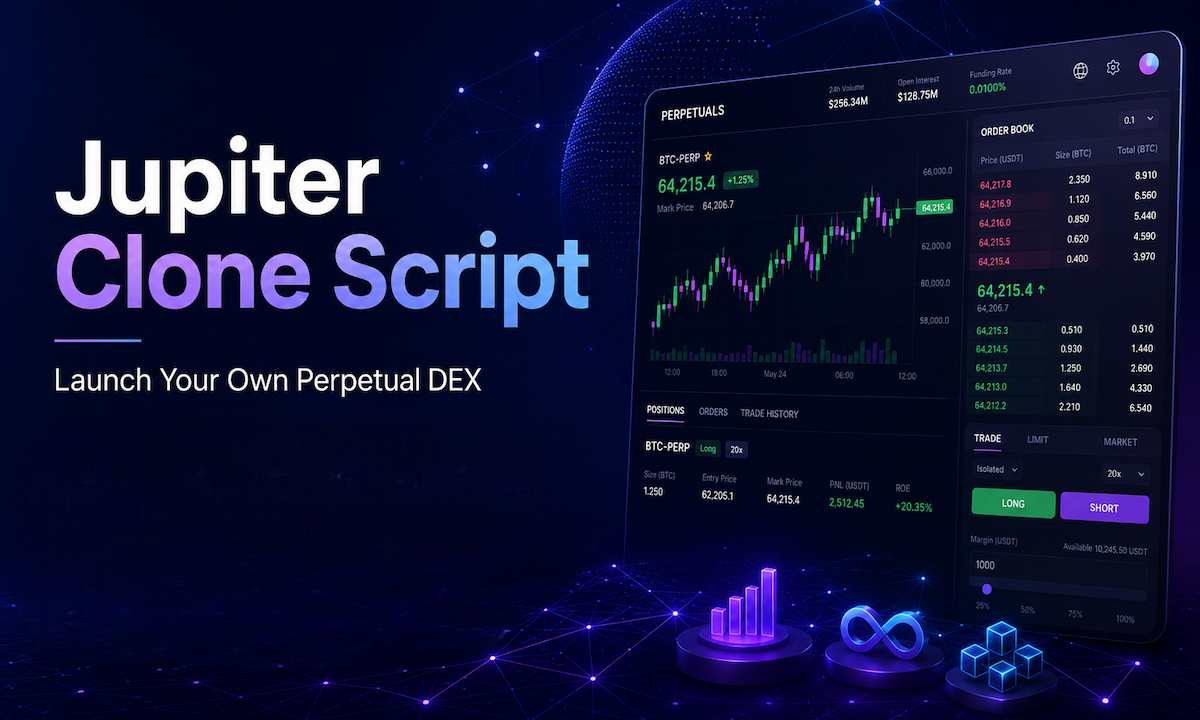
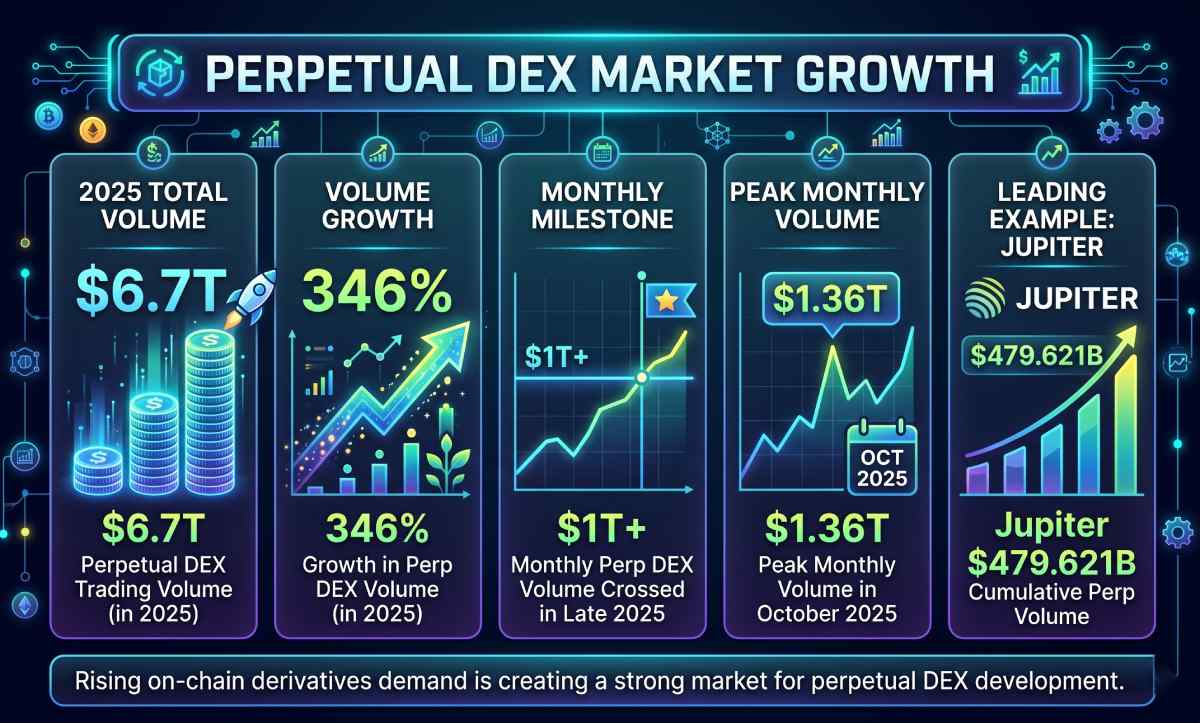
The market for on-chain perpetual trading has moved far past the early test phase. Jupiter Perpetual Exchange has recorded $479.621 billion in cumulative perp volume, $826.4 million in cumulative fees, and $206.6 million in cumulative revenue. Its liquidity model gives 75% of all fees to JLP liquidity providers, which helps attract capital and keep trading markets active.
These numbers show clear demand, strong fee potential, and a tested business model for DeFi derivatives platforms. A Jupiter Clone Script gives businesses a faster way to launch a perpetual DEX with margin trading, LP-backed liquidity, oracle-based pricing, wallet access, and admin controls inspired by one of Solana’s leading perp trading platforms.
What is Jupiter ?
Jupiter is a Solana-native perpetual exchange. It lets users open leveraged long and short positions without holding the underlying asset. Eco’s support page states that Jupiter supports up to 100x leverage on SOL, ETH, and BTC against a shared liquidity pool.
Jupiter began as a Solana DEX aggregator. Its main value came from routing trades across liquidity sources to find better swap prices. CoinGecko notes that Jupiter’s flagship product helps users find the best price across Solana in one place. The platform then expanded into a broader DeFi trading ecosystem.
Key Features of Jupiter
Jupiter combines several trading functions in one product:
- Leveraged long and short positions
- Liquidity pool-backed trading
- Oracle-based pricing
- Fast Solana execution
- Multi-asset perpetual contracts
- Shared liquidity through JLP
These features help traders access higher capital exposure, and they give liquidity providers a role in the platform’s earning model.
Why Jupiter Became Popular in DeFi
Jupiter gained traction through low fees, quick trade settlement, and access to deep Solana liquidity. Its familiar Jupiter interface made perpetual trading easier for existing Solana users. For businesses, that user flow is the main lesson: a perpetual DEX must feel simple, fast, and clear from the first trade.
What is a Jupiter Clone Script?
A Jupiter Clone Script is a ready-built perpetual DEX codebase that helps a business launch a trading platform with features similar to Jupiter. Jupiter is a Solana-native perpetual exchange where traders open long and short positions with up to 100x exposure on assets such as SOL, ETH, and BTC. It uses a shared liquidity pool model instead of a traditional order book.
For a business, this model saves months of product planning and engineering work. The platform owner gets the base trading flow, wallet access, liquidity pool logic, risk controls, and admin tools. The brand can still change the interface, fee model, supported assets, reward system, and governance structure. This makes the script useful for crypto startups, DeFi firms, and Web3 finance brands that want faster market entry.
Core Components of a Jupiter Clone Script
A strong Jupiter Clone Script needs a fast trading engine, audited smart contracts, wallet support, and a liquidity management module. The JLP model shows how traders borrow from a pool backed by assets such as SOL, ETH, WBTC, USDC, and USDT. Traders pay borrow fees to the pool, and liquidity providers gain exposure to platform activity.
The platform also needs a risk engine for margin checks, liquidation logic, price feed protection, and trade limits. An admin dashboard helps the operator track fees, markets, liquidity, user activity, and system health. Analytics tools help teams study volume, revenue, asset demand, and trader behavior.
Benefits of Using a Perpetual DEX Clone Script
The main business benefit is speed. A custom perpetual DEX can take many months to build. A clone script shortens that path. It also lowers early development cost and gives the founder a tested product structure. The business can then focus on liquidity, branding, compliance, and user growth.
Market Demand for Perpetual DEX Platforms
Growth of Decentralized Derivatives Trading
Perpetual DEX platforms processed about $6.7 trillion in trading volume in 2025, up 346 percent from 2024, according to Binance Square data. Reuters also reported that crypto perpetual futures volume reached $61.7 trillion in 2025 across the wider market.
Why Investors Prefer Perpetual DEXs
Traders like perpetual DEXs for self-custody, open access, on-chain records, and lower counterparty risk. They keep control of their wallets and trade without handing funds to a central exchange. That trust factor drives demand.
Business Opportunities in the Perpetual Trading Sector
A Jupiter Clone Script can generate revenue from trading fees, borrow fees, listing fees, staking, governance tokens, and liquidity provider programs. For businesses, the real value sits in repeat trading activity. Active traders return often, which creates steady fee flow and stronger community growth.
Key Features of a Jupiter Clone Script
A Jupiter Clone Script needs more than a trading screen. It needs a fast trading engine, deep liquidity, clean wallet access, exact pricing, and strict risk controls. Jupiter shows why this matters. It runs on Solana and supports up to 100x long and short positions on major assets through a shared liquidity pool model.
Advanced Trading Engine
The trading engine is the core of a perpetual DEX. It handles order creation, position updates, collateral checks, and liquidation triggers. High-frequency order execution helps traders enter and exit positions without long delays. Low-latency architecture reduces price slippage during volatile markets. Real-time price feeds support fair trade settlement and better risk control.
Liquidity Pool Integration
A strong liquidity pool gives the platform its trading depth. The LP-to-trader model lets liquidity providers supply assets, then traders borrow against that pool for leveraged positions. Jupiter’s developer docs describe the Pool account as the data structure that holds JLP pool details, including AUM and custody data. This model creates fee income for liquidity providers and steady market access for traders.
Multi-Wallet Connectivity
A user-friendly perpetual DEX must support popular wallets. Phantom and Solflare matter for Solana users. MetaMask and WalletConnect help reach wider Web3 users. Smooth wallet access reduces drop-offs during onboarding.
Leverage, Oracles, and Security
Adjustable leverage lets traders manage risk based on their capital and market view. Margin tracking and liquidation logic protect the pool from bad debt. Oracle support from networks like Pyth brings real-time market data on-chain, which helps platforms price positions with accuracy. Smart contract audits, multi-signature access, anti-manipulation checks, and DDoS protection strengthen the platform.
Admin Control Panel
The admin panel gives operators control over users, fees, liquidity, risk limits, and trading analytics. This helps businesses track revenue, user activity, and pool health from one place.
Technology Stack Behind Jupiter Clone Development
A Jupiter Clone Script needs a tech stack built for speed, cost control, and future growth. Solana fits this model due to its low transaction fee structure. The Solana docs state that the base fee is 5,000 lamports per signature.
Blockchain Infrastructure
Solana forms the base layer for fast trade settlement. Smart contracts can be written in Rust. Anchor helps developers build, test, deploy, and interact with Solana programs with less boilerplate code.
Frontend Development Technologies
React.js and Next.js work well for trading dashboards, position screens, and wallet flows. Web3.js connects the interface with wallets, smart contracts, and on-chain data. A clean frontend matters, since traders need fast access to charts, collateral, leverage, PnL, and liquidation price.
Backend Architecture
Node.js can support APIs, trade history, user activity logs, and admin functions. WebSocket connections are needed for live prices, order updates, liquidation alerts, and pool metrics. Real-time APIs help the platform feel responsive during active market hours.
Database and Cloud Infrastructure
PostgreSQL can store user activity, trade records, platform settings, and analytics data. Redis caching helps serve frequent data faster. AWS or Google Cloud can support deployment, monitoring, backups, and traffic control. A community-driven ecosystem then adds long-term value through governance, liquidity campaigns, referrals, and trader rewards.
How Jupiter Clone Script Works
User Registration and Wallet Connection
A Jupiter Clone Script starts with wallet-based access. Users connect wallets such as Phantom, Solflare, or WalletConnect and trade without handing over private keys. This non-custodial model matters to traders who want control over funds from the first click.
Liquidity Deposit Mechanism
The platform runs through a shared liquidity pool. Jupiter’s own documentation explains that Jupiter uses the JLP pool, where traders borrow assets to open leveraged positions. The pool earns 75% of trading fees, and JLP holders act as the counterparty to trades.
In a clone model, users deposit supported crypto assets into the pool. The system then issues LP tokens that represent their pool share. For a business, this creates two user groups at once: active traders and liquidity providers.
Opening and Managing Perpetual Positions
Traders open long or short positions based on price direction. They select collateral, asset pair, leverage, and trade size. The platform tracks margin, unrealized profit, loss, and liquidation price in real time.
This model has strong commercial value. DeFiLlama lists Jupiter Perpetual Exchange with $5.277 billion in 30-day perp volume and $6.52 million in 30-day fees at the time of its latest indexed data.
Funding Rates and Liquidation Process
Funding fees help balance long and short demand. The liquidation engine closes unsafe positions once collateral falls below the required margin. This protects the liquidity pool and keeps trading risk measurable.
Profit Distribution and Rewards
Revenue flows through trading fees, LP rewards, and governance incentives. A well-built Jupiter Clone Script can use these layers to grow user retention and token utility.
Steps to Launch a Perpetual DEX Using Jupiter Clone Script
Requirement Analysis
The launch starts with a clear business plan. Decide the target chain, trading pairs, leverage limits, fee model, and user region. This step shapes compliance, liquidity needs, and revenue design.
UI/UX Customization
The trading screen must feel simple. Traders need fast order placement, clear charts, margin data, and risk alerts. Branding should support trust, not distract from execution.
Smart Contract Deployment
Developers create and test contracts for positions, pools, fees, liquidations, and LP token logic. Each contract needs testnet trials before mainnet release.
Liquidity Setup
Initial liquidity decides the trading experience. The business can fund the first pool, work with market makers, or use incentive campaigns to attract LPs.
Security Testing and Audit
Security checks must cover smart contracts, admin keys, APIs, and price feeds. Recent DeFi events show that perp platforms need strict wallet controls and tested incident plans.
Mainnet Launch and Marketing
The final launch combines community building, token campaigns, referral plans, and exchange partnerships. A strong Jupiter Clone Script gives businesses a faster path to enter the decentralized derivatives market.
Monetization Models for Perpetual DEX Platforms
Trading Fees
A Jupiter Clone Script gives a business a clear income base from trading activity. The platform can charge maker and taker fees on every long, short, open, close, and liquidation event. This model works well for a perpetual DEX, since active traders often enter and exit positions many times a week. Perp DEX activity crossed more than $1 trillion in monthly volume by late 2025, which shows strong demand for on-chain derivatives trading.
Liquidity Pool Fees
Liquidity pool fees add a second revenue stream. Jupiter’s JLP model links pool value to an index of SOL, ETH, WBTC, and USDC, plus trader profit and loss. Jupiter states that 75% of selected platform fees support the JLP pool. A clone platform can use a similar LP fee-sharing model to attract capital, reward liquidity providers, and keep markets active.
Token Utility and Governance
A native token can support fee discounts, staking access, reward programs, and voting rights. For businesses, this creates long-term user retention. A DAO model gives active traders and liquidity providers a role in fee changes, asset listings, and treasury use. This can turn users into platform supporters, not just short-term traders.
Premium Trading Features
Premium tools create higher-margin income. Businesses can offer paid dashboards, real-time risk alerts, trader leaderboards, API access, and VIP trading memberships. These features suit professional traders who need faster data and deeper market views.
Use Cases of Jupiter Clone Script
DeFi Trading Startups
Startups can use a Jupiter Clone Script to launch a perpetual DEX faster than building from zero. The script can include wallet login, margin trading, oracle feeds, LP pools, and an admin panel. This helps founders test markets, build a user base, and run launch campaigns with lower technical risk.
Institutional Trading Platforms
Institutions need high-volume infrastructure, clear risk controls, and stable liquidity. Reuters reported that crypto perpetual futures volume reached $61.7 trillion in 2025, far above spot crypto trading. That demand makes perpetual trading infrastructure attractive for larger trading desks and fintech firms.
Web3 Financial Ecosystems
A perpetual DEX can become part of a wider Web3 product set. Wallet apps, DeFi dashboards, launchpads, and token projects can add perps to increase user activity and fee income.
Crypto Brokerage Firms
Brokerage firms can use white-label perpetual trading products under their own brand. This suits firms that want faster entry, custom fees, referral systems, influencer campaigns, and partnership-led user growth.
Conclusion
A Jupiter Clone Script gives businesses a practical route to enter the fast-growing perpetual DEX market with a tested trading model, strong liquidity design, and multiple revenue streams. As on-chain derivatives gain higher trading volume, companies that launch early can build user trust, attract liquidity providers, and create a branded DeFi trading platform with long-term income potential. For startups, brokers, and Web3 finance brands, this is the right time to build a secure, scalable, and revenue-ready perpetual DEX like Jupiter.