
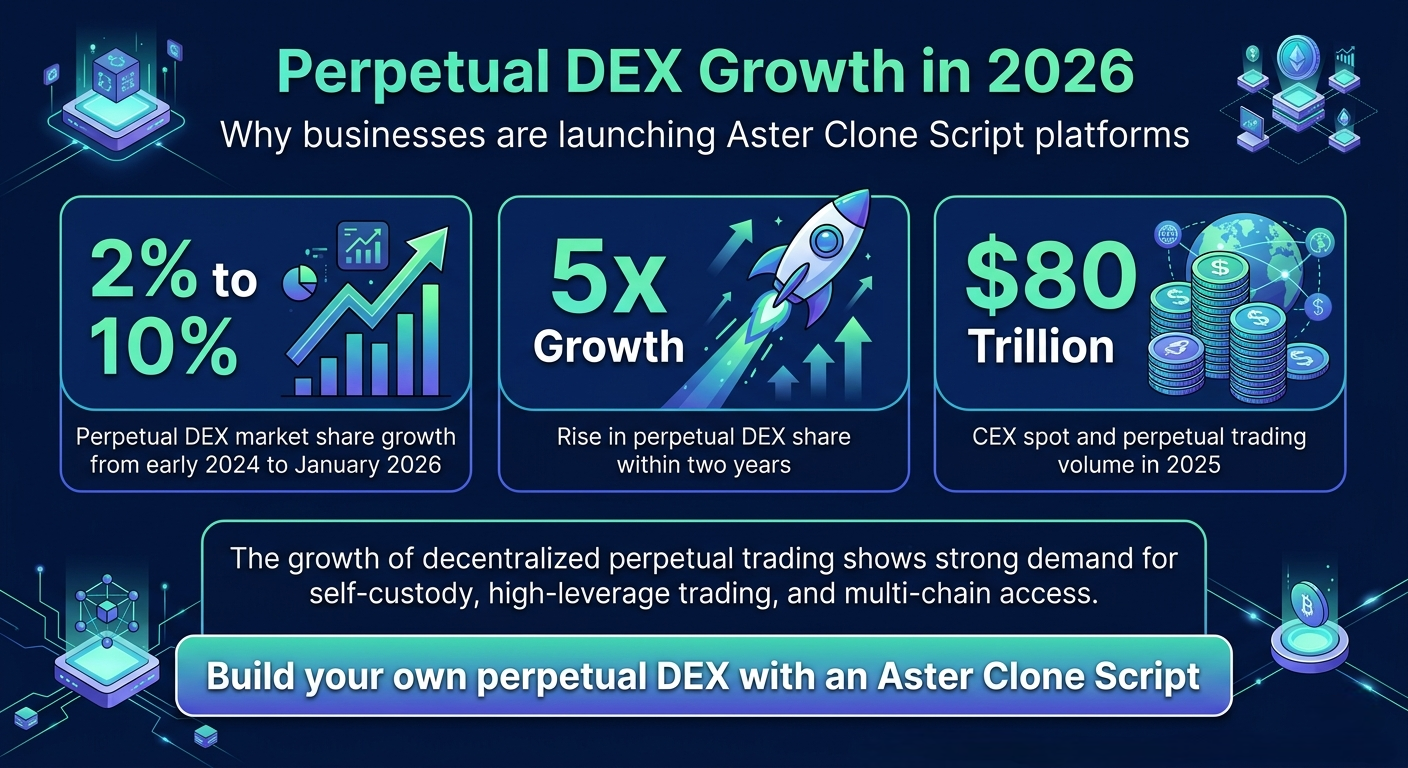
Perpetual DEX trading is gaining real market share in 2026. CoinGecko’s 2026 CEX and DEX Trading Activity Report shows that perpetual DEXs grew from nearly 2% of perpetual trading volume in early 2024 to about 10% by January 2026. Centralized exchanges still handled nearly $80 trillion in spot and perpetual trading volume in 2025, but the shift toward decentralized derivatives is clear.
This growth creates a strong opening for crypto startups, exchanges, and Web3 firms. An Aster Clone Script helps businesses launch a perpetual DEX with self-custody, high-leverage trading, multi-chain access, liquidity tools, and trader-friendly features. It gives founders a faster path to enter the decentralized derivatives market in 2026 with lower build time and clear revenue potential.
What Is an Aster Clone Script?
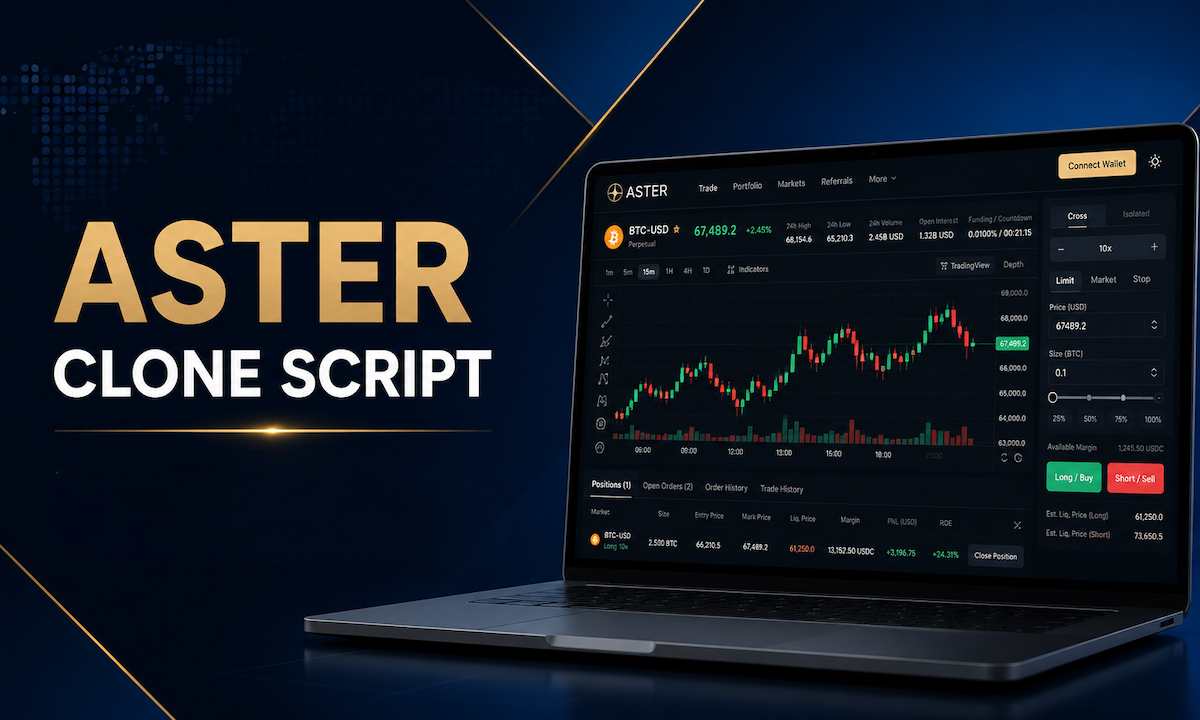
An Aster clone script is a ready-made perpetual DEX software model inspired by Aster’s trading features and user flow. It usually includes wallet login, perpetual contracts, leverage settings, order types, margin controls, price oracles, liquidity modules, admin tools, and trader dashboards.
For businesses, the main value is speed. A custom perpetual DEX can take longer, cost more, and carry higher engineering risk. A clone script gives teams a working base that developers can tailor for brand design, tokenomics, supported chains, trading pairs, fee rules, and compliance needs.
A strong Aster DEX clone script should never reuse Aster’s trademarks, copyrighted design, or private IP. It should act as a business-ready foundation for a new decentralized derivatives exchange with its own identity, rules, and market focus.
What Makes Aster a Strong Model for Perpetual DEX Development?
Multi-Chain Trading That Reduces User Friction
Aster gives builders a clear model for a modern multi-chain perpetual DEX. Its main strength is access. Traders can use one platform across networks, which reduces the need for repeated bridging and chain switching. The official Aster site highlights multichain support, deep liquidity, low fees, high leverage, and yield features as core parts of its trading setup.
Trading Modes Built for Different User Types
A strong cross-chain DEX platform must serve both new and advanced traders. Aster does this through Simple Mode and Pro Mode. Simple Mode keeps trading fast and direct. Pro Mode adds a deeper order book, advanced tools, and more control. This split matters for businesses. It widens the user base without forcing every trader into the same interface.
High-Leverage Trading for Active Markets
High-leverage trading is another reason Aster works as a reference point. Its 1001x Mode offers fully on-chain perpetual trading with up to 1001x leverage on selected pairs across BNB Chain and Arbitrum. This feature attracts active traders who want high-risk, high-speed markets.
Hidden Orders for Better Trading Privacy
Privacy is part of the product design too. Aster’s hidden orders let users place limit orders without showing size or presence on the public order book. For whales, funds, and professional traders, this helps reduce copy trading and front-running risk.
Yield-Bearing Collateral for Better Capital Use
Aster also supports yield-linked assets through Aster Earn, including asBNB and USDF. This improves capital use. Traders can keep collateral active rather than leaving funds idle inside margin accounts.
Why Launch a Perpetual DEX Trading Platform in 2026?
Traders now want more control over assets. A DeFi derivatives trading platform gives them wallet-based access, on-chain settlement, and self-custody. This demand creates room for new perpetual DEX brands.
The market data supports the timing. CoinGecko reported that centralized exchanges processed close to $80 trillion in spot and perpetual volume in 2025, yet DEX platforms have gained share since 2024 as products became more mature.
For businesses, a perpetual DEX can earn through trading fees, liquidation fees, funding flows, API access, premium tools, staking, token utility, and market-maker deals. Early entrants in 2026 can build liquidity, user trust, and brand recall before the sector becomes crowded.
Core Features of an Aster Clone Script
Perpetual Futures Trading Engine
An Aster clone script needs a strong perpetual futures trading engine at its core. Traders must open long and short positions, set leverage, manage margin, track funding rates, and view real-time PnL without delays. Aster’s 1001x Mode supports fully on-chain perp trading with up to 1001x leverage on select pairs across BNB Chain and Arbitrum, which shows the demand for fast, high-risk trading flows in 2026.
Advanced Order Book System
A serious Aster DEX clone script must support market orders, limit orders, stop-loss, take-profit, trigger orders, post-only orders, and reduce-only orders. Hidden orders matter for high-volume traders. Aster describes hidden orders as limit orders that hide size and presence from the public order book. This protects trading intent and helps large traders avoid front-running.
Simple Trading Mode for Retail Users
Retail users need speed and clarity. A simple mode should offer one-click trading, preset leverage, clear liquidation warnings, fast wallet login, and a mobile-first interface. This format reduces confusion for new traders.
Pro Trading Mode for Advanced Traders
Pro users expect TradingView charts, order book depth, trading history, portfolio analytics, advanced order types, and API access. Aster’s perpetuals product focuses on margin systems, risk tools, and advanced trading functions across supported chains.
Multi-Chain Wallet Integration
A business-grade perpetual DEX must connect with MetaMask, WalletConnect, Trust Wallet, Coinbase Wallet, and OKX Wallet. Network support can include BNB Chain, Arbitrum, Ethereum, Base, Polygon, and other chains based on the target market.
Liquidity, Collateral, Assets, and Admin Control
The platform needs internal liquidity pools, external DEX liquidity, market maker links, synthetic liquidity, and oracle-backed execution. Yield-bearing collateral can include stablecoins, liquid staking tokens, LP tokens, and custom assets. Aster promotes crypto-settled U.S. stock exposure, so businesses can add crypto perps, forex pairs, commodities, synthetic assets, and tokenized stock perps after legal review. An admin dashboard should cover users, trades, fees, liquidity, risk limits, disputes, analytics, revenue, and compliance controls.
Technical Architecture of an Aster-Like Perpetual DEX Platform
Smart Contract Layer
The smart contract layer handles margin contracts, vault contracts, liquidation contracts, settlement contracts, collateral contracts, and governance contracts. This layer controls user funds, trade settlement, and risk rules, so audits must happen before launch.
Matching Engine
The matching engine decides trade speed and price quality. On-chain matching gives transparency. Off-chain matching gives lower latency. A hybrid order book gives many businesses a practical middle path with fast order routing and MEV-resistant execution.
Oracle Integration
Price feeds guide liquidations and settlements. The platform can use Chainlink, Pyth, RedStone, API3, or custom oracle networks. Each feed needs fallback logic, deviation checks, and update monitoring.
Risk Management Engine
The risk engine tracks margin ratio, maintenance margin, liquidation levels, funding rate calculation, insurance fund balance, open interest caps, and circuit breakers. This protects the exchange during sharp market moves.
Liquidity Layer
A perp DEX can use AMM liquidity, order-book liquidity, RFQ models, market maker APIs, and vault-based liquidity. Strong liquidity keeps spreads tight and helps traders enter large positions.
Frontend, Backend, and Security Infrastructure
The frontend should include Web3 login, TradingView charts, responsive dashboards, portfolio views, order panels, and real-time market data. The backend can use Node.js, Go, Rust, PostgreSQL, Redis, GraphQL, Subgraphs, WebSockets, Kafka, and blockchain indexing. Security work must include smart contract audits, penetration testing, bug bounties, multi-sig treasury controls, rate limits, key management, and live monitoring. Perpetual DEXs recorded $7.9 trillion in 2025 volume, so weak infrastructure is a direct business risk.
Step-by-Step Process to Build a Perpetual DEX Like Aster
Step 1: Market Research and Business Model Planning
A strong Aster clone script starts with clear market research. The business team must define who the platform serves: retail traders, pro traders, market makers, crypto funds, or regional exchange users. Each group needs different leverage limits, asset pairs, risk controls, and fee plans.
The next task is market selection. A perpetual DEX can support crypto pairs, stablecoin pairs, tokenized assets, or synthetic markets. The team must pick a clear legal base, preferred jurisdictions, supported regions, and restricted locations. Token strategy matters too. A native token can support governance, fee discounts, staking, and trader rewards.
Step 2: Define Platform Features and Trading Modes
Aster works well as a reference model since it serves both simple and advanced traders. A new platform can follow a similar structure with simple mode for quick trades and pro mode for advanced order placement.
Core modules can include perpetual trading, spot trading, staking, copy trading, referral rewards, and launchpad access. The key is focus. A platform built for serious derivatives traders should give more weight to speed, liquidity, charts, order types, and risk controls.
Step 3: Choose Blockchain Networks
Network choice affects cost, speed, liquidity, and user reach. Ethereum offers deep DeFi access but high gas costs. BNB Chain gives low fees and strong retail reach. Arbitrum and Base suit fast EVM trading. Solana offers high throughput. Polygon and Avalanche work well for lower-cost expansion. A custom L1 or L2 gives more control, but it raises engineering and maintenance costs.
Step 4: Design Tokenomics and Incentive Programs
Tokenomics must reward real trading activity, not short-term farming. Useful incentives include trading rewards, staking benefits, liquidity mining, referral payouts, and VIP fee discounts. Poor token design can drain treasury funds fast. Strong models link rewards to volume, liquidity depth, user retention, and platform revenue.
Step 5: Develop Smart Contracts and Trading Engine
The core build includes margin contracts, collateral vaults, liquidation logic, funding rate rules, and settlement contracts. The trading engine must handle order matching, position updates, price checks, and real-time profit and loss. Oracle setup is critical. Bad price feeds can trigger false liquidations and user losses.
Step 6: Integrate Wallets, Liquidity, and APIs
A trading platform needs wallet access through MetaMask, WalletConnect, Trust Wallet, and other major wallets. Liquidity can come from vaults, market makers, external DEXs, or hybrid models. Trading APIs, analytics APIs, and live data feeds help attract pro traders and institutional desks.
Step 7: Conduct Security Audits and Testing
Security testing must start before mainnet. The team should run testnet trials, smart contract audits, load tests, oracle attack tests, and liquidation stress tests. A bug bounty can bring outside researchers into the process. Perpetual trading platforms handle leverage, so one logic error can create large losses.
Step 8: Launch Mainnet and Growth Campaigns
Mainnet launch should start with a controlled beta. The first users can test trading, deposits, withdrawals, orders, and liquidations. Growth then needs trader onboarding, referral programs, liquidity partnerships, exchange listings, community campaigns, and influencer outreach.
Business Models for an Aster Clone Perpetual DEX
Trading Fee Revenue
Maker and taker fees form the base revenue stream. VIP tiers can reward high-volume traders with lower fees. Institutional packages can include custom limits, API access, and direct support.
Funding Rate and Liquidation Fee Revenue
Perpetual platforms can earn from funding flows, liquidation fees, and insurance fund activity. These fees must stay transparent. Traders accept fees better when rules are clear.
Native Token Utility
A native token can support governance votes, staking, fee discounts, liquidity rewards, and ecosystem incentives. Revenue sharing needs legal review before launch.
Premium Trading Tools
Advanced analytics, bot access, copy trading, portfolio tracking, and institutional dashboards can create paid plans. These tools help serious traders act faster.
White Label and B2B Licensing
The platform can serve more than one brand. Businesses can license the software to regional exchanges, brokers, fintech firms, and Web3 communities. This model creates recurring revenue without relying only on trading volume.
Cost to Develop an Aster Clone Script in 2026
The cost of an Aster clone script depends on features, blockchain support, trading engine type, liquidity setup, UI/UX, audits, admin tools, and post-launch support. A basic single-chain build costs less than a multi-chain perpetual DEX with advanced orders, oracle feeds, liquidation logic, and market maker APIs.
Development Package Cost
A basic perpetual DEX clone script can cost around $8,000 to $20,000. It includes wallet login, core trading features, one blockchain network, and basic admin controls.
An advanced Aster-like DEX can cost around $20,000 to $50,000. It includes multi-chain support, advanced order types, chart tools, referral modules, and liquidity links.
An enterprise-grade decentralized derivatives exchange can cost around $50,000 to $120,000+. It includes trading APIs, market maker support, audit assistance, compliance tools, and high-volume trading features.
A custom L1 or L2 perpetual DEX ecosystem can cost around $120,000 to $250,000+, based on chain design, settlement logic, and infrastructure needs.
Why Cheap Clone Scripts Can Be Risky
Very cheap scripts can create serious issues after launch. Unaudited smart contracts, weak liquidity design, poor admin controls, security gaps, and limited scalability can hurt user trust and trading volume.
Cost by Business Size
For small businesses, the cost can range from $8,000 to $20,000. Mid-range platforms can cost $20,000 to $70,000. Enterprise platforms can cost $70,000 to $250,000+.
The overall development duration can range from 4 weeks to 10 months, based on features, audit depth, chain support, and customization needs.
Conclusion
The demand for decentralized perpetual trading platforms continues to grow in 2026 as traders look for faster execution, self-custody, multi-chain access, and advanced leverage features. An Aster clone script gives startups, crypto exchanges, and Web3 businesses a practical way to launch a secure and scalable perpetual DEX without building everything from the ground up. From liquidity integration and trading engine setup to smart contract security and custom branding, the right development strategy can reduce launch time and cost. Businesses that want to enter the decentralized derivatives market can partner with Cryptocurrency Exchange Script for professional Aster Clone Script development tailored for modern crypto trading demands.