
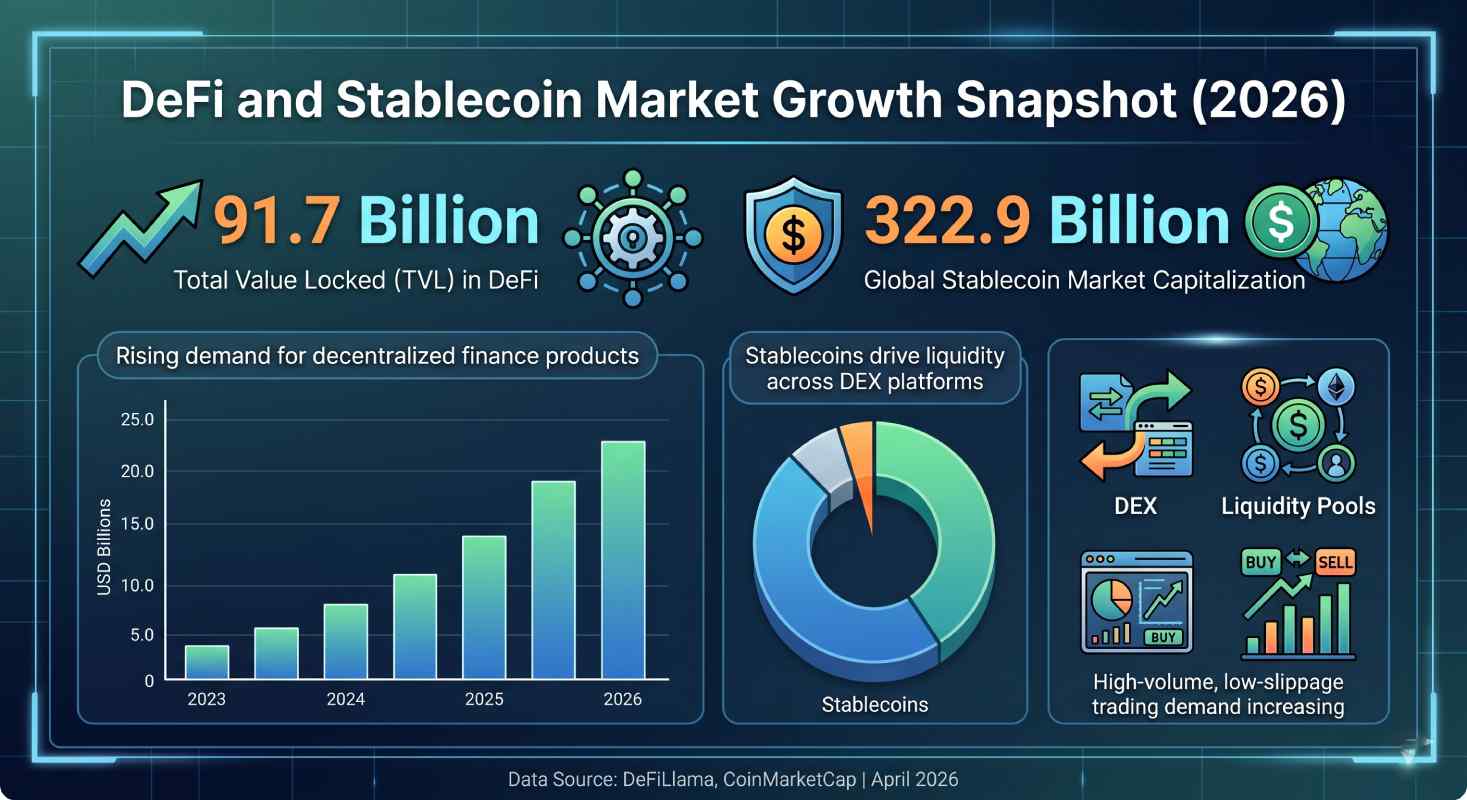
Decentralized finance has moved far beyond early experimentation. DeFiLlama reports about $91.7 billion locked across DeFi protocols, and CoinMarketCap values the stablecoin market at roughly $322.9 billion as of April 2026. These figures show clear demand for on-chain financial services and stable asset trading at scale. Businesses now view decentralized exchanges as revenue platforms, not just technical products. Curve Finance-style exchanges have gained traction in this market by focusing on stable assets, where price swings stay lower and trade execution stays predictable. This model appeals to payment firms, crypto treasuries, and institutions that need reliable liquidity for larger transactions.
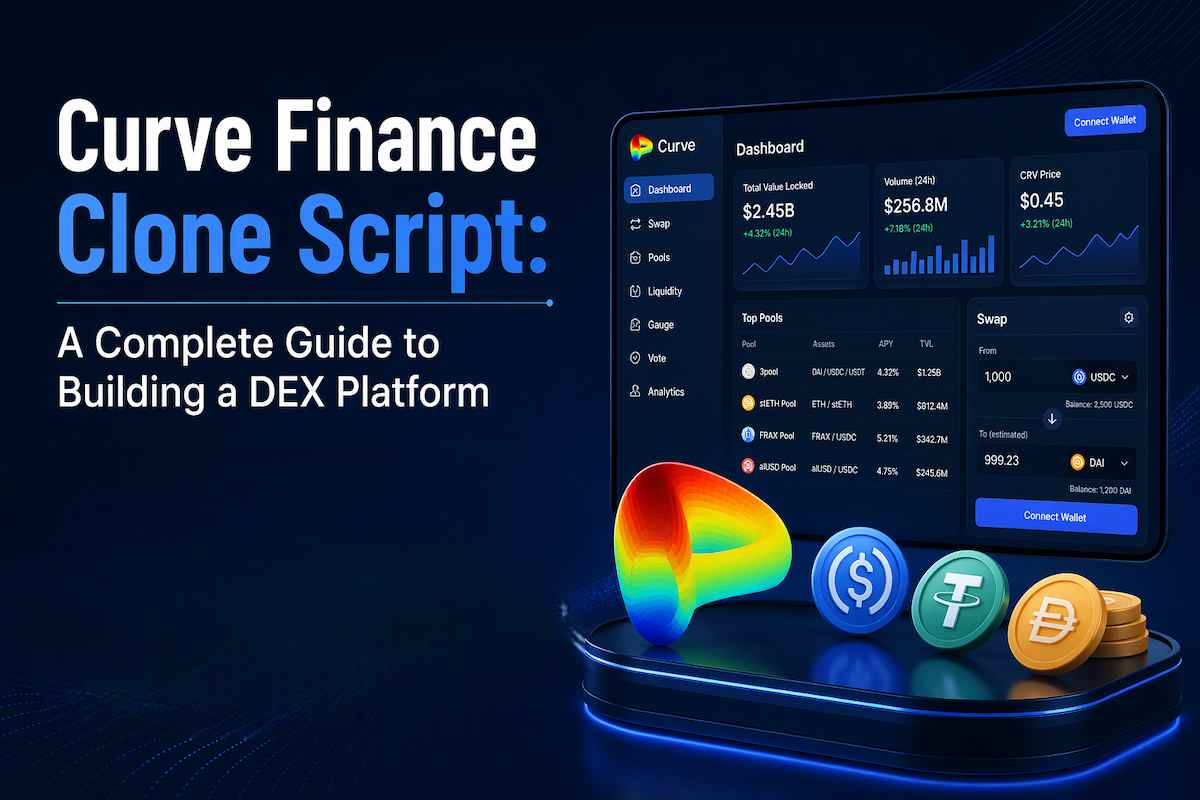
A Curve Finance clone script gives businesses a faster path into this market. Teams can launch a decentralized exchange in weeks instead of spending months on core protocol development. Costs stay lower since the smart contracts and trading logic already follow a proven structure. The business case is clear. Companies can earn from swap fees, liquidity programs, and governance token models, all built around a trading format that users already understand. For decision-makers, this creates a practical way to enter DeFi with a product that supports steady fee income, stronger liquidity, and long-term growth.
What Is Curve Finance and Why It Matters in DeFi?
Curve Finance is a decentralized exchange that runs on an automated market maker model. Users do not trade through an order book. They trade against liquidity pools held in smart contracts. Curve focuses on assets with close prices, such as USDT, USDC, DAI, and wrapped versions of major coins. That design matters. It reduces slippage on large trades and keeps fees low for users who need stable execution, not broad speculation. Curve’s docs describe the protocol as a system built for secure, efficient swaps, and DefiLlama lists it as a StableSwap DEX designed for extremely efficient stablecoin trading.
Key Features That Make Curve Finance Unique
Curve stands out through its pool design and incentive model. Its liquidity pools group similar-value assets, which helps trades clear with less price movement than general AMMs. Curve pairs that with low-fee swaps and rewards for liquidity providers. The protocol’s CRV token adds another commercial layer. Liquidity providers can earn CRV in reward programs, and token holders can take part in governance through the veCRV system described in Curve’s docs and token resources. For businesses, that means a clone script is not just a swap engine. It is a base for fee income, pool growth, staking programs, and governance-led user retention.
How Curve Differs from Other DEX Platforms
The clearest contrast appears in the pricing model. Uniswap documents its classic AMM around the constant product formula x*y=k, which works well for broad token pairs and price discovery. Curve takes a different path. It specializes in closely priced assets and uses StableSwap logic to keep trades tighter in those pools. That gives it stronger capital use for stable pairs. A business choosing between the two models should look at its user base first. A broad retail DEX may prefer a general AMM. A payments platform, stablecoin desk, or treasury-focused DeFi product will often gain more from Curve-style mechanics, where low slippage matters on every large trade.
How Curve Finance Works
Trading without an order book
Curve runs on an automated market maker model. There is no order book. Traders interact with code, and the price updates through a formula tied to the assets inside each pool. This keeps trading open at all times, as long as the pool holds enough liquidity.
The role of liquidity pools and liquidity providers
Liquidity providers supply the assets that make those trades possible. In return, they earn a share of trading fees. Curve’s own resources state that protocol revenue is collected from pool admin fees and then distributed to veCRV holders after conversion into a single token. This fee logic matters for business owners, since it turns trading activity into a direct revenue stream.
Why StableSwap matters for stable assets
StableSwap is the technical piece that makes Curve different from many other DEX models. It was designed for assets expected to hold a close price peg. That makes it a strong fit for stablecoin pairs and liquid staking pairs. The model aims to keep price movement small during swaps and to use locked capital more productively than a basic constant-product AMM in this asset class. That can reduce impermanent loss pressure in many stable-asset pools, which helps explain why DeFi teams keep using Curve-style designs.
Governance, tokenomics, and long-term platform control
Governance completes the model. Curve uses token-based voting through its DAO, and veCRV holders receive voting power and fee-linked rewards. A strong clone script copies this logic in a business-ready form. That gives operators control over emissions, pool approvals, and long-term user incentives.
Key Features of a Curve Finance Clone Script
Advanced Liquidity Pool Management
A strong Curve Finance clone script starts with pool design. Curve’s own Stableswap pool model allows up to eight tokens in one pool, which gives founders a clear template for stablecoin trading, wrapped assets, and paired liquid staking tokens. Stableswap-NG adds dynamic fees that rise with heavier pool use, so a clone can price risk in real time instead of relying on a flat fee model. That matters for businesses that want steady volume and cleaner trade execution.
Multi asset pools cut friction for traders. A user can move across related assets in one venue, and the platform keeps more value inside its own contracts. Dynamic pool balancing makes that setup more practical. It helps the pool react to changing ratios, protects depth, and keeps slippage low for pairs that should trade near the same price. Curve’s pool design was built for pegged assets, and its docs stress careful token review, oracle checks, and rebasing awareness before launch. Those details shape a safer clone from day one.
Low Slippage Trading Engine
Low slippage is the main sales point of this DEX model. Curve’s Stableswap design targets assets that stay close in price, such as USDT, USDC, and DAI, so swaps can clear with less price impact than a general purpose AMM. For a business buyer, this is not a minor feature. It drives repeat usage, larger orders, and better retention from funds, market makers, and treasury teams.
Yield Farming, Multi-Chain Reach, and Security
A commercial clone needs yield farming and staking modules. Curve’s docs show that users swap, provide liquidity, and take part in governance, which is the model most buyers want to mirror. Liquidity rewards give providers a reason to stay, and staking adds another revenue layer for the platform.
Chain reach matters too. Curve states that Ethereum is its primary network, yet its DEX is available on many chains and can now be deployed permissionlessly to any chain. For a clone, that opens room for Ethereum, BNB Chain, Polygon, and other EVM networks, with MetaMask and wallet connections built around EIP 1193 flows.
Security is the final filter. The July 30, 2023 Curve incident showed how a Vyper compiler flaw exposed pools to reentrancy attacks and led to about $70 million in losses before later recoveries trimmed the damage. Smart contract review, dependency checks, oracle validation, and external audits are not optional for a buyer facing public capital.
Step-by-Step Process to Build a Curve Finance Clone
Step 1 – Define Business Requirements
Start with the business model, not the code. Decide who the platform serves, what assets it lists, and which chains it will enter first. A treasury desk wants deep stablecoin pools. A retail DeFi app wants simple swaps and visible rewards. That choice shapes token support, fee logic, and pool structure.
Step 2 – Choose the Right Technology Stack
The next step is the stack. Ethereum is still the reference market for DeFi liquidity, yet many teams launch on lower cost EVM chains for faster user growth. Curve’s developer material centers on smart contracts and APIs, and the 2023 exploit put extra focus on contract language choice and compiler review. Teams usually compare Solidity and Vyper, then lock testing rules before a single pool goes live.
Step 3 – Develop and Customize the Clone Script
Development should adapt the base product to the brand. That includes the pool dashboard, fee settings, reward logic, admin controls, and analytics. A business buyer is not paying for a copy alone. It is paying for a product that fits its users and margin goals.
Step 4 – Integrate Wallets and APIs
Wallet and data links come next. MetaMask Connect EVM gives dapps a path into Ethereum and other EVM networks through an EIP 1193 provider. For pricing, Chainlink Data Feeds give contracts access to onchain market data from many node operators. That is useful for token pricing, rate checks, and risk controls.
Step 5 – Testing and Security Audits
Testing needs depth. Run unit tests on swaps, deposits, withdrawals, fees, and rewards. Run adversarial tests on reentrancy, oracle failure, and permission misuse. Then send the code to an outside auditor.
Step 6 – Deployment and Launch
Launch starts on mainnet only after liquidity planning is ready. Curve’s cross chain docs note that users often bridge funds into target networks, so bootstrapping early pool depth is part product work and part growth work. Without strong opening liquidity, even good code feels weak to traders.
Technology Stack & Frameworks for Curve Clone Development
Choosing the Right Blockchain Base
A Curve Finance clone stands or falls on its stack. The base layer must support EVM contracts, deep wallet support, and reliable liquidity flows. Ethereum remains the main choice for teams that want broad DeFi access, mature tooling, and strong market trust. It works well for businesses that value brand credibility and access to large liquidity pools.
BNB Smart Chain and Polygon fit teams that want lower transaction costs and faster user activity. BNB Smart Chain gives builders EVM compatibility, which reduces porting work for Ethereum-based contracts. Polygon offers the same practical advantage and supports payment-focused use cases. Both networks help new DEX platforms attract users who care about lower gas fees and quicker swaps.
Smart Contract Tools That Power the Platform
For smart contract work, Solidity stays the main language for most clone projects. It has broad developer support, large libraries, and strong community use. This makes hiring and maintenance easier for businesses that plan to grow their product over time.
Hardhat now leads many active development teams. It combines testing, deployment, debugging, and local chain simulation in one setup. Truffle still appears in older projects, but many teams now favor Hardhat for active builds and ongoing updates. A business that wants cleaner testing and smoother release cycles will usually start there.
Frontend and Backend Stack for User Experience
The app layer often pairs React.js on the front end with Node.js on the back end. React helps teams build fast and responsive trading dashboards. Node.js supports APIs, admin tools, and real-time data handling. This pairing gives DEX founders a familiar stack that developers can work with quickly.
Wallet and contract calls usually run through Web3.js or Ethers.js. Ethers.js is often preferred for cleaner contract interactions. That matters in trading apps where users expect clear balances, accurate swap previews, and fast confirmations.
DevOps and Cloud Setup for Long-Term Growth
DevOps work should include CI/CD pipelines for testing, deployment checks, and contract verification. That cuts launch risk and helps teams push updates with fewer errors. Cloud hosting on AWS or Azure gives room to scale APIs, analytics, and traffic from day one. For a commercial DEX product, this setup supports both launch speed and post-launch stability.
Use Cases of Curve Finance Clone Platforms
Stablecoin Trading Platforms
The strongest use case is stablecoin trading. Curve-style pools work best for assets that stay close in price, such as USDT, USDC, and DAI. That makes the model attractive for businesses that want a lower-risk trading environment with tighter spreads and lower slippage.
A clone script built for this purpose can target payment firms, crypto exchanges, and fintech startups. These buyers often care less about meme token traffic and more about predictable swap performance. Stablecoin-focused trading also helps create a more consistent user base.
DeFi Yield Aggregators
A second use case is the yield aggregator model. Curve-style pools can connect with lending systems, vaults, and staking products. This lets a platform combine trading fees with lending income and liquidity rewards.
That model works well for businesses that want higher user retention. Users do not just swap and leave. They can stake, farm, and earn on the same platform. This creates more activity and more revenue opportunities from one user base.
Institutional Liquidity Platforms
Institutional liquidity platforms form another strong use case. Funds, fintech firms, and treasury teams want stable execution and clear contract logic. A Curve clone can support internal stable asset swaps, partner liquidity pools, and controlled trading environments.
This matters for companies moving larger volumes. They often need better capital use, more predictable pricing, and a platform structure that can grow with added compliance features. A Curve-style DEX can meet those needs better than a general-purpose swap platform.
Cross-Border Payment Solutions
Cross-border payments are another practical fit. Stable asset pools can lower conversion costs and reduce slippage for firms moving digital dollars across regions. This makes the model useful for remittance firms, payment apps, and B2B settlement networks.
For business buyers, the appeal is direct. They can launch faster, collect trading fees, and enter a market that already understands stable-asset exchange. That gives the platform both product clarity and commercial value from the start.
Conclusion
A Curve Finance clone Script gives businesses a faster way to enter DeFi with a product model built for stablecoin trading, low slippage, and recurring fee revenue. It brings together proven AMM logic, flexible blockchain support, and clear commercial use across exchanges, payment apps, treasury systems, and institutional liquidity platforms. The value is not just in copying a known platform. The real value is in launching a focused DEX that fits a real market need and starts generating traction early. For companies that want to build a strong DeFi product with lower development time and clearer revenue paths, this model offers a practical place to start.