
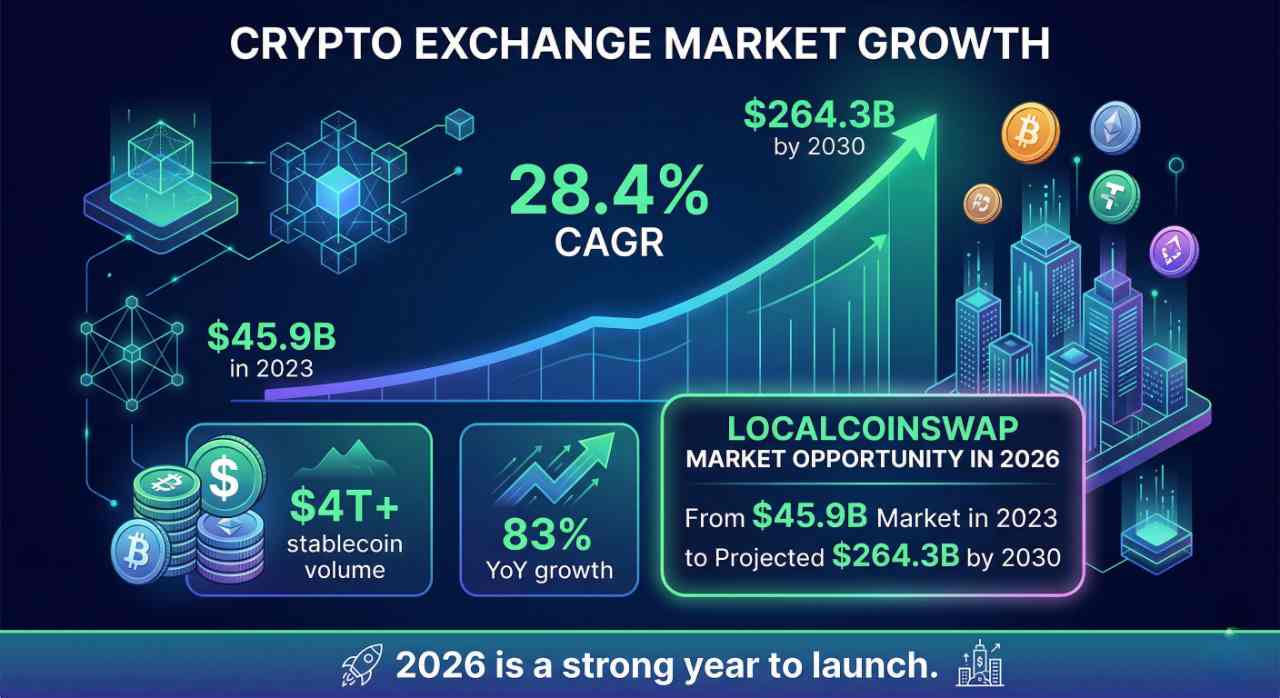
Launching a P2P crypto exchange in 2026 is a business move backed by hard market data. Grand View Research estimates that the global cryptocurrency exchange platform market was worth $45.9 billion in 2023 and is set to reach $264.3 billion by 2030, with a 28.4% compound annual growth rate. That pace shows strong demand for trading infrastructure and points to a large revenue window for new entrants. At the same time, TRM Labs found that stablecoins processed more than $4 trillion in transaction volume between January and July 2025, up 83% from the same period a year earlier. This matters for P2P exchange businesses that want to serve remittances, merchant payments, and direct crypto settlements at scale.
User demand is shifting too. More traders now want direct access, flexible payment methods, and better control over funds. That is why non-custodial and hybrid P2P platforms keep gaining ground. Platforms like LocalCoinSwap meet that need by connecting buyers and sellers directly, using escrow to protect trades, and supporting a wide range of local payment methods. For businesses, this opens a clear path to launch a secure exchange product without building every feature from scratch. A LocalCoinSwap clone script gives founders a faster route to market, lower early development costs, and a tested model they can brand, customize, and monetize.
What is a LocalCoinSwap Clone Script?
A LocalCoinSwap clone script is a pre-built P2P crypto exchange software package modeled on the core mechanics of LocalCoinSwap. It copies the business logic that powers a non-custodial marketplace, then lets the buyer rebrand the platform under a new company name, design system, and feature set. In plain terms, it is a white label crypto exchange product made for companies that want to launch a P2P trading business without starting from zero.
The flow is simple. A user signs up, completes identity checks if the platform requires them, links a wallet or uses an in-platform wallet, and posts or accepts a trade offer. The platform locks crypto in escrow, waits for payment confirmation, then releases the asset once both sides meet the trade terms. LocalCoinSwap states that its non-custodial trading uses smart contracts and custom bitcoin scripts, with features such as two-factor authentication and escrow protection. That matters for trust. In P2P trading, trust is the product as much as the trading engine itself.
This model sits between a centralized exchange and a full DEX. A centralized exchange controls user funds and trade execution inside its own system. A DEX runs trading on-chain with self-custody at its core. A hybrid P2P exchange combines parts of both. It gives users direct trading, flexible payment rails, and non-custodial or limited-custody options, but it still offers moderation, dispute tools, KYC controls, and an admin layer for the business. That balance explains its appeal in 2026. Users get flexibility. Operators get a product they can govern, monetize, and adapt to local market rules.
Key Features of a High-Quality LocalCoinSwap Clone Script
Core Trading Features
A strong LocalCoinSwap clone script must do more than copy a familiar screen layout. It needs to process trades fast, display live market activity, and support many payment paths across regions. In 2026, buyers and sellers expect a trading experience that feels instant. That starts with a stable matching engine that can handle high transaction volume without delays.
Real-time order books and live pricing are central to that experience. Users want to see available offers, price movement, and trade updates without refreshing the page. Multi-crypto support is now basic. Multi-fiat support matters just as much. A business that wants to serve real users must support local currencies, bank transfers, e-wallets, and region-specific payment systems. This gives the platform wider market reach and helps attract traders from both developed and emerging markets.
Security Infrastructure
Security is one of the first things business buyers review before choosing a clone script. Two-factor authentication adds an extra login layer and blocks many common account attacks. Cold wallet storage protects reserve funds by keeping most assets offline. This reduces exposure to hot wallet breaches and limits the damage from direct attacks on online systems.
Multi-signature wallet controls add another check before funds move. Encryption protects user records, wallet data, and internal platform activity. Fraud detection has also become more important. A modern exchange script should flag unusual login behavior, payment mismatches, suspicious wallet movement, and account abuse patterns. These controls help reduce scam attempts and improve trust across the platform.
P2P Exchange Capabilities
Peer-to-peer trading works only when both sides trust the process. That is why escrow is the most important P2P feature in a LocalCoinSwap clone script. The platform must hold crypto in escrow until payment is confirmed and both trade conditions are met. This protects buyers and sellers during direct trades.
In-platform chat is another core feature. It gives both parties a clear space to discuss payment steps, timing, and proof of transfer. Reputation tools matter just as much. A visible rating system, completed trade count, and user feedback record help traders judge risk before they enter a deal. These trust signals support repeat usage and reduce friction across the marketplace.
Admin and Business Controls
A business-ready script must give operators strong internal control. The admin dashboard should show active trades, user activity, dispute status, payment patterns, and revenue data in one place. This helps teams act fast when issues appear.
Fee control is another revenue tool. The platform should allow flexible commission settings for trading, withdrawals, token listings, and premium services. A dispute management system is also essential. Admins need access to trade logs, chat history, payment proof, and action records. These details help resolve conflicts fairly and protect platform credibility.
Compliance and Regulatory Tools
Compliance features are no longer optional for crypto exchange businesses. A quality clone script must include KYC and AML modules from the start. Identity checks help reduce fake accounts, and transaction screening helps detect risky activity early.
Geo-restriction tools let the business block access in restricted markets or apply country-specific controls. Reporting tools help teams prepare records for audits, reviews, and internal checks. Audit trails are critical here. Every login, trade action, payment event, dispute step, and wallet movement should be logged. This creates a clear legal record and supports better platform governance.
Benefits of Using a LocalCoinSwap Clone Script for Businesses
Faster Time-to-Market
One of the biggest benefits of a LocalCoinSwap clone script is speed. Building a crypto exchange from scratch can take many months. A clone script gives businesses a working base product with the key systems already in place. That can cut launch time down to a few weeks.
This matters for startups and established firms alike. Crypto markets move fast. User demand can shift across regions in a short period. A faster launch helps businesses enter the market early, test demand, and start building transaction volume without waiting through a long development cycle.
Cost-Effective Development
Cost is the next major reason businesses choose a clone script. A custom P2P exchange requires large spending across design, backend engineering, wallet architecture, testing, security review, and compliance setup. That process can stretch budgets quickly.
A clone script lowers those costs by reusing proven components. This makes it a practical option for startups with limited budgets and for larger firms that want to enter crypto without funding a full custom build. The lower starting cost also leaves more room for branding, marketing, regional expansion, and post-launch support.
Proven Business Model
A LocalCoinSwap clone script is based on a model that users already understand. P2P trading, escrow-backed transactions, trader chat, and ratings have a clear market fit. That reduces product risk for new exchange owners.
Familiar user flows also help with adoption. New users do not need to learn a completely new system. They can browse offers, start a trade, chat with the counterparty, complete payment, and review the outcome in a format they already recognize. This lowers friction and helps businesses convert signups into active traders faster.
Full Customization and Scalability
The strongest clone scripts give businesses room to grow beyond the base model. Owners can add staking, NFT support, DeFi access, language packs, local payment gateways, and region-specific compliance features. That flexibility helps the business serve a focused niche or expand into new markets over time.
Scalability matters just as much. The platform should support higher user volume, more payment methods, more trade pairs, and larger admin workloads as growth continues. Hybrid P2P exchanges stand out in 2026 because they combine direct user trading with platform-led escrow, moderation, and compliance control. This gives users more freedom than a fully custodial exchange and gives businesses more control than a purely decentralized front end.
How to Launch a LocalCoinSwap Clone Platform (Step-by-Step)
Step 1: Market Research and Niche Selection
A P2P exchange starts with a clear market. You need to pick one region, one buyer group, and a short list of payment methods. That choice shapes every later decision. Chainalysis reported that India and the United States led global crypto adoption in 2025, and TRM Labs found strong growth across South Asia, with India, Pakistan, and the Philippines among the top markets by adoption. That makes regional demand research a real business task, not a branding exercise.
Start with local trade behavior. In some markets, bank transfer wins. In others, traders want cash deposits, mobile wallets, or domestic payment rails. LocalCoinSwap promotes hundreds of payment methods on its marketplace, which shows how much payment choice shapes P2P volume and user trust. Build your first release around the methods your target users already know.
Step 2: Choose the Right Clone Script Provider
The script provider sets the base quality of your exchange. Review the code structure, escrow logic, admin controls, and support terms. A weak base script creates long delays later. A strong one cuts custom work and lowers launch risk.
Check three areas first. Security comes first, with escrow, wallet controls, encryption, and admin permissions. Growth capacity comes next, so the platform can handle more users and more trades. Custom work comes last, with room for local branding, payment modules, fees, and dispute flows. LocalCoinSwap’s own marketplace model centers on non-custodial trading with escrow, so any clone product that lacks those core mechanics misses the point of the business model.
Step 3: Customize the Platform
A clone script is only the base layer. Your brand, fee model, trade flow, and trust signals make the platform saleable. Keep the home page simple. Show supported coins, payment types, seller ratings, and dispute rules. Buyers need fast trust signals. Sellers need clear terms and low friction.
Feature changes should match your niche. A regional cash market may need map-based trade listings. A remittance-focused exchange may need stablecoin pairs and faster payment checks. A B2B desk may need higher limits, manual review, and account tiers.
Step 4: Integrate Wallets and Payment Gateways
Wallet setup should match the assets you plan to list. Many teams begin with BTC, ETH, USDT, and one or two local favorites. Fiat support needs local banking links, payment APIs, or manual settlement tools. For P2P trade, payment proof and release logic matter just as much as wallet support.
Step 5: Implement Security and Compliance
Security and compliance sit at the center of a 2026 exchange launch. FATF states that virtual asset service providers must collect and transmit sender and receiver data under the Travel Rule, and its 2025 updates pushed for tighter payment transparency and stronger supervision. Your exchange needs KYC, AML checks, case logging, risk scoring, and clear escalation paths from day one.
Step 6: Testing and Deployment
Run wallet tests, trade flow tests, dispute tests, and load tests. Check release timing, failed payments, duplicate orders, and blocked accounts. Then deploy in stages. Start with one region and a short asset list. That gives your team room to fix gaps before wider rollout.
Step 7: Launch and Marketing
Launch with search traffic, trader outreach, and community trust. Publish pages for country terms, payment terms, and coin pairs. Work with creators who already speak to crypto traders in your target region. Seed your first offers, reward early sellers, and watch completion rate, dispute rate, and repeat trade rate in the first 90 days.
Technology Stack Behind LocalCoinSwap Clone Script
Hybrid P2P models lead in 2026 for one clear reason. They give users direct trade choice, but they still keep platform-level escrow and dispute control. LocalCoinSwap describes its marketplace as non-custodial, with users trading local currency directly and the crypto side protected by escrow. That mix appeals to users who want more control and to operators who need a business they can govern.
Backend Technologies
Node.js fits real-time trade events, notifications, and API-heavy services. Python fits analytics, fraud checks, and admin tooling. Go fits high-concurrency trade services and queue workers. Many exchange teams split these roles across services instead of forcing one language to handle every task. Node’s official crypto module supports hashing, signing, and encryption work inside backend services, which makes it useful for exchange components that need secure message handling.
Frontend Technologies
React works well for fast, component-based trading screens, and React’s official docs describe UI construction through reusable components. Angular is a full web framework built for reliable, scalable apps, which suits admin panels and large internal dashboards. The right pick depends on team skill and release speed.
Blockchain Integration
Ethereum remains the standard for broad token support. BNB Smart Chain often fits lower-fee retail trading. Solana appeals to platforms that want high-speed transaction handling, and Solana’s docs position it as a high-performance blockchain for mass adoption. A multi-chain exchange draws more traders and gives the business more room to price fees by network demand.
Database, Infrastructure, and Third-Party Services
PostgreSQL is a strong fit for order, user, and compliance records, and its official docs stress reliability for committed transactions. MongoDB often fits activity logs and flexible metadata. AWS and Azure are common hosting choices for autoscaling, backups, and regional deployment. Third-party services usually cover KYC checks, fiat payment APIs, and liquidity feeds for pricing and market depth.
Industry Use Cases
A LocalCoinSwap clone script fits more than one business model. The strongest demand in 2026 comes from firms that want direct crypto trading, local payment support, and tighter control over fees and user flows. That demand tracks with wider market growth. Chainalysis placed India and the United States at the top of its 2025 global crypto adoption index, which points to strong user activity in both retail and business markets. FATF has kept pressure on virtual asset firms to build licensing, KYC, AML, and Travel Rule controls into live products, so buyers now look for platforms that combine speed with compliance from day one.
Crypto Startups
For crypto startups, the clearest use case is a regional P2P exchange. This model works well in markets where users prefer domestic payment rails, local language support, and direct cash settlement. A startup can launch with a narrow scope, such as USDT trades in one country with bank transfer and mobile wallet support, then grow into more pairs and more payment methods after the first user base forms. That path cuts build time and gives founders a direct way to test fees, dispute handling, and seller liquidity in one market before wider expansion. LocalCoinSwap itself centers its offer on local currency trading and broad payment choice, which shows why regional fit matters so much in P2P exchange design.
Fintech Companies
Fintech companies use clone platforms to add crypto trading without building a full exchange stack from scratch. This works best for apps that already handle wallets, transfers, remittances, or stored balance products. A fintech can plug in a P2P trading layer and offer crypto buy and sell access under one brand. That gives the company a new fee stream and stronger user retention. Stablecoins push this trend forward. Visa states that stablecoins create new revenue streams and new money movement models for banks, wallets, and fintech firms. Its stablecoin materials push a clear message to financial firms in 2025 and 2026: build a stablecoin plan now or risk missing the shift in payment behavior.
Payment Service Providers
Payment service providers can use a LocalCoinSwap clone script as a bridge between fiat payment systems and crypto settlement. This model fits remittance firms, merchant payment gateways, and card-linked payment platforms. A provider can support merchant settlement in stablecoins, offer currency conversion inside the platform, and keep P2P trading open for retail users who want local exits and entries. FATF’s 2026 report on stablecoins and unhosted wallets states that payment service providers and card networks can support stablecoin payments for goods, services, and remittances by offering merchant infrastructure. Visa has already expanded stablecoin-linked card work to more than 100 countries through its Bridge partnership, which shows that payment firms now treat onchain settlement as a live business line, not a pilot concept.
Enterprises and Investment Firms
Enterprises and investment firms often need a private trading environment instead of a public marketplace. A clone script can serve that need with invite-only access, custom fee logic, internal wallet controls, and limited asset support. This setup fits OTC desks, treasury operations, digital asset funds, and corporate groups that want controlled trading between approved participants. The interest is no longer theoretical. BlackRock continues to market bitcoin exposure through IBIT to financial professionals and investors, which reflects deeper institutional acceptance of digital assets in regulated channels. That shift creates room for private crypto trading ecosystems that sit inside firms, funds, and partner networks.
These use cases all point to the same commercial truth. A LocalCoinSwap clone script is not just a startup product. It is a fast entry model for firms that want local market reach, new transaction revenue, and tighter control over crypto trade operations in 2026.