
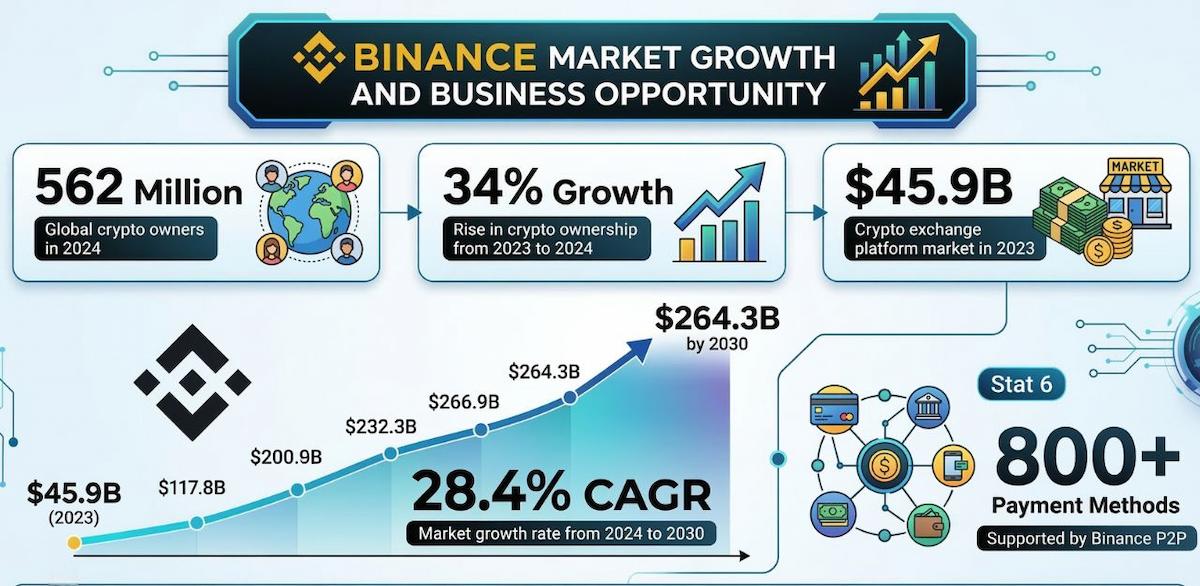
Crypto trading is no longer a niche market. Triple-A estimated 562 million digital currency owners worldwide in 2024, equal to 6.8% of the global population, up 34% from 2023. Chainalysis reported that India and the United States led global crypto adoption in 2025, with strong retail demand across Asia, Latin America, and Africa. The platform market is growing at the same pace. Grand View Research valued the global cryptocurrency exchange platform market at $45.9 billion in 2023 and projects it will reach $264.3 billion by 2030, with a 28.4% CAGR from 2024 to 2030. For business owners, these numbers point to a clear revenue opportunity. More users now want digital assets, local payment choices, and direct trading models that work across different regions and banking systems. A Binance P2P clone script fits into that demand by giving firms a faster way to enter a fast-growing exchange market with lower early development cost.
P2P exchanges work well in this setting because they let buyers and sellers trade directly, choose their own prices, and settle deals through local payment methods. Binance states that its P2P marketplace supports 800+ payment methods and 100+ fiat currencies, which explains why this model works across varied markets. Escrow adds trust by holding the crypto until both parties confirm the trade. That structure gives users more control and gives platform owners a practical model for markets where card access, banking rails, or centralized exchange liquidity can vary from country to country. Building this from scratch takes time, capital, and technical depth across wallets, escrow logic, KYC, admin controls, and security systems. A Binance P2P clone script gives founders a ready-made base with core exchange features, brand customization, and a shorter path to launch, test demand, and grow revenue.
What is a Binance P2P Clone Script?
Definition and Core Concept
A Binance P2P clone script is pre-built cryptocurrency exchange software that mirrors the core structure of Binance-style trading. The script usually includes user onboarding, wallet access, order handling, trade history, admin controls, and a P2P module. Openware notes that white label exchanges are customizable exchange platforms, and vendor sources describe Binance clone scripts in the same way: a launch-ready base that businesses can brand, edit, and extend for their own market. The value is not copy-paste imitation alone. The value lies in starting with a tested product skeleton, then shaping it around a target region, asset list, fee model, and payment stack.
How P2P Crypto Trading Works
The P2P module handles the part users care about most. A seller posts an offer. A buyer picks that offer and sends payment through the listed method. Binance states that the platform places the seller’s crypto in escrow once the order starts. After the seller confirms payment receipt, the crypto moves to the buyer. That flow reduces counterparty risk and gives the exchange a clear dispute process. Payment confirmation, order status tracking, trade limits, and identity checks sit around that core loop. Each part supports trust, speed, and repeat use.
Binance Model as a Proven Framework
Many businesses choose the Binance model for one reason. Users already understand it. The interface, trading logic, and escrow-led P2P flow are familiar to a global crypto audience. That lowers the learning curve for new customers and shortens the path from sign-up to first trade. A clone script gives operators a commercial shortcut. They start with a format the market already recognizes, then build a stronger local brand on top of it.
Market Opportunity for P2P Crypto Exchange Platforms
Growth of Cryptocurrency Trading Worldwide
The market for crypto trading keeps getting larger, and that growth creates room for new P2P exchanges. Triple-A estimated that 562 million people owned digital currencies in 2024, equal to 6.8 percent of the global population. That figure rose 34 percent from 420 million in 2023. Chainalysis reported that Central and Southern Asia and Oceania led its 2024 Global Crypto Adoption Index, which shows strong retail demand across emerging and high-volume markets.
This matters for business buyers. A larger user base means more traders, more local payment needs, and more demand for platforms that support direct crypto deals in local currency. P2P trading fits that demand well. Binance states that its P2P marketplace supports more than 125 fiat currencies and over 1,000 payment methods. That range shows why users pick P2P desks for local access, not just for price.
Why P2P Exchanges Are Disrupting Traditional Trading Platforms
P2P exchanges attract users with lower barriers to entry. Users can buy and sell directly with each other instead of routing every trade through a standard exchange book. Binance explains that P2P platforms connect buyers and sellers and protect trades with escrow, rating systems, and dispute resolution. That model gives users more control over price, payment method, and settlement speed.
The fiat gateway matters just as much as the crypto trade. In many regions, users want bank transfer, mobile wallet, or local payment rails, not cards or SWIFT. Binance says its P2P desk lets users trade in local currency with escrow protection, which is one reason P2P trading keeps growing in markets with banking friction or limited card access.
Business Opportunities for Startups and Enterprises
For startups, a P2P platform opens the door to niche plays. A company can target remittance corridors, stablecoin settlement, or a single region with strong crypto demand. Latin America, for example, placed four countries in Chainalysis’s 2024 top 20 adoption ranking, with stablecoin use gaining ground across the region. That type of market gives founders a clear entry point for local P2P trading.
Larger firms can build broader products around the exchange itself. A regional P2P desk can sit inside a fintech app, a payments business, or a digital banking product. The business case is simple. More crypto owners now want direct, low-friction ways to move value across borders, hold stable assets, and convert fiat to crypto without a long chain of middlemen
Key Features of a Binance P2P Clone Script
Core Exchange Features
A strong Binance P2P clone script starts with the basics. Users need a smooth sign-up flow, secure login, and fast identity checks. The platform should support email, phone, and two-factor authentication. A clean onboarding process helps reduce drop-offs and builds trust from the first session.
The trading engine is just as important. It must process orders fast and keep pricing data accurate. Users expect stable performance during peak trading hours. Multi-currency wallet support gives the platform more value. Traders want to store, send, and receive major coins, stablecoins, and local fiat-linked assets in one place.
P2P Trading Features
The P2P module drives the platform’s core value. Escrow protection holds the seller’s crypto until the buyer completes payment. This step reduces fraud and gives both sides more confidence during the trade. It is one of the main reasons users choose P2P exchanges over informal over-the-counter deals.
Buy and sell ad posting is another key feature. Traders should be able to set prices, choose payment methods, add trade limits, and define order terms. A flexible ad system gives users more control and helps the marketplace grow faster. Support for many payment methods matters too. Bank transfers, mobile wallets, and region-based payment channels help the platform attract users from different markets.
Advanced Trading Capabilities
Many exchange owners want more than basic P2P trading. A good clone script can include spot trading for users who want a standard exchange experience. This creates another revenue stream through trading fees and keeps users inside one platform instead of pushing them to other apps.
Some businesses add margin or futures modules at a later stage. These features fit traders who want more advanced tools. Charting tools, live market data, and order history reports help users make better decisions. Clear charts and trade records can increase platform activity and improve retention.
Security Infrastructure
Security sits at the center of every exchange product. Two-factor authentication adds a basic layer of account safety. Anti-phishing codes help users confirm that official emails come from the platform. These small checks can prevent account theft and fake support scams.
KYC and AML checks protect the business from compliance risks and bad actors. A well-built script should support ID checks, risk flags, and transaction monitoring. Wallet security matters just as much. Multi-signature wallet controls and DDoS protection help keep funds and platform access safe. For any business entering crypto exchange development, these are core product features, not optional extras.
Revenue Models for a Binance P2P Crypto Exchange
Trading Fees
Trading fees are the main income source for most exchanges. Each completed trade brings a small commission. That model creates steady revenue once trading volume grows.
A P2P exchange can charge the buyer, the seller, or the merchant who posts the ad. Some platforms keep P2P fees low at launch to attract users. Then they earn more from repeat trades and added services. This model works well for startups that want fast user growth with a clear revenue base.
Token Listing Fees
Token listing fees can bring strong income after the platform gains users and trust. New crypto projects pay to list their tokens, reach traders, and build market activity.
The fee often covers wallet setup, contract review, and launch support. This model becomes more valuable after the exchange has active users and strong daily trading. Projects pay for access to real market demand, not just a listing page.
Withdrawal and Deposit Fees
Wallet operations can add steady income. Exchanges often charge a fee for crypto withdrawals. Fiat deposits or withdrawals can also carry service charges through payment providers.
These fees look small per transaction, but they grow with user activity. For a busy exchange, wallet fees can become a reliable part of monthly revenue.
Premium Trading Features
Premium features help raise revenue per user. These features include margin trading, futures, copy trading, and advanced charts. They attract active traders who trade more often and stay longer on the platform.
This creates a strong business model. P2P trading brings users in. Premium tools create more ways to earn from those users. For many exchanges, this mix improves long term growth.
Advertising and Partnerships
Advertising and partnerships add another revenue stream. Exchanges can sell featured token spots, merchant promotions, and sponsored campaign placements. Payment firms, wallet brands, and token issuers often pay for this visibility.
This works best on platforms with strong traffic and user trust. Security also matters here. Multi-signature wallets protect funds, and anti-DDoS systems keep the platform online. That helps the exchange build trust with users and business partners, which supports more paid partnerships and repeat deals.
Conclusion
A Binance P2P clone script gives businesses a fast way to enter the crypto trading market with a proven model, clear revenue paths, and room for custom growth. It helps reduce build time, lowers development cost, and supports key features such as P2P trading, wallet management, premium tools, and platform security. For startups and established firms alike, this model offers a practical way to launch a crypto exchange that can attract users, earn steady transaction income, and grow with market demand.