
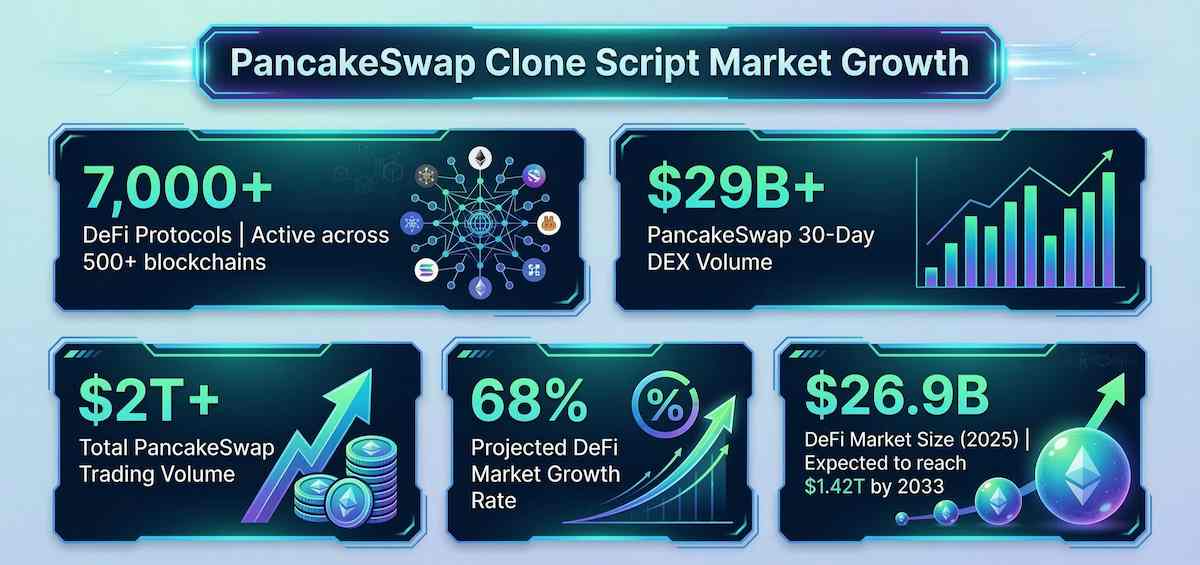
Decentralized finance has moved far past the early trial stage. DefiLlama now tracks more than 7,000 DeFi protocols across 500-plus chains, which shows how active and crowded this market has become. PancakeSwap stands near the front of that race. DefiLlama lists about $29.3 billion in 30-day DEX volume for PancakeSwap and about $2.045 trillion in cumulative DEX volume, which points to real trading demand and long-term user activity. The wider market data supports that trend. Grand View Research estimates the global DeFi market at $26.94 billion in 2025 and projects it to reach $1.42 trillion by 2033, with a 68.2 percent CAGR from 2026 to 2033. It also values the decentralized exchange segment at $4.49 billion in 2025 and projects it to grow to $242.03 billion by 2033, with a 68.7 percent CAGR.
For businesses, those numbers show a strong case for launching a DEX with a PancakeSwap Clone Scriptrd. PancakeSwap changed crypto trading by making liquidity automated and open to any wallet holder, and its model gives operators room to earn from swap fees, liquidity activity, and token ecosystem growth. This reduces the need for a central order book, custodial user accounts, or a large market-making desk at launch. Building that system from scratch still takes major time, budget, and specialist talent, which is why many firms choose a white-label clone model instead. It gives them a faster path to market with a trading structure users already understand, and it places them inside a sector where the broader crypto exchange platform market is projected to reach $264.3 billion by 2030.
What Is a DeFi Trading Platform?
A DeFi trading platform is a decentralized exchange that runs on smart contracts. Users trade from their own wallets, which means they keep control of their funds. This is one of the main differences between a DEX and a centralized exchange. A centralized platform holds user assets. A DEX does not.
That self-custody model appeals to traders who want more control and more transparency. It also helps businesses build a trading platform without running a full custodial system.
How Automated Market Makers Power DeFi Exchanges
Most DeFi exchanges use an automated market maker model. Trades happen through liquidity pools, not matched buy and sell orders. These pools hold token pairs locked in smart contracts. Liquidity providers add funds to the pools and earn a share of trading fees.
This model makes trading easier to launch and maintain. It removes the need for a traditional market structure and gives new platforms a clear way to support token swaps from day one.
Why DeFi Exchanges Are Gaining More Users
DeFi exchanges keep growing for simple reasons. They offer transparent on-chain trading, quick access through wallets, and lower barriers for global users. People can trade without long sign-up flows or handing control of assets to a third party.
For businesses, this creates a strong case for using a PancakeSwap clone script. It offers a proven exchange model, faster entry into the market, and a practical way to launch a scalable DeFi product.
Why Should a Business Create a DEX Exchange Using a PancakeSwap Clone Script?
Decentralized finance (DeFi) is rapidly transforming the financial industry, and decentralized exchanges (DEXs) are becoming essential platforms for crypto trading. Businesses looking to enter this growing market often choose a PancakeSwap clone script, a ready-made solution that replicates the core features of the PancakeSwap exchange and enables quick deployment of a DeFi trading platform.
Faster Time-to-Market
Developing a DEX from scratch requires extensive time and technical resources. A PancakeSwap clone script provides a pre-built infrastructure with features like token swapping, liquidity pools, and smart contracts, allowing businesses to launch their platform much faster.
Cost-Effective Development
Building a decentralized exchange independently can be expensive. Using a clone script reduces development costs while still allowing customization, making it an efficient solution for startups and enterprises.
Proven Business Model
PancakeSwap’s automated market maker (AMM) model has proven successful in enabling decentralized token trading through liquidity pools. A clone script adopts this tested framework, helping businesses reduce risks and deliver a reliable trading experience.
Built-In DeFi Features
Most PancakeSwap clone scripts include essential DeFi functionalities such as token swaps, staking, liquidity farming, multi-wallet integration, and governance mechanisms, helping businesses create a complete DeFi ecosystem.
Scalability and Revenue Opportunities
A PancakeSwap clone platform can be customized and expanded with additional features like NFT marketplaces or launchpads. Businesses can also generate revenue through trading fees, liquidity pool fees, and token listing charges.
Secure and Transparent Transactions
With smart contract-based automation, transactions on the platform are transparent and secure, ensuring trust and reliability for users.
Growing Demand for DEX Platforms
As more users prefer non-custodial trading platforms, launching a DEX using a PancakeSwap clone script allows businesses to tap into the rapidly expanding DeFi trading market and establish a strong presence in the blockchain ecosystem.
What Is a PancakeSwap Clone Script?
A PancakeSwap clone script is a ready-made software package for building a decentralized exchange like PancakeSwap. It includes the main features needed to run a DeFi trading platform, such as token swaps, liquidity pools, staking, and yield farming.
Most clone scripts are built on BNB Smart Chain or other EVM-compatible networks. This helps businesses launch faster with lower development effort. Instead of building every feature from the ground up, companies can start with a working base and customize the platform to match their brand, business model, and market goals.
For startups and enterprises, this reduces both cost and launch time. It also gives them a proven DEX model that users already understand.
Why Businesses Prefer PancakeSwap-Based DEX Solutions
Businesses choose PancakeSwap-based DEX platforms for simple reasons. They can enter the DeFi market faster, spend less on development, and use a product model that already has strong market demand. These platforms also support growth through wallet integration, liquidity tools, and scalable trading features.
Step-by-Step Process to Launch a DeFi Exchange Using a PancakeSwap Clone Script
Step 1 – Define Your DeFi Business Model
Start with a clear business plan. Decide who the platform serves. A retail DEX needs easy swaps, low fees, and simple wallet access. A project-based DEX needs strong liquidity for a few token pairs. This choice shapes fees, rewards, and listings.
Tokenomics matters from day one. A PancakeSwap clone script uses liquidity pools, swap fees, and user rewards. You need to set fee tiers, reward terms, treasury share, and launch pairs early. This helps you control costs and attract users.
Network choice matters too. Many businesses start with BNB Smart Chain since fees are lower and transactions are faster. That makes it a practical fit for swaps, staking, and farming.
Step 2 – Choose the Right Blockchain Network
BNB Smart Chain is a common choice for fast and low-cost DeFi trading. Ethereum has strong trust and a large DeFi user base, but gas fees can rise fast. Polygon gives lower costs and EVM support, which helps teams that want flexibility.
For most startups, one chain is enough at launch. Multi-chain support can come later. A single-chain launch keeps development, liquidity, and support easier to manage.
Step 3 – Smart Contract Development and Customization
The smart contract layer handles the main platform logic. This includes token swaps, liquidity pools, staking rules, and governance features. At launch, keep the contract set small and focused.
The goal is simple. Build clean swap logic, secure pool contracts, and limited admin control. Then add more advanced features after the platform gains traction.
Step 4 – UI/UX Customization
The user interface shapes trust. The dashboard should show token prices, pool data, rewards, fees, and wallet balances in a clear way. The trading page should make swaps quick and easy.
Wallet integration is also important. Support common wallets such as MetaMask and WalletConnect. A simple and familiar interface helps users start trading with less friction.
Step 5 – Security Audits and Testing
Security is a core part of launch planning. A DeFi exchange handles user funds, so smart contracts must be audited before mainnet release. Teams should fix issues, test again, and then review the full system.
Security checks should include contract audits, penetration tests, and bug bounty programs. This lowers risk and builds trust with users and investors.
Step 6 – Platform Deployment
Deployment starts with testnet validation. After testing, the exchange moves to mainnet with a clear liquidity plan. The first pools should have enough capital to support trading activity.
Start with a small number of verified tokens. Publish your fee rules, reward model, and treasury structure before launch. Clear rules help users trust the platform.
Step 7 – Marketing and Community Growth
Growth starts with a strong user base. Token rewards can bring in early users, but short-term rewards alone do not build long-term volume. Campaigns should focus on deeper liquidity, repeat trading, and active governance.
Community growth also needs regular updates, clear support, and transparent communication. Users stay longer when they understand the platform and trust the team behind it.
A PancakeSwap clone script helps businesses launch faster, but speed alone is not enough. A strong DeFi exchange needs clear tokenomics, secure contracts, simple design, and active community support.
How Much Does It Cost to Create a PancakeSwap Clone Script?
The cost to build a PancakeSwap clone script usually falls between $25,000 and $120,000 for a business-grade product. The lower end fits a basic MVP with token swaps, wallet login, simple pools, and one-chain deployment. The higher end fits a branded DEX with custom tokenomics, farming, staking, governance, analytics, audits, and post-launch support. Current market data from Clutch shows many blockchain development firms charge $25 to $49 per hour, and reviewed blockchain projects often fall in the $10,000 to $49,999 range for smaller scopes. Web3 firms listed on Clutch also show minimum project sizes of $25,000+ for deeper builds.
Security affects both cost and timeline. Hacken says a smart contract audit often takes 5 to 15 business days, which makes audits a real budget line, not a final checkbox. For most teams, the final budget rises with the number of smart contracts, chain count, custom UI work, admin controls, analytics, and audit rounds.
Conclusion