

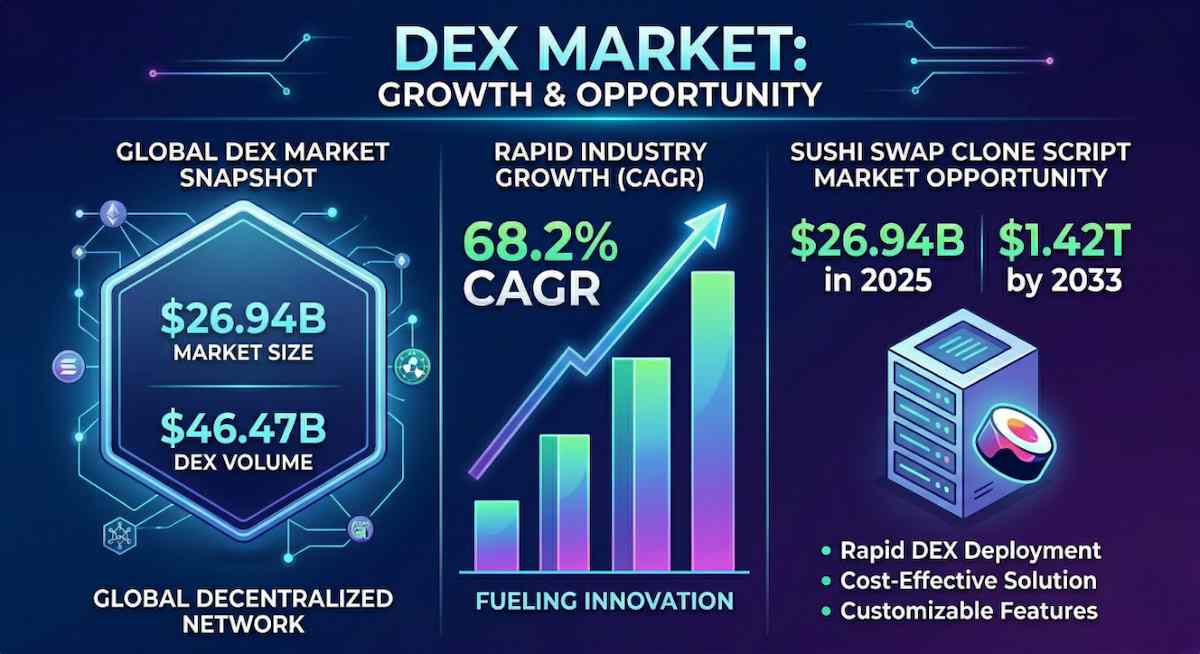
Decentralized finance is no longer a side topic in crypto. It is now a fast-growing business category with clear market demand. Grand View Research values the global DeFi market at $26.94 billion in 2025 and projects it to reach $1.42 trillion by 2033. The firm places the expected annual growth rate at 68.2% from 2026 through 2033. DeFiLlama tracks more than 7,000 DeFi protocols across 500-plus chains, which shows broad product expansion across the market. Uniswap adds another strong signal for business teams. DeFiLlama lists roughly $46.47 billion in 30-day volume for the protocol, along with about $3.6 trillion in cumulative volume. These figures show that decentralized exchange models can support large trading activity and fee-based income at scale.
SushiSwap helped push this model into wider use. Its AMM lets users trade through liquidity pools instead of a central order book. Liquidity providers add assets to those pools and earn a share of trading fees. That structure gives users direct control over assets and places trade execution on smart contracts. For companies, this creates a clear product template with built-in trading logic, token incentives, and room for custom branding. Security adds more weight to the business case. Chainalysis reported $2.2 billion stolen from crypto platforms in 2024. By mid-2025, stolen funds had already reached more than $2.17 billion, which had already passed the full 2024 total. This pressure has pushed many firms toward tested exchange frameworks, audited contracts, and faster launch models such as SushiSwap clone scripts.
What Is a SushiSwap Clone Script?
A SushiSwap clone script is pre-built software that copies the main features of SushiSwap and leaves room for custom branding and feature edits. At its core, it supports peer-to-peer token swaps through smart contracts and AMM logic. In plain terms, users trade against liquidity pools, not against matching orders from other traders.
That structure sets it apart from a traditional exchange. A regular crypto exchange often holds user funds, manages the order book, and processes trade matching on its own system. A SushiSwap-style DEX does not follow that model. Users connect wallets, approve trades on chain, and keep custody of their assets through the full transaction flow. The result is clearer auditability and less dependence on a central operator.
The link to Uniswap matters too. Sushi began as a fork of Uniswap, then added its own governance token, staking, and farm-based rewards. Sushi’s own docs state that SUSHI supports governance rights and value accrual through staking rewards and protocol fee buybacks. For a business reader, that matters less as brand trivia and more as product strategy. A SushiSwap clone is not just a swap engine. It is a base model for a revenue-led DEX that can include community voting, liquidity incentives, and long-term user retention.
Market Opportunity for Decentralized Exchanges
Growth of the DeFi Ecosystem
Decentralized exchanges now sit at the center of DeFi growth. DefiLlama tracks more than 7,000 DeFi protocols across 500 plus chains, which shows how fast blockchain finance has spread beyond early crypto users. Trading activity backs that up. CoinGecko reports that tracked decentralized exchanges handled about $5.69 billion in 24 hour volume at the time of writing, and its 2026 market report says DEX spot market share doubled to 14 percent since 2024. For a business reader, that matters for one simple reason. User demand already exists, and the market no longer treats DEX products as a niche experiment.
Why Businesses Are Launching DEX Platforms
Firms are launching DEX platforms for clear commercial reasons. The model removes the central middle layer that stores user funds, matches orders, and approves listings. That shift can lower operating overhead and reduce custody risk. It can open fresh income channels too. A DEX can collect swap fees, pool fees, token listing revenue, and staking income. Sushi’s own docs show how liquidity providers earn fee shares and token rewards, which gives businesses a direct model for user growth and retention.
Target Industries and Use Cases
The value of a DEX does not stop with crypto native firms. Fintech startups use DEX products to enter crypto markets fast. Existing exchanges add non custodial trading to widen their product mix. NFT marketplaces use token swaps to support creator economies. Web3 gaming projects build in game token markets with direct wallet access. Global reach adds another business benefit. Users can trade from any supported region with a wallet and an internet connection, which expands the addressable market from day one.
Key Features of a SushiSwap Clone Script
Automated Market Maker Protocol
A strong SushiSwap clone script starts with the AMM model. Sushi states that its AMM uses liquidity pools instead of order books, so traders swap against pooled assets rather than wait for a matching buyer or seller. That design matters for launch speed and market depth. The pricing model often follows the constant product formula, known as x multiplied by y equals k. This formula adjusts token prices as pool balances change. For founders, this means fewer moving parts than a central matching engine and a cleaner path to live trading.
Liquidity Pools and Yield Farming
The next layer is user retention and fee generation. Liquidity pools let users deposit token pairs and earn a share of trading fees. Sushi’s docs add token rewards through farm programs, which turns passive holding into yield generation. This feature helps a new DEX attract early liquidity, which is often the hardest part of launch.
Token Swapping and Multi-Token Support
A good clone script also supports direct token swapping across common token standards such as ERC 20. Multi chain support expands that reach even further. Users want quick trades without handing assets to a broker or central exchange. That is one of the main reasons DEX adoption keeps rising.
Smart Contract Integration
Smart contracts handle execution on chain, so the platform records each swap in a transparent way and removes manual approval from the process. This setup cuts friction for users and reduces back office work for operators. It also gives the business a rules based trading engine that runs the same way for every transaction.
Governance and Staking Mechanisms
Governance adds another layer of value. Sushi documents that SUSHI holders can vote on protocol changes, and stakers can receive xSUSHI tied to fee generation. That structure helps a platform turn users into long term participants. It gives the business a stronger community model and a clear way to reward active holders.
Advanced Security Features
Security still decides trust. A commercial grade clone needs audited contracts, non custodial wallet access, strong admin controls, and account protection such as two factor authentication where the front end uses it. Without those parts, growth slows fast in a market that remembers every exploit.
Benefits of Using a SushiSwap Clone Script for Businesses
Cost-Effective DEX Development
A SushiSwap clone script helps businesses enter the DeFi market without building an exchange from the ground up. That cuts early development work in a major way. Instead of spending months on core trading logic, liquidity pool design, smart contract structure, and wallet connectivity, teams can start with a ready codebase and shape it around their own brand and goals. This lowers engineering costs and shortens the planning cycle. For startups, that means less pressure on budget. For established firms, it means a faster test launch with lower internal risk.
Faster Time-to-Market
Speed often decides who captures early users in crypto markets. A SushiSwap clone script gives businesses a usable base that can go live far sooner than a custom-built DEX. Teams do not need to spend long development cycles solving basic AMM functions from scratch. They can focus on product fit, interface design, liquidity planning, and launch promotion. This shorter path to launch helps businesses respond to market demand quickly and start building traction before competitors move into the same space.
High Scalability and Customization
A clone script also gives businesses room to grow. A platform can start on one blockchain and expand to other networks later. That helps companies match the product to user behavior and transaction costs. Ethereum may suit a brand that wants strong DeFi visibility. Polygon or BNB Chain may suit projects that want lower fees and faster retail adoption. At the same time, the platform can be tailored to fit a specific market. Teams can adjust the interface, change trading pairs, add staking or farming tools, support more wallets, and build features for a niche user base. That makes the exchange more useful and easier to position in a crowded market.
Enhanced Security and Reliability
Security remains one of the biggest concerns in decentralized exchange development. A SushiSwap clone script gives businesses a stronger starting point than brand-new code written under launch pressure. The structure is already based on a live and widely used model, which reduces the chance of basic logic errors. That does not remove all risk, but it gives teams a better foundation for testing and audits. Businesses can then review every custom change, run security checks, and improve contract reliability before launch. This process builds more trust with users, investors, and token partners.
Revenue Generation Opportunities
The revenue model is another strong reason businesses choose a SushiSwap clone script. A decentralized exchange can earn from several sources at once. Trading fees create recurring income tied to daily activity on the platform. Liquidity-related fees add another layer of earnings. Some businesses also charge token listing fees for approved projects that want access to the exchange. This creates a business model based on steady platform use rather than one-time sales. As trading volume grows, revenue can grow with it.
Step-by-Step Process to Build a SushiSwap Clone Exchange
Step 1 – Define Business Model and Requirements
The process starts with business planning. Before development begins, a company needs to define who the exchange is for, which blockchain it wants to support, and how the platform will earn money. A DEX built for retail traders will look very different from one built for a token launch platform or a regional crypto business. This early planning stage shapes every later decision, from design and features to liquidity strategy and fee settings.
Step 2 – Choose the Right Blockchain Network
The next step is selecting the blockchain network. This choice affects speed, transaction cost, liquidity access, and user growth. Ethereum offers deep DeFi liquidity and strong brand trust. BNB Chain and Polygon attract users who want lower fees and faster transactions. Some businesses may also look at Solana or Base, depending on market demand and technical goals. The right network depends on where the target users already trade and what type of experience the business wants to offer.
Step 3 – Customize the Clone Script
Once the network is selected, the script needs to be customized. This stage turns a general product into a branded exchange. Teams work on interface design, logo placement, trading layout, token support, fee logic, and feature changes. Some may add farming, staking, referral tools, or multilingual support. The goal is to make the product fit a clear business use case instead of looking like a direct copy of another exchange.
Step 4 – Smart Contract Development and Deployment
After customization, the smart contract layer needs careful work. Developers review and adjust pool contracts, router logic, treasury rules, and reward distribution systems. Every change in this stage matters, since even a small contract mistake can affect user funds or trading behavior. Contracts must be tested in controlled environments before they go live. Clean deployment practices are critical at this point.
Step 5 – Integrate Wallets and Payment Gateways
The exchange then needs user access tools. Wallet integration usually starts with options like MetaMask and WalletConnect, since these are common across DeFi products. Some businesses also add fiat on-ramp services through external partners to make onboarding easier for new users. The aim is to keep the funding and login process simple. A clean onboarding flow helps improve user conversion and early retention.
Step 6 – Security Audits and Testing
Testing and security review come next. This stage includes smart contract testing, frontend testing, gas checks, bug fixing, and third-party audits. A DEX should never go live without deep testing. Security issues can damage funds, brand trust, and long-term growth. Strong review at this stage helps reduce avoidable problems after launch and gives the business more confidence in the product.
Step 7 – Deployment and Launch
The final stage is deployment and launch. The exchange goes live through cloud infrastructure or decentralized hosting, depending on the project setup. Liquidity pools need to be funded, token pairs need to be active, and users need a reason to start trading. That means launch planning must include marketing, partnerships, and liquidity onboarding. A decentralized exchange only works well when traders can access active markets with fair pricing and low slippage. For that reason, launch success depends on both the technology and the business plan behind it.
Conclusion