
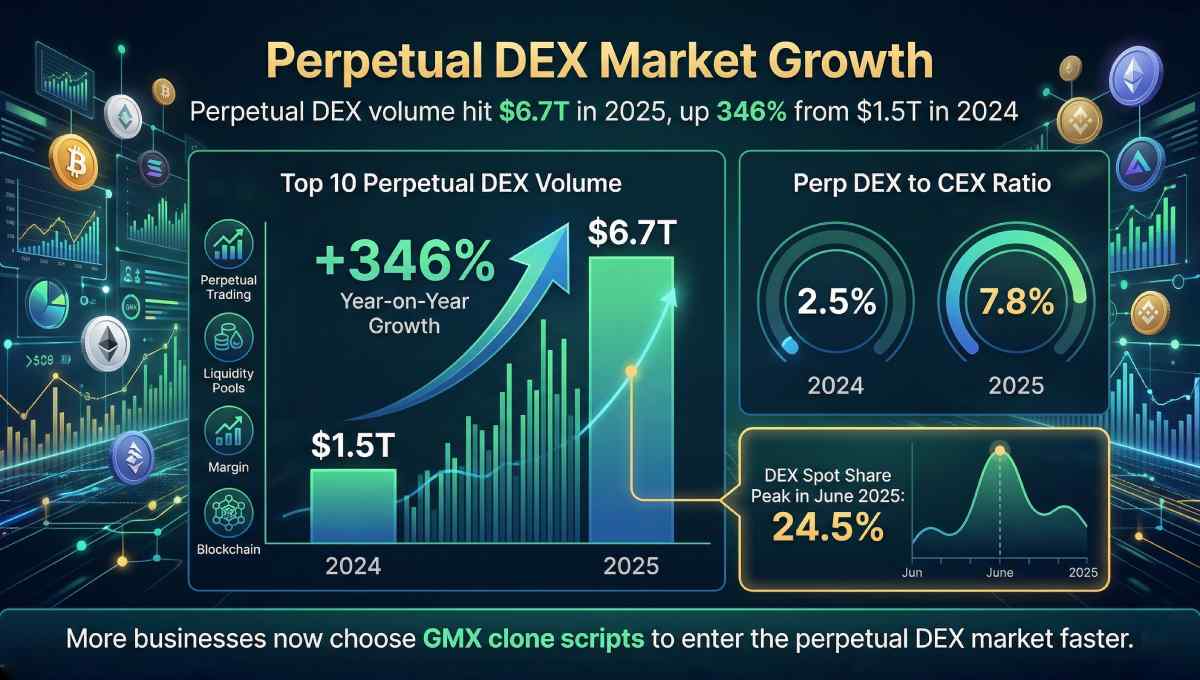
Interest in decentralized derivatives trading keeps rising, and businesses are paying close attention. The growth is clear in the numbers. CoinGecko found that the top 10 perpetual DEXs processed $6.7 trillion in trading volume in 2025, up 346% from $1.5 trillion in 2024. It also reported that the Perp DEX to CEX ratio climbed to 7.8%, up from 2.5% a year earlier. Traders want fast execution, self-custody, and round-the-clock market access, so more founders, exchange operators, and Web3 firms are turning to the perpetual DEX model. A GMX clone script fits this demand well. It gives businesses a ready base to build a perpetual DEX without starting from zero.
The appeal is practical and commercial. Building a decentralized derivatives exchange from scratch takes a large budget, a skilled smart contract team, long testing cycles, and deep market knowledge. Teams must build the trading engine, connect price feeds, design liquidity logic, create the user dashboard, and review every contract for security flaws. A GMX clone script removes much of that early strain and shortens the path to launch. That speed matters in a market where user demand for on-chain trading keeps growing. CoinGecko reported that DEX share of spot trading stayed above 10% from January 2025 and peaked at 24.5% in June 2025. For business leaders, that points to a simple fact. The market is active, and firms that enter early have a stronger chance to capture users, fees, and long-term value.
What Is a GMX Clone Script?
A GMX clone script is pre-built decentralized exchange software modeled on the core trading logic of GMX. It helps a business launch a perpetual futures platform in far less time than a custom build. The script usually includes wallet login, liquidity pool functions, leveraged trading, admin controls, and price oracle support. That gives founders a usable framework from day one.
How GMX Changed Perpetual DEX Trading
GMX changed the market by showing that on-chain perpetual trading could feel simple and fast. It brought leveraged long and short trading into a non-custodial format. It paired that with a shared liquidity model that reduced friction for traders. The result was a DEX structure that many new businesses now study and adapt. For startups, this model offers proof that a perpetual DEX can attract users without copying the old centralized exchange model.
GMX Clone vs Traditional Crypto Exchange Development
The difference between a clone script and a full custom build is clear. A custom platform needs long planning cycles, larger engineering teams, and heavier spending on architecture. A GMX clone script shortens that path. It gives startups and enterprises a faster route to test demand, launch core features, and enter the market with fewer technical delays. That speed makes the model attractive for any company that wants to build a perpetual DEX with strong commercial potential.
Key Features of a GMX Clone Script
A GMX clone script includes the core parts needed to run a perpetual DEX that feels fast, clear, and reliable for traders. The first and most important part is the perpetual futures trading engine. This engine lets users open long and short positions with leverage, which gives them a way to trade price movement without owning the asset itself. The system also uses funding rates to keep the market balanced between buyers and sellers. At the same time, liquidation logic protects the platform from bad debt. If a trader’s collateral falls below the required level, the smart contract closes the position. This keeps losses from spreading to the shared liquidity pool. For a business, this matters a lot. A platform with stable risk controls can attract more serious traders and liquidity providers.
Perpetual Futures Trading Engine
Another key feature is the multi asset liquidity pool model. Instead of matching traders through a standard order book, a GMX style platform uses a shared pool of assets such as BTC, ETH, and stablecoins. This structure makes better use of capital since one pool can support many trading pairs. It also helps reduce slippage, which is a major issue in trading platforms with thin liquidity. A larger and better balanced pool can process larger trades without sharp price movement.
Multi-Asset Liquidity Pool Model
Accurate pricing is another core requirement, so GMX clone scripts connect with oracle services such as Chainlink and TWAP feeds. These price feeds pull market data from external sources and help the platform avoid manipulation. This is critical in leveraged trading, where a small price error can lead to unfair liquidations.
Oracle-Based Pricing Integration
On the user side, the trading dashboard gives real time data such as profit and loss, charts, open positions, and risk levels. This makes the platform easier to use and keeps traders engaged. Multi chain support also adds direct business value. A GMX clone can support Ethereum, Arbitrum, BSC, and Polygon, which gives users more flexibility on cost and speed. Wallet support through MetaMask and WalletConnect removes signup friction and keeps access simple.
Advanced Trading and Analytics Dashboard
Security ties all of this together. Strong smart contracts, encrypted communication, controlled admin access, and third party audits help protect funds and build trust, which is essential for any platform that wants long term growth.
How a GMX Clone Script Works
The way a GMX clone script works is direct and easy to follow. A user begins by connecting a wallet, which removes the need for account creation and keeps onboarding quick. After that, the user deposits assets such as USDC or ETH into the platform. The next step is selecting a trading pair and choosing the trade type, such as spot or perpetual. The trader then enters the position size, picks the leverage level, and decides whether to go long or short. Once the trade is confirmed, the smart contract routes it through the liquidity pool and records the new position. From that point, the trader can monitor the position in real time through the dashboard. The interface shows profit and loss, margin usage, entry price, and liquidation level. This constant visibility helps users react faster to market changes.
User Journey Workflow
Behind the interface, the backend handles the heavy work. The trading engine manages orders and position updates. The risk management module checks collateral levels and decides whether a position stays open or moves into liquidation. Liquidity pool contracts manage deposits, withdrawals, and fee distribution for liquidity providers. Oracle integrations supply current pricing data so the platform can value positions correctly at all times. Each part has a clear job, and together they create a trading system that runs with little manual intervention.
Backend Architecture
The admin workflow is just as important for the business side. Platform operators can set trading fees, manage liquidity incentives, launch new markets, and control governance settings. This gives the business room to shape the platform around its revenue plan and user base. A well built GMX clone script is not just a copy of a trading product. It is a working business model with technical depth, strong revenue logic, and room for growth.
Admin Workflow
The admin panel gives full control over platform settings. Operators can adjust trading fees, which often range from 0.1% to 0.3% per trade. They can manage liquidity incentives to attract providers.
Admins can list new markets, such as ETH/USD or BTC/USD pairs. Governance settings allow token-based voting if the platform includes a native token. This adds community involvement and supports long-term growth.
A clear admin workflow helps businesses maintain control while the system runs on automated logic.
Market Trends Driving Decentralized Perpetual Exchanges
Rising Demand for On-Chain Derivatives Trading
The market for on-chain derivatives has moved far past the early experiment stage. Perpetual contracts now sit at the center of crypto trading demand, and that shift has pushed more users away from custodial venues toward smart contract based trading. Chainlink notes that DeFi derivatives give traders 24/7 access, transparent settlement, and direct control of funds through smart contracts instead of exchange-held accounts. It also describes perpetual futures as the dominant form of crypto derivatives in DeFi.
That change matters for any business studying a GMX clone script. A trader who keeps assets in a private wallet gains a clear benefit. Funds stay under user control until a trade interacts with the protocol. Trade logic, liquidation rules, and settlement all live on-chain, so users can inspect how the system works. GMX reflects this design in practice. Its docs state that trades route against GM and GLV liquidity pools and use oracle index prices instead of a classic order book.
The Growth of DeFi-Native Trading Platforms
DeFi-native trading platforms have grown on better infrastructure, stronger pricing systems, and clearer product design. Chainlink points to low-latency oracle systems as a core building block for real-time derivatives markets. Its documentation states that pull-based oracle models power real-time DeFi perps such as GMX and Jupiter. That matters for platform owners. Fast pricing and verifiable execution shape user trust, fee generation, and long-term retention.
GMX shows why this model has gained traction. Its protocol information on DeFiLlama describes a decentralized spot and perpetual exchange with low swap fees, zero price impact trades, and a multi-asset pool that earns fees from trading, liquidations, borrowing, swaps, and rebalancing. GMX docs add that liquidity providers receive 63 percent of fees on Arbitrum and Avalanche, and 50 percent on Botanix. That revenue design gives operators and liquidity partners a direct business case, not just a product story.
Why Perpetual DEX Platforms Appeal to Modern Traders
Why do traders keep choosing perpetual DEX platforms? The answer is simple. They want control, visibility, and access. Public ledgers show how trades settle. Wallet-based access lowers entry barriers. Markets stay open across time zones, and users do not need a bank-style onboarding path to start trading. Chainlink states that on-chain derivatives create a global market with permissionless access and transparent execution.
How This Trend Creates Opportunities for New Exchange Businesses
This trend opens a real path for new exchange brands. A GMX clone script gives founders a tested product model in a market that already understands perpetual trading. That lowers product education costs and shortens launch cycles. A new business can target a region, a language group, or a specific trading niche such as majors, memecoins, or tokenized assets. The commercial upside comes from trading fees, liquidation fees, borrowing fees, and pool activity. GMX’s live structure shows that these revenue lines already work in production.
Technology Stack Behind GMX Clone Development
Blockchain and Smart Contracts
A GMX clone starts with Solidity smart contracts on EVM-compatible chains. This choice gives development teams access to battle-tested tooling, wallet support, and chain options such as Arbitrum, Avalanche, and other EVM networks. GMX documentation points to contract APIs, oracle pricing, and deterministic execution as core protocol traits. That gives businesses a clear template for margin logic, liquidation rules, market creation, and governance hooks.
Frontend, Infrastructure, and Modular Architecture
The user-facing layer usually relies on React and Web3 libraries that connect wallets, trading forms, dashboards, and portfolio views. Under that layer sits the real operating stack: RPC access, cloud hosting, indexing, REST or GraphQL APIs, and fallback endpoints for uptime. GMX docs list GraphQL, REST market data, oracle price endpoints, and fallback URLs, which shows how a production-grade perpetual DEX supports both traders and external integrators. A modular build makes each part easier to update. Teams can swap the front end, add new markets, change fee logic, or expand governance without rebuilding the full exchange. That structure gives businesses a faster path to upgrades and a cleaner route to long-term growth.
Business Benefits of Launching a GMX Clone Script
A GMX clone script gives a business a shorter path to market in a fast-growing trading segment. Recent market data shows how large that opportunity has become. CoinGecko reported that the top 10 perpetual exchanges processed $92.9 trillion in 2025, and perpetual DEX trading volume grew 346% during the year. That pace tells founders and exchange operators one thing. Demand already exists, and speed matters.
Faster Time-to-Market
A custom perpetual DEX takes months of planning, coding, testing, and rework. A clone script cuts that cycle by starting with a ready product base. The Troniex article positions this as one of the main reasons firms choose the model. That claim fits the product logic. Core exchange modules, wallet flows, liquidity logic, and admin controls already exist, so the team spends less time building basic parts from zero.
This speed has business value. A project that launches earlier can start user acquisition earlier. It can list markets faster, collect fees sooner, and react to demand before that demand shifts to another platform. In crypto, delay has a direct cost. Markets move fast, and user attention moves faster.
Cost-Effective Development
The cost gap between a clone script and a fully custom build is one of the strongest commercial reasons to choose this route. A pre-built codebase reduces engineering hours across frontend, smart contracts, admin systems, and testing. It also lowers the number of unknowns during development. Vendor pages from Troniex and Trioangle both pitch this lower-cost entry point to startups and exchange operators.
That matters for founders who need to control burn rate. Instead of funding a long R and D cycle, they can put more capital into audits, liquidity programs, growth campaigns, and market maker deals. That shift often creates a stronger launch than a large code budget alone.
High ROI Potential
Revenue potential sits at the center of the business case. GMX itself shows how fee-based mechanics can support a durable model. According to GMX documentation, liquidity providers earn 63% of fees generated from trading, liquidations, borrowing fees, and swaps on Arbitrum and Avalanche. That fee mix shows how a perpetual DEX can earn from more than trade execution alone.
For a clone platform, that opens several income paths: trading fees, liquidation fees, borrowing fees, spread-based income, token listings, and premium analytics. A well-run platform can stack these revenue lines instead of relying on one source.
Full Customization and Branding
A clone script is not just a copy. It is a base for a branded product. Operators can change the interface, market list, fee model, reward system, and token design to match a clear market segment. One team may target high-frequency traders with lower fees. Another may focus on regional users, mobile-first flows, or DAO-led governance. Vendor pages stress this flexibility, and it is a real buying factor for businesses that want a quicker build without giving up identity.
Scalability for Enterprise Use
Growth only matters if the platform can handle it. GMX’s own design gives a useful reference point here. Orders route against liquidity pools, use oracle pricing, and use a two-phase execution model that helps reduce front-running and sandwich attacks. Keepers and oracle infrastructure support execution at scale. Those design choices matter for any business that expects larger order flow and rising user counts.
Development Process for Building a GMX Clone Platform
Building a GMX clone platform starts with product planning, not code. A perpetual DEX handles margin, liquidity, pricing, and liquidation in one system, so each early choice shapes the final product. GMX’s own model routes trades through liquidity pools and uses oracle-based pricing instead of an order book, which shows how much technical planning sits under a clean trading interface.
Requirement Analysis & Planning
The first stage defines the business itself. The team sets its revenue model, target users, supported trading pairs, leverage limits, fee logic, and blockchain network. A retail-focused platform needs simple onboarding and a short trade flow. A business platform for market makers or pro traders needs API access, deeper analytics, and stricter risk settings. Troniex places strong focus on this business-first view in its GMX clone article, and that matches how real exchange projects move from idea to launch.
This stage should lock key product rules early. Teams need to decide which assets will be listed first, how liquidations will work, which wallets will connect, and what role a native token will play. Clear planning reduces rework later. It keeps design, smart contract logic, and compliance review tied to one product brief.
UI/UX Design
The next stage shapes the trader experience. A GMX clone platform must present collateral, entry price, liquidation price, fees, open interest, and order status in a way that traders can read fast. That is not just a design task. It is a trust task. Users place larger positions on products that look clear and predictable.
A trader-centric interface should remove friction from core actions. Wallet connection must be quick. Market selection must be clear. Position details must stay visible before and after execution. GMX’s own product keeps the front end focused on pools, positions, and fee visibility, which is a useful reference for clone development.
Smart Contract Development
Smart contract work forms the core of the platform. This stage covers the trading engine, liquidity pool contracts, oracle connections, fee distribution, liquidation rules, and admin permissions. GMX documentation shows that trading runs through GM and GLV liquidity pools and uses oracle index prices for execution. That design lowers reliance on an order book and external market makers.
For a clone platform, this means the contracts must do more than process swaps. They must track collateral, margin exposure, borrowing costs, and pool balances in real time. Oracle design matters here. Chainlink states that its data feeds connect smart contracts to asset prices and sequencer health, which explains why oracle selection matters for fair execution and risk control.
Testing & Security Audits
Security review must run through the full build cycle. GMX’s security documentation states that the protocol uses rigorous testing, independent audits, and an active bug bounty program, yet still warns that undiscovered vulnerabilities can remain in smart contract code. That is the right way to view this stage. Audit work reduces risk, but it does not remove risk.
A serious clone build needs unit tests, integration tests, liquidation stress tests, and third-party audits before launch. Audit records published in the GMX contracts repository show a long audit trail across versions, which underlines how much review a perpetual trading system needs.
Deployment & Launch
Deployment moves the platform from controlled testing into live market conditions. This stage covers mainnet contract deployment, oracle setup, keeper services, frontend release, wallet checks, and post-launch monitoring. GMX’s architecture relies on keepers and oracle-linked execution, so a clone platform needs the same level of operational readiness at launch.
Monitoring stays critical after launch day. Teams need alerts for failed orders, pool imbalance, abnormal liquidations, oracle delays, and wallet connection errors. A perpetual DEX does not stop at deployment. It enters a live environment where users trade around the clock, and every weak point becomes visible fast.