
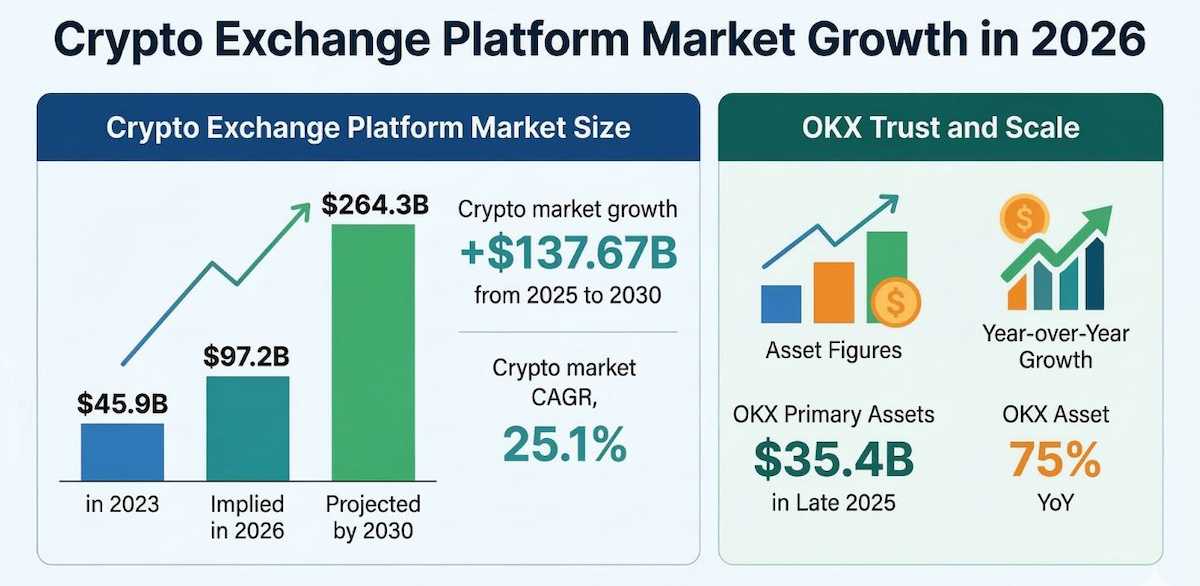
Crypto trading is a much larger business in 2026 than it was a few years ago. The broader cryptocurrency market is forecast to grow by $137.67 billion from 2025 to 2030 at a 25.1% CAGR, and the crypto exchange platform market was valued at $45.9 billion in 2023 and is projected to reach $264.3 billion by 2030 at a 28.4% CAGR. Based on that growth path, the exchange platform segment points to an implied market size of about $97.2 billion in 2026. There is no widely tracked public report for the OKX clone script market as a separate category, but it clearly sits inside the larger white-label and crypto exchange software space, which is growing fast as more startups, fintech brands, and trading communities look for faster ways to enter the market.
OKX itself helps show why this model attracts so much business interest. In late 2025, OKX reported $35.4 billion in primary assets, up 75% year over year, which reflects the scale and trust that a strong exchange can build. Many companies want that same market position, but building a full exchange from scratch takes a large budget, a long timeline, and deep technical skill across trading engines, wallets, liquidity, admin tools, and compliance systems. An OKX clone script gives businesses a faster route by offering a ready-made base platform with the main features users already expect, along with room for branding, feature changes, and future growth.
What Is an OKX Clone Script?
An OKX clone script is a pre-built crypto exchange software package designed to mirror the core structure and features of the OKX platform. It usually includes trading functions, wallet support, user dashboards, admin controls, liquidity tools, and security features. In simple terms, it gives a business the base system needed to launch its own exchange under its own brand.
The main value of this model is speed. Instead of building every feature from the ground up, a business starts with a working framework and customizes it for its market. This cuts development time and lowers early costs. It also helps founders focus on branding, user growth, payment support, and compliance instead of spending months on core engineering.
An OKX clone script is very different from building an exchange from scratch. A custom build needs a larger budget, more developers, longer testing cycles, and more technical planning. A clone script reduces that burden by offering the main exchange modules in advance. That makes it easier to launch quickly and test business demand sooner.
Businesses usually choose one of three paths. The first is a white-label version, which is the fastest and most affordable. The second is a hybrid model, where the base script is customized with extra features. The third is an enterprise-grade version built on clone architecture with deeper changes for larger trading operations.
For companies that want to enter the crypto exchange market in 2026, an OKX clone script offers a practical starting point. It saves time, reduces complexity, and gives businesses a proven exchange model they can shape into a commercial product.
Why Businesses Are Launching Crypto Exchanges in 2026
Digital asset demand keeps rising
The business case for a new crypto exchange is stronger in 2026 than it was two years ago. User adoption keeps rising, trade volumes stay high, and large investors now treat digital assets as part of a wider capital plan. Chainalysis placed India and the United States at the top of its 2025 Global Crypto Adoption Index. In APAC, Chainalysis reported that Japan’s on-chain value received rose 120 percent in the 12 months to June 2025. India rose 99 percent in the same period. Those numbers show a live market with strong user demand across retail and cross-border flows.
Institutional money is no longer on the sidelines
Large investors are taking digital assets more seriously. EY’s 2025 Institutional Investor Digital Assets Survey found that institutional investors increased their digital asset allocations over the prior year and planned to keep adding exposure through 2025. This matters for exchange founders. Bigger investors bring larger order sizes, stronger demand for custody, tighter reporting needs, and more API trading. A modern exchange now serves far more than casual traders buying Bitcoin on weekends.
Trading volume supports new entrants
Trading activity supports the same trend. CoinGecko reported that perpetual trading volume on centralized exchanges reached $86.2 trillion in 2025, up 47.4 percent from 2024 and the highest level on record. CoinGecko also reported that the top 10 centralized exchanges handled $18.7 trillion in total trading volume in 2025, up 7.6 percent from the year before. These are large numbers. They show a market with depth, daily activity, and room for new operators that serve a clear audience.
Web3 is changing user expectations
Web3 growth adds another reason to launch now. Users want trading, wallet access, staking, NFTs, and dApp support inside one product line. OKX Wallet shows this shift with support for more than 60 networks and built-in access to DeFi tools, NFT activity, and dApps. A new exchange does not need every product on day one. It does need to match what users now expect from a serious crypto brand.
Exchanges can earn from many revenue streams
Crypto exchanges can produce revenue from several channels, and that is a major draw for founders and firms. Trading fees remain the main source. Every filled spot, margin, or futures order can generate maker or taker fees. Then come listing fees for new tokens, withdrawal fees, spread income in selected markets, and paid access to premium tools such as advanced charts, higher API limits, or VIP support. Some exchanges add staking products, lending desks, OTC services, and private account plans for large clients. The model works best for firms that think past one fee line and build a full trading business.
Early entry still creates an edge
Early entry still matters in crypto. Markets mature fast, and user loyalty forms early around trust, local support, and trading depth. Regional demand can create openings that global exchanges do not fully serve. Chainalysis highlighted strong growth across APAC and continued high activity in MENA, where transaction volumes passed $60 billion in December 2024 before moderating in 2025. This creates room for exchanges focused on local language support, fiat rails, country-based compliance needs, or niche asset classes. A founder who enters early in the right region can build a user base before the market gets crowded.
Clearer rules reward serious operators
There is another edge for early movers. Regulation is getting clearer in more regions, and that helps serious operators stand apart from weak platforms. Chainalysis’ 2025 crypto regulatory review tracked broad policy progress across the year, with 2026 set up as a period of tighter standards and more formal market structure. A business that launches with strong controls, clean onboarding, and visible risk systems can win trust faster than a copycat site built only to chase fast fees.
Why the timing works in 2026
The reason businesses are launching crypto exchanges in 2026 is direct. Demand is high. Trade volumes are huge. Institutional capital is active. Web3 users want more than simple trading screens. Firms that enter with focus, speed, and a clear market fit can claim a real place in a market that still has room to grow.
OKX Clone Script Market Growth in 2026
Growth of the Crypto Exchange Software Market
The OKX clone script market is growing in 2026 as the wider crypto exchange software sector expands. Grand View Research valued the global cryptocurrency exchange platform market at $45.9 billion in 2023 and projects it to reach $264.3 billion by 2030 at a 28.4% CAGR. Based on that growth path, the exchange platform segment points to an implied market size of about $97.2 billion in 2026.
Rising Demand for OKX Clone Scripts
There is no major public report that tracks the OKX clone script market as a separate segment. Still, it sits inside the white-label and exchange software category that keeps gaining traction. Startups, fintech firms, and trading communities want faster launch timelines, lower build cost, and a proven product base. That demand keeps pushing interest toward ready-made exchange platforms.
OKX Market Scale Drives Business Interest
OKX adds weight to this trend. In October 2025, OKX reported $35.4 billion in primary assets, up 75% year over year. Those numbers show the scale that a strong exchange can reach and why businesses want platforms built around similar trading flow, wallet support, and trust features. For many founders, an OKX clone script offers a faster route to that business model than a full custom exchange build.
Key Features of a Powerful OKX Clone Script
A fast trading engine is the core layer
A strong OKX clone script must do more than copy the look of a major exchange. It must handle live trading at speed, hold assets safely, connect to outside liquidity, and give operators clear control over users, markets, and risk. The quality of these core features decides whether the platform can support real volume or fail under pressure. That is why founders should judge clone scripts by technical depth, not by a sales page alone.
The trading engine sits at the center of the system. It matches buy and sell orders, updates prices, manages open books, and records every fill. This part of the exchange must process requests in real time and keep latency low during busy market periods. Traders notice slow execution in seconds. They leave in minutes. A serious exchange script needs a matching engine built for heavy throughput, stable order routing, and clean handling of spot and derivative markets.
Multi-asset support drives user growth
Multi-currency support is now a basic requirement. Users trade across Bitcoin, Ethereum, stablecoins, altcoins, and chain-native assets from many networks. OKX Wallet points to this market standard with support for more than 60 networks. That range matters for clone script buyers too. A new exchange needs room to list many assets, add new trading pairs fast, and support deposits and withdrawals across major chains without forcing users into a narrow asset menu.
Advanced trading tools raise platform value
Advanced trading modules drive higher user value and stronger revenue per account. Spot trading is the entry point for most users, but active traders want more. Margin markets increase trade size. Futures and perpetual contracts pull in users who trade price movement without holding the underlying coin. P2P modules help platforms reach regions where direct banking access is limited. These tools widen the user base and keep traders inside the platform longer.
Liquidity access shapes the user experience
Liquidity integration is just as critical. A new exchange rarely starts with enough natural order flow to support tight spreads across many pairs. It needs access to outside liquidity providers or market makers. Good clone scripts include API links for liquidity aggregation, order book syncing, and trade routing. This reduces empty books, lowers slippage, and gives new users a better first trading experience. Without liquidity, even a well-designed exchange feels weak.
Wallet architecture protects customer funds
The wallet system is another feature that cannot be treated as a side item. Exchanges need hot wallets for day-to-day withdrawals and cold wallets for long-term storage. They need role-based controls, address monitoring, and approval rules for large transfers. OKX’s public wallet material shows how much users now value multichain support, asset control, and clear security choices across custodial and non-custodial models. A clone script should reflect that reality with strong wallet architecture from the start.
Multi-signature controls reduce internal risk
Security inside the wallet layer should include multi-signature controls for treasury actions and admin approvals. This reduces single-point failure risk. It supports internal governance for firms with finance teams, compliance officers, or outside custody partners. No exchange can sell trust with design alone. Users judge trust by withdrawal speed, account safety, and the absence of ugly surprises.
Admin tools support daily operations
The admin dashboard often gets less attention in sales copy, yet it shapes daily business control. Operators need one place to manage users, view KYC status, review deposits, flag risky accounts, pause trading pairs, set fees, and track system health. Strong analytics add another layer. Teams need live data on volume, active users, failed logins, order flow, and wallet balances. That data helps the business react fast during market spikes and spot weak points before they turn into losses.
The right feature set builds a real exchange
A powerful OKX clone script should give founders a full operating base, not just a front-end theme. The must-have features are clear: a fast trading engine, broad asset support, advanced market types, outside liquidity access, secure wallet architecture, and a practical admin panel. These are the features that turn a script into a working exchange business.
Step-by-Step Process to Launch a Crypto Exchange Using an OKX Clone Script
Step 1 – Market Research & Business Planning
A crypto exchange starts with market clarity, not code. You need to know who will trade on your platform, which region you will serve, and what kind of trading demand exists there. Some markets want spot trading and simple onboarding. Others want futures, copy trading, API access, and local payment options.
The business model should stay focused in the early stage. Most new exchanges do better with a limited launch that includes spot trading, wallet support, KYC, and a few strong trading pairs. This lowers cost, shortens launch time, and gives the team room to study user behavior before adding more products.
Step 2 – Choosing a Reliable Development Company
The development partner shapes the quality of the final exchange. A strong company should show live projects, source code ownership terms, security practices, and real experience with trading engines, wallets, admin panels, and APIs.
You should also check whether the team understands liquidity, compliance, and exchange security. A platform may look polished on the surface and still fail under real trading pressure. That is why technical depth matters more than sales claims.
Step 3 – Customizing the OKX Clone Script
Customization should focus on trust and usability. Branding covers more than a logo. It includes the platform name, domain, onboarding pages, support flow, legal pages, and user dashboard. A clean and consistent brand helps users feel safe when they deposit funds.
UI and UX work should make trading simple. Retail users want clear screens and fast actions. Pro traders want charts, order books, multiple order types, and balance tracking. Feature setup should match the target market, not copy every function from a large exchange.
Step 4 – Liquidity Setup and API Integration
Liquidity decides whether an exchange feels active or empty. Without strong order book depth, users face slippage, slow fills, and weak price confidence. New exchanges often combine internal liquidity, market makers, and external exchange feeds to create stable trading conditions.
API integration is just as important. It supports order placement, market data, account balances, deposits, and withdrawals. Strong APIs also open the door to broker services, bot trading, and business partnerships.
Step 5 – Security Implementation & Compliance
Security should sit at the center of the exchange build. Most assets should stay in cold wallets, with limited funds in hot wallets for daily use. The platform should include 2FA, withdrawal checks, anti-phishing tools, and device controls.
Compliance must be built into onboarding and transaction flow. This includes KYC, AML checks, sanctions screening, and transaction monitoring. These controls help protect the platform and support legal operation in regulated markets.
Step 6 – Testing and Quality Assurance
Testing should cover real trading conditions. Performance checks should measure order speed, login traffic, wallet sync, and system stability during busy periods. A trading platform cannot afford downtime during market volatility.
Security testing should review account access, API abuse paths, wallet controls, and withdrawal rules. This helps find weak points before attackers do.
Step 7 – Launch & Post-Launch Optimization
Launch is the start of the growth phase. After going live, the team should track active users, trading volume, spread quality, failed KYC attempts, and support issues. This data shows what needs improvement.
Post-launch work should focus on trust, liquidity, and product refinement. Add new features only after the core exchange runs well and users show steady engagement.
Revenue Models of a Crypto Exchange Business
Trading Fees
Trading fees are the main income source for most exchanges. The standard model uses maker and taker fees. Makers add liquidity to the order book. Takers remove liquidity by filling open orders. This structure supports trading activity and stable revenue.
A new exchange should use simple tiered pricing. Lower fees can attract volume, but fees alone do not keep users. Good liquidity and a smooth trading experience matter more.
Token Listing Fees
Listing fees can generate early revenue. Exchanges may charge projects for technical setup, review work, and market launch support. This can be profitable, but weak listing standards can damage trust.
A better model is to list fewer assets with stronger review checks. Good token selection protects the exchange brand and keeps trading pairs active.
Withdrawal & Transaction Fees
Withdrawal fees help cover network costs, wallet operations, and risk controls. These fees stay small for each transaction, yet they add up across active users.
The pricing model should stay clear and predictable. Hidden or excessive fees often push users to competitors.
Premium Trading Services
Premium services can raise revenue per user. VIP plans may include lower fees, faster support, higher withdrawal limits, and account management. This model works well for active traders and high-volume clients.
API trading access can also bring business revenue. Bot traders, brokers, and trading firms often need stable APIs, sub-accounts, and deeper technical support.
Native Exchange Token Strategy
A native token can support user retention and fee discounts. It can be used for lower trading fees, reward programs, VIP access, and staking features. This works best when the token has clear utility inside the exchange.
The token model should stay practical. It needs defined use cases, supply rules, and admin controls. A token without real purpose adds noise, not value.
Conclusion
An OKX clone script gives businesses a faster way to enter the crypto exchange market with a product model that users already understand and trust. It cuts development time, lowers upfront cost, and gives founders a base platform with core trading, wallet, liquidity, and admin features already in place. The real value comes from how the business plans the launch, sets up security, builds liquidity, and chooses revenue streams that fit the target market. A focused launch with strong compliance, clear pricing, and a clean user experience has a better chance of winning trader trust and building steady volume. For companies that want to start a crypto exchange in 2026, an OKX clone script is not just a quick build option. It is a practical business route to launch, grow, and compete in a fast-moving market.