
What Is a Raydium Clone Script?
A Raydium clone script is white-label decentralized exchange software built to mirror the main functions of Raydium. At its core, it recreates the parts that matter most to users and operators. Users get swap screens, liquidity pool access, yield farming, and staking. Operators get admin dashboards, fee controls, token listing tools, and room for custom product logic. Raydium’s public materials confirm the core user actions behind the model: trade, provide liquidity, earn fees, and launch assets or pools on Solana.
The clone is not the same as the original platform. That distinction matters. The original Raydium protocol has its own community, token structure, governance history, and live network liquidity. A clone script copies the working mechanics, then lets a company reshape the product for its own market. One firm may launch a public DEX for meme coin trading on Solana. Another may build a private exchange portal for a gaming ecosystem, a tokenized asset desk, or a regional Web3 startup network. Some projects keep the build Solana-only. Others add bridges, multi-chain asset support, or custom custody layers for enterprise clients.
The 2026 business case is strong. Raydium’s docs show that the platform now supports multiple pool types, including CLMM and CPMM pools. Its GitHub repository still documents the OpenBook-linked AMM design that made Raydium stand out in Solana DeFi. That gives clone developers a tested product pattern to model, then refine for a niche audience. For a company that wants to launch in weeks instead of many months, a Raydium clone script offers a direct route into a live and active market.
Understanding the Raydium Business Model
A Hybrid Model Built for Active Trading
Raydium gives traders two things that matter most on a live market: speed and usable liquidity. On its current product stack, users can swap tokens, provide liquidity, launch tokens, and trade perpetuals on Solana. Raydium states that it has been one of the most widely integrated liquidity layers on Solana since 2021. Its docs point to fast and cheap Solana transactions as a key reason teams build on top of it.
Why the AMM Plus Order Book Model Matters
The earlier Raydium model became known for mixing AMM liquidity with order book access. That structure gave traders deeper execution than a pool-only exchange. Raydium’s docs now explain the change more clearly. Its AMM v4 pools once shared idle liquidity with Serum and later OpenBook. Current v4 pools now run as standard AMMs. Newer Raydium deployments focus on CPMM and CLMM pools. This gives founders more choice over fee tiers, token launch design, and capital use.
Revenue Starts With Trading Activity
For a business, that model turns a clone script into a revenue engine. Raydium’s fee docs show that every swap carries a trading fee. In CLMM and CPMM pools, 84 percent goes to liquidity providers, 12 percent goes to RAY buybacks, and 4 percent goes to the treasury. Standard AMM v4 pools send 88 percent to LPs and 12 percent to buybacks. That fee structure shows how a Raydium-like exchange can reward users and still build protocol income.
Extra Income Beyond Swap Fees
A Raydium clone script works best for firms that want steady on-chain revenue, not one-time token hype. The first income source is swap and perp trading fees. The next comes from pool creation. Raydium charges 0.15 SOL to create a CPMM or AMM v4 pool, which gives founders a direct model for launch fees on a white-label exchange. Token launches add more room for revenue through listing charges, graduation fees, and promoted pool placement.
Staking, farming, and paid platform tools can add more income. A DEX owner can charge for analytics access, launchpad placement, market-making tools, or API access for trading firms. That matters in 2026. Serious DeFi buyers want more than token swaps. They want data, custody support, and clean execution.
Why Market Demand Keeps Growing
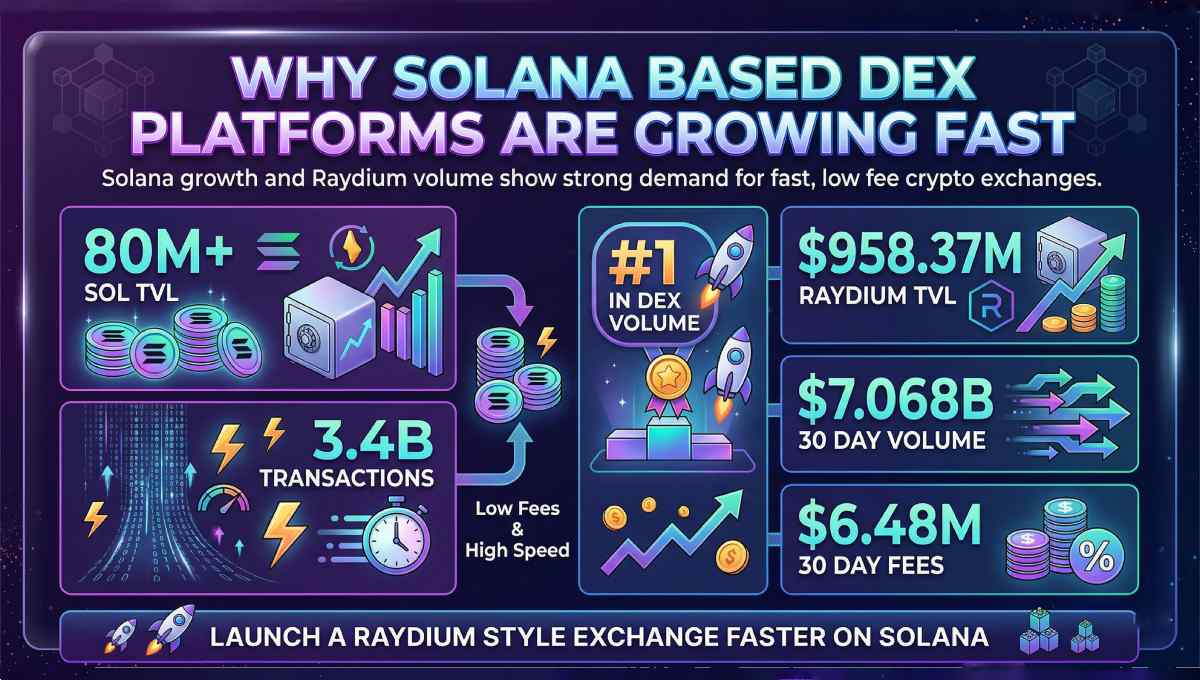
The demand side looks strong. Solana reported sub-cent fees and sub-second finality in its February 2026 ecosystem report. The same report said SOL-denominated TVL crossed 80 million SOL, an all-time high, and cited DefiLlama as the source. DefiLlama’s current Solana chain page shows about $1.577 billion in DEX volume over 24 hours and $11.058 billion over seven days.
Institutional Interest Is No Longer Early Stage
Institutional demand has moved past early testing. Solana’s February 2026 report says Nasdaq filed a proposal to list the VanEck JitoSOL Solana Liquid Staking ETF. The same report says BlackRock’s BUIDL fund cleared $550 million on Solana. Grayscale’s 2026 outlook says clearer rules and broader access will bring new capital into digital assets through 2026. For founders, this means a Raydium-like exchange now appeals to retail users, token issuers, funds, and trading firms.
Key Features of a Raydium Clone Script
Core Features That Traders Expect
A strong Raydium clone script must serve traders first and operators second. On the user side, the must-have set includes token swaps, pool deposits, farming, staking, wallet support, and live dashboards. Raydium’s own product pages show the baseline clearly: swap token pairs, provide liquidity for fees and token rewards, and create launch pools for new assets. Pool options now include CLMM for active range-based liquidity and CPMM for simpler token launches.
Tools That Improve User Retention
The best platforms keep users active after the first trade. That means real-time charts, wallet history, farming dashboards, reward tracking, and clear pool data. Multi-wallet support matters too. Most users expect fast access through Phantom and other Solana wallets. A clean dashboard helps new users act faster and helps experienced traders compare pools, fees, and rewards with less friction.
Admin Controls That Support Daily Operations
On the admin side, businesses need direct control over fees, pool creation, token listings, user activity, and treasury flows. This is where a commercial Raydium clone script proves its value. Founders need one panel to set fee rules, review wallet activity, manage reward campaigns, and track pool health in real time. Strong reporting tools also help teams monitor volume, user growth, liquidity depth, and platform income.
Add-On Modules That Expand Revenue
Advanced modules widen the business case. A launchpad can turn the exchange into a token issuance venue. Cross-chain bridges can bring in outside liquidity. NFT support can attract project communities that already trade digital assets. Margin trading and flash loan tools can appeal to pro traders who want more than simple spot swaps. These add-ons matter for firms that plan to turn a DEX into a broader DeFi product.
Security Features That Buyers Look For First
Security sits at the center of the pitch. Raydium’s protocol docs include a security section and a bug bounty program. That shows how mature DEX platforms treat trust as a product feature, not a side task. This point feels even sharper in April 2026, after DefiLlama logged a $285 million Drift exploit on Solana and the Solana Foundation introduced STRIDE and the Solana Incident Response Network for stronger DeFi security standards.
For any business buyer, audits, multi-factor authentication, anti-bot controls, DDoS defense, wallet security, and encrypted admin access are not extra features. They are standard requirements. A Raydium clone script that lacks these basics will struggle to win users, partners, or serious liquidity.
Technology Stack Behind a Raydium Clone
Solana as the Core Blockchain Layer
The technology stack behind a Raydium clone has a direct effect on speed, security, uptime, and trading costs. For businesses that want to enter DeFi in 2026, this is the base of the product, not a technical side note. Most Raydium clone platforms start on Solana. The reason is clear. Solana supports fast transaction processing and low fees. Those two strengths matter in every part of a decentralized exchange. Users swap tokens, add liquidity, claim rewards, and move funds often. High fees can slow growth. Slow confirmations can weaken trust. Raydium gained traction through this model, and a clone script built on Solana follows the same path. It gives founders a proven base for token swaps, liquidity pools, and yield products.
Adding Multi-Chain Support for Wider Market Reach
Some companies still want more than a Solana-only platform. They add support for Ethereum, BNB Chain, or Base. This expands token access and reaches a wider trader base. It also lowers dependence on one network. The trade-off is extra complexity. The platform needs bridge support, wallet support for each network, and deeper contract testing. Even so, the business case is strong since multi-chain support can bring more projects, more listings, and more fee volume.
Smart Contracts and AMM Logic
Smart contracts handle the core exchange logic. On Solana, teams write them in Rust. On EVM chains, teams use Solidity. These contracts manage swaps, liquidity pool rules, farming rewards, staking logic, and platform fees. This code must be exact. A small flaw can freeze funds or expose pools to attacks. That is why serious businesses treat clone scripts as financial infrastructure. The automated market maker sits at the center of the product. It prices assets through liquidity pool balances instead of a central buyer and seller model. That gives users instant swaps, but only if the AMM logic is built and tested with care. Many firms start with audited contract models, then adapt them for custom fees, governance tokens, or launchpad tools. This saves time and improves trust.
Frontend, Backend, and Data Flow
On the user side, many teams choose React.js and Next.js. These frameworks support responsive pages, wallet connections, live token prices, and trading dashboards. A clean interface matters more than many founders expect. A cluttered screen can hurt retention even if the backend works well. On the backend, teams often use Node.js and Express.js for analytics, admin controls, transaction indexing, and user-facing data. Some builds connect with Chainlink for pricing support. Others use Serum-linked market data for a deeper Solana trading model.
DevOps, Uptime, and Platform Stability
DevOps planning matters just as much as code quality. A Raydium clone must stay stable during market swings and token launches. Most teams deploy on AWS or Google Cloud. They use distributed hosting, failover systems, and constant monitoring. Load balancers spread traffic across servers, and high-availability setups keep the platform running even if one part fails. For a business that wants long-term growth, this protects revenue and user trust.
Step-by-Step Process to Launch a Raydium-Like Exchange
Start With Clear Business Requirements
Launching a Raydium-like exchange starts with clear business requirements. A fast launch sounds attractive, but speed alone does not build a strong product. A rushed rollout can lead to weak token support, poor security, and low liquidity. The first step is to define the target audience. Retail traders want simple swaps, fast wallet access, and easy farming tools. Institutional users look for deeper liquidity, better reporting, and tighter controls. This early choice shapes the whole product, from interface design to token support and fee rules.
Decide on Tokens and Chain Coverage
The next step is to decide which assets and chains the platform will support. Some exchanges focus on Solana-native assets only. Others support wrapped assets or multi-chain trading. This decision affects wallet support, liquidity planning, and development scope.
Choose the Right Development Partner
The next major task is choosing a reliable development partner. A company may claim blockchain experience but still lack real DeFi delivery history. Founders should review past exchange builds, Solana-specific work, security practices, and live product quality. This check can prevent expensive failures later.
Customize the Product for Brand and Revenue Goals
Once the team is in place, customization begins. A clone script should not feel copied. The product needs clear branding, a strong design system, and a trading flow that users understand at once. This stage also covers tokenomics, platform fees, governance plans, and farming rewards. These choices shape user growth and revenue from the first day.
Deploy Smart Contracts and Set Up Liquidity
After customization, the team deploys the smart contracts and creates the first liquidity pools. Pool depth matters a lot. Without strong liquidity, swap quality drops and traders leave. The platform then adds token pairs and checks wallet compatibility, balance logic, and contract behavior.
Test Security and Platform Performance
Testing comes next and must be strict. The team needs smart contract audits, penetration testing, traffic stress tests, wallet flow checks, and reward distribution checks. These steps reduce the chance of failure during launch week.
Launch the Exchange and Build Early Traction
The final stage is launch and market entry. A strong rollout often includes token listings, liquidity mining campaigns, and trading incentives. Early growth usually comes from Telegram, Discord, and X communities, along with support from token issuers, market makers, and liquidity providers. A Raydium clone can go live in weeks with the right team, but long-term success comes from trust, liquidity, and steady product updates.
Benefits of Launching a Raydium Clone Exchange
Business Advantages
The biggest business gain is speed. A white-label Raydium style platform can reach market months earlier than a ground-up exchange, and that gap matters in crypto. Fast entry helps founders capture trading volume, list new tokens, and sign liquidity partners sooner. Revenue can come from swap fees, pool fees, listing packages, farming programs, and premium partner placements. Raydium pool fees now range from 0.01 percent to 4 percent by pool type, which gives operators clear room to build fee models around target users.
Technical Advantages
The technical case is strong on Solana. Fees stay low, settlement is fast, and the network supports high-frequency activity better than many older chains. Solana states instant settlement near 400 milliseconds and median fees near $0.001. Raydium’s routing engine pulls liquidity across pools to reduce slippage, and its current product stack supports CPMM, CLMM, and Token-2022 assets. That mix gives new exchanges a practical base for active trading, token launches, and liquidity growth.
Competitive Edge
A Raydium clone exchange stands out through its hybrid market design roots, customizable modules, and smoother trader experience. Raydium’s legacy AMM v4 began as a hybrid model tied to central limit order books, and its newer stack now adds concentrated liquidity and routing for tighter execution paths. That lets a business launch a product that feels more advanced than a plain swap site. The result is simple: better pricing paths, broader feature depth, and a stronger pitch to token issuers, market makers, and growth-stage Web3 brands.