
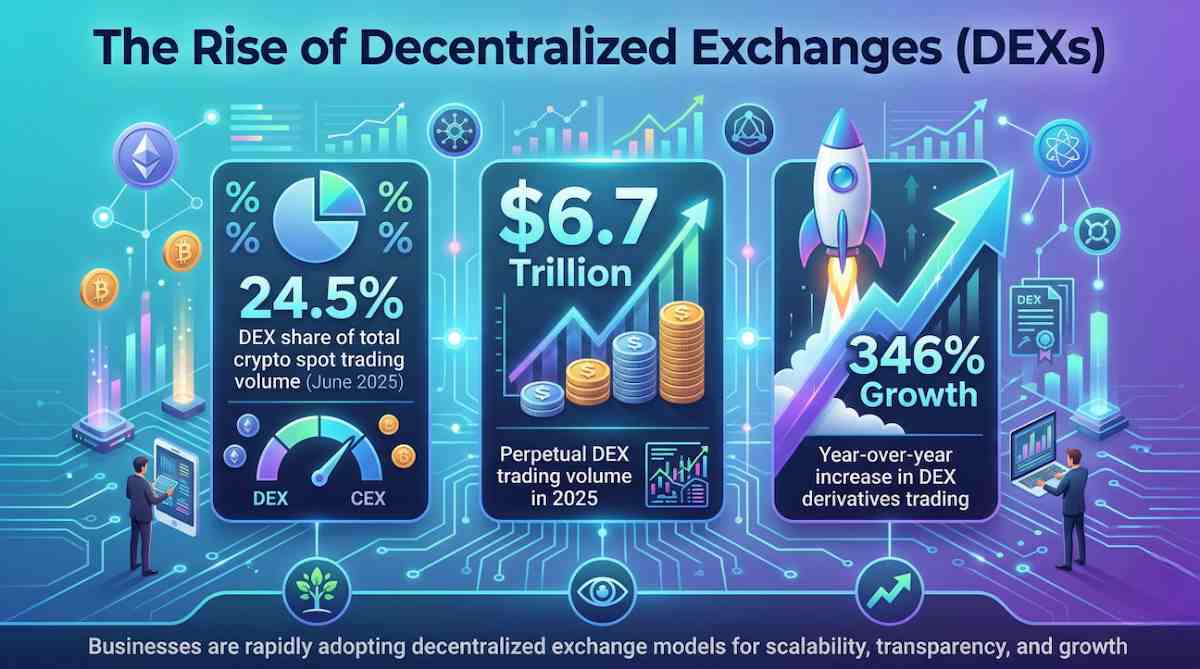
The rapid growth of Decentralized Finance (DeFi) is transforming how financial systems operate, offering a more transparent and efficient alternative to traditional banking and trading infrastructures. This shift is no longer theoretical it is clearly reflected in market data. Decentralized exchanges accounted for as much as 24.5% of total crypto spot trading volume in June 2025, while the top 10 perpetual DEXs processed $6.7 trillion in trading volume in 2025, representing a 346% year-over-year increase. These figures highlight a strong and accelerating move toward onchain trading, signaling growing confidence in decentralized financial infrastructure.
As centralized platforms face increasing scrutiny over security risks, regulatory pressure, and lack of transparency, businesses are actively exploring more resilient alternatives. The demand for non-custodial platforms, where users retain full control of their assets, is driving this transition. By leveraging smart contracts, DEXs enable trustless and automated transactions, improving both security and transparency. Platforms like Kine further enhance this model with features such as deep liquidity, low slippage, and high-speed execution. For businesses, adopting a Kine clone script provides a fast, cost-effective way to launch a scalable DEX platform making decentralized exchange development more accessible and commercially viable than ever.
What is Kine Protocol? A Benchmark for Modern DEX Platforms
Kine Protocol represents a next-generation DEX model designed to address the inefficiencies of earlier decentralized trading systems. At its core is a peer-to-pool liquidity model, which allows traders to interact with a shared liquidity pool rather than relying on direct counterparties. This eliminates liquidity fragmentation and improves execution efficiency.
Kine-like platforms also support multi-collateral pools, enabling users to deposit various assets and trade across multiple markets. Combined with features such as high leverage trading, cross-margin functionality, and real-time settlement, this creates a highly flexible and capital-efficient trading environment.
Unlike traditional AMM-based DEXs, Kine uses a hybrid infrastructure off-chain execution with on-chain settlement. This significantly reduces latency and gas costs while maintaining security and transparency. As a result, users benefit from a smoother, faster trading experience similar to centralized exchanges.
From a business standpoint, adopting a Kine-inspired model offers clear advantages:
- Improved user retention due to better UX
- Higher liquidity efficiency, leading to better pricing
- Scalability for advanced trading products like derivatives
Overall, Kine Protocol sets a new standard in DEX innovation, making it an ideal blueprint for businesses aiming to enter the DeFi market with a competitive edge.
What is a Kine Clone Script?
A Kine clone script is a ready-made, customizable software solution that replicates the core functionality of a Kine-like decentralized exchange (DEX). It is specifically designed to help businesses launch a decentralized derivatives trading platform quickly, without the need to build complex blockchain infrastructure from scratch. In a highly competitive DeFi landscape, this approach significantly reduces development barriers while enabling companies to capitalize on emerging market opportunities.
Unlike traditional development methods that require extensive time, capital, and specialized expertise, Kine clone script development offers a streamlined pathway to deployment. By leveraging an existing, proven architecture, businesses can focus on branding, user acquisition, and liquidity strategies rather than foundational engineering.
Key Components of a Kine Clone Script
A robust white-label DEX solution typically includes several critical components that ensure seamless functionality and scalability:
- Smart Contracts: These handle trading, staking, and liquidity pool operations, enabling trustless and automated execution.
- Trading Engine: Manages order execution, pricing logic, and position tracking, ensuring efficient trade processing.
- Liquidity Pool Architecture: Provides the underlying market depth required for smooth trading without reliance on direct counterparties.
- Tokenomics Module: Supports the creation and management of utility or governance tokens, incentivizing user participation.
- Admin Dashboard: Allows operators to control platform settings, fees, listings, and monitor performance analytics.
These integrated components form the backbone of a scalable decentralized exchange, making it easier to customize and expand based on business requirements.
Why Businesses Prefer Clone Scripts
Businesses increasingly favor clone scripts due to their strategic and economic advantages. First, they reduce development time and costs, allowing companies to avoid lengthy engineering cycles. Second, they are built on proven architectures with tested features, minimizing technical risks. Finally, they offer a faster go-to-market advantage, which is critical in the rapidly evolving DeFi ecosystem where early adoption can drive liquidity and user growth.
Why Kine Clone Exchanges Are Ideal for DEX Aggregators
Unified Liquidity Source
One of the biggest challenges faced by traditional DEX aggregators is liquidity fragmentation across multiple platforms. A Kine clone exchange addresses this issue by offering a peer-to-pool liquidity model, which consolidates liquidity into a single, unified source.
This significantly reduces dependency on multiple decentralized exchanges and eliminates the need for complex routing mechanisms. As a result, businesses can deliver more efficient trade execution, ensuring users get consistent pricing and smoother transactions.
Enhanced Price Optimization
Price optimization is critical for any DEX aggregator aiming to attract active traders. With pooled liquidity, a Kine clone exchange enables stable and predictable pricing, regardless of trade size.
Unlike traditional aggregators that rely on multiple liquidity pools, this model minimizes price discrepancies and slippage. Additionally, it opens up better arbitrage opportunities, allowing platforms to maximize profitability while offering competitive rates to users.
Faster Transaction Execution
Speed is a key differentiator in the DeFi ecosystem. Kine clone exchanges eliminate the delays associated with routing trades across multiple DEXs.
By leveraging an internal liquidity pool, transactions are executed with reduced latency, resulting in near-instant trade settlements. This leads to a significantly improved user experience, which is essential for retaining high-frequency and institutional traders.
Cost Efficiency
Operational and transaction costs can quickly add up in a traditional DEX aggregator model. A Kine clone exchange helps reduce these expenses by optimizing how trades are executed.
With fewer interactions across multiple smart contracts and networks, users benefit from lower gas fees. At the same time, businesses can reduce infrastructure complexity, leading to lower operational overhead and higher profit margins.
Scalability & Performance
As your platform grows, scalability becomes a critical factor. Kine clone exchanges are designed to handle high trading volumes without compromising performance.
Their architecture supports seamless scaling, enabling businesses to serve a global user base while maintaining fast execution speeds and system reliability. This makes them an ideal solution for enterprises looking to build future-ready DEX aggregators.
How Decentralized Exchanges Work
Smart Contracts and Blockchain Infrastructure
Decentralized exchanges operate on blockchain networks, with smart contracts acting as the core mechanism for executing trades and managing assets. Platforms are commonly built on Ethereum due to its mature ecosystem and developer support. However, to address scalability challenges such as high gas fees and network congestion, many DEXs integrate Layer-2 solutions, which improve transaction speed and reduce costs while maintaining security.
Smart contracts enable trustless execution, meaning transactions occur automatically based on predefined rules without requiring intermediaries. This not only enhances efficiency but also ensures transparency, as all activities are recorded on the blockchain.
Liquidity Models in DEX
Liquidity is a fundamental aspect of any exchange, and DEXs utilize different models to facilitate trading:
- Automated Market Makers (AMMs): Use algorithm-driven liquidity pools, allowing users to trade directly against pooled assets.
- Order Book-Based DEXs: Match buyers and sellers, similar to centralized exchanges, but operate on-chain.
- Peer-to-Pool Model (Kine): A shared liquidity pool acts as the counterparty, enabling efficient derivatives trading with reduced slippage.
The peer-to-pool model stands out for its ability to improve capital efficiency and provide consistent liquidity, making it particularly suitable for advanced trading environments.
Non-Custodial Trading Mechanism
A defining feature of decentralized exchanges is their non-custodial nature. Users retain full control over their private keys and funds, eliminating the need to trust a central authority. This significantly reduces counterparty risk and enhances security.
Additionally, the transparency of blockchain technology ensures that all transactions are publicly verifiable, fostering trust among users. As a result, non-custodial trading has become a key driver behind the growing adoption of decentralized exchanges in both retail and institutional markets.
Step-by-Step Process to Launch a DEX Like Kine
Step 1 – Market Research & Business Planning
Launching a Kine-like decentralized exchange begins with a clear understanding of the target market and revenue strategy. Businesses must identify whether they are catering to retail traders seeking simplicity or institutional users demanding advanced trading tools. This distinction influences platform design, liquidity strategy, and compliance requirements. Equally important is defining revenue streams such as trading fees, staking rewards, or token-based incentives which directly impact long-term sustainability. A well-structured business model ensures that the platform not only attracts users but also maintains liquidity and profitability over time.
Step 2 – Choose the Right Kine Clone Script Provider
Selecting the right development partner is critical. A reliable Kine clone script provider should offer customization flexibility, audited smart contracts, and scalable architecture. Since Kine’s model relies on efficient liquidity pooling and derivatives trading, the underlying codebase must be secure and adaptable. Businesses should prioritize vendors with proven experience in white-label DEX solutions, as this reduces technical risks and accelerates deployment.
Step 3 – Blockchain Selection
The choice of blockchain significantly impacts performance and cost. Ethereum remains a dominant choice due to its mature DeFi ecosystem, but high gas fees can hinder user adoption. As a result, many platforms integrate Layer-2 solutions or adopt multi-chain strategies (such as BNB Chain or Polygon) to improve scalability and reduce transaction costs. This decision directly affects user experience and trading efficiency.
Step 4 – Smart Contract Development & Integration
At the core of any DEX are its smart contracts. These include liquidity pool contracts, margin trading logic, and token issuance mechanisms. For a Kine-like platform, integrating derivatives trading logic and real-time pricing is essential. Secure and well-tested contracts ensure trustless execution and minimize vulnerabilities, making this step one of the most critical in the development lifecycle.
Step 5 – UI/UX Development
User experience plays a decisive role in adoption. A successful DEX must provide intuitive trading dashboards, seamless wallet integration, and mobile compatibility. Given that many users are transitioning from centralized platforms, the interface should balance simplicity with advanced trading features such as leverage controls and risk indicators.
Step 6 – Security Testing & Audit
Security is non-negotiable in DeFi. Before launch, platforms must undergo rigorous smart contract audits and penetration testing. Identifying vulnerabilities early helps prevent exploits and builds user trust. Continuous monitoring and updates are also essential to maintain platform integrity post-launch.
Step 7 – Deployment & Launch
The final stage involves launching the platform, often starting with a beta phase to gather feedback and test performance under real conditions. Liquidity bootstrapping through incentives or partnerships is crucial to ensure active trading. This is followed by marketing campaigns and user acquisition strategies to drive adoption.
Key Features to Include in a Kine Clone Script
Advanced Trading Features
A competitive Kine-like DEX must support advanced trading functionalities such as cross-margin and isolated margin trading, enabling users to manage risk effectively. The inclusion of derivatives and perpetual contracts expands trading opportunities, while real-time price feeds ensure accurate and fair market execution. These features collectively enhance user engagement and attract professional traders.
Liquidity & Tokenomics
Efficient liquidity management is fundamental to platform success. Multi-collateral liquidity pools allow users to deposit various assets, improving capital efficiency and market depth. A native token can be used for governance, fee discounts, and rewards, while staking and yield farming mechanisms incentivize user participation and liquidity provision.
Security & Compliance
Robust security measures are essential to protect user funds and maintain credibility. This includes multi-layer encryption, secure wallet integrations, and optional KYC/AML compliance for hybrid platforms targeting regulated markets. Additionally, built-in risk management systems help monitor leverage and prevent excessive exposure.
Performance Optimization
Performance directly impacts user retention. A Kine clone script should include a low-latency trading engine to ensure fast execution and minimal delays. Optimizing for low or zero gas fees, especially through Layer-2 integration, further enhances the user experience and makes the platform more competitive in the DeFi ecosystem.
Tech Stack & Frameworks for Kine Clone Development
Blockchain & Smart Contracts
A strong blockchain foundation is essential for building a Kine-like DEX. Solidity is the primary language used for developing smart contracts on Ethereum, BNB Chain, and Polygon, enabling secure and automated execution of trades, liquidity management, and staking. In some advanced ecosystems, Rust may be used for high-performance blockchain development. These smart contracts form the backbone of the platform, ensuring transparency and trustless operations.
Backend & Infrastructure
The backend layer supports the operational side of the exchange, including APIs, analytics, and risk management systems. Technologies like Node.js and Python are commonly used due to their flexibility and integration capabilities with blockchain networks. For hosting and scalability, cloud platforms such as AWS and Azure are widely adopted, providing reliable infrastructure, monitoring, and data management.
Frontend Development
User experience is critical in driving adoption. Frameworks like React.js and Angular are used to build responsive and interactive trading interfaces. These frontends are integrated with blockchain networks using Web3.js or Ethers.js, enabling users to connect wallets, execute trades, and monitor positions in real time.
Oracle Integration
Accurate price data is vital for derivatives trading. Oracle services like Chainlink provide reliable, real-time price feeds that ensure fair trade execution and proper liquidation mechanisms. This layer is crucial for maintaining platform integrity and minimizing risk.
Industry Use Cases of Kine Clone Script
Crypto Trading Platforms
The most common application of a Kine clone script is in building crypto trading platforms that support both spot-style and derivatives trading. These platforms benefit from improved liquidity models and reduced slippage, enhancing user experience and trading efficiency.
Institutional Trading Solutions
Kine-like DEXs are well-suited for institutional trading environments, where high leverage, capital efficiency, and advanced trading tools are required. Their architecture supports professional-grade trading while maintaining decentralized transparency.
DeFi Ecosystem Expansion
Within the DeFi space, these platforms enable synthetic asset trading and cross-chain liquidity solutions, allowing projects to expand their offerings beyond basic token swaps. This flexibility makes them valuable for scaling decentralized financial ecosystems.
Fintech Startups
For fintech startups, a Kine clone script offers a fast and cost-effective way to launch innovative financial products. By leveraging a ready-made framework, startups can focus on market differentiation and user acquisition rather than complex backend development.
Conclusion
A Kine clone script offers businesses a powerful and efficient pathway to enter the rapidly evolving decentralized finance ecosystem with a feature-rich, scalable trading platform. By combining advanced liquidity models, robust smart contract infrastructure, and high-performance tech stacks, companies can deliver a seamless trading experience comparable to centralized exchanges while maintaining the transparency and security of decentralization. More importantly, the ability to launch quickly using a proven white-label solution allows businesses to focus on strategic growth areas such as liquidity acquisition, user engagement, and market expansion. As DeFi continues to gain mainstream adoption, investing in a Kine-inspired DEX is not just a technological upgrade but a strategic move to capture long-term value in the future of digital finance.