
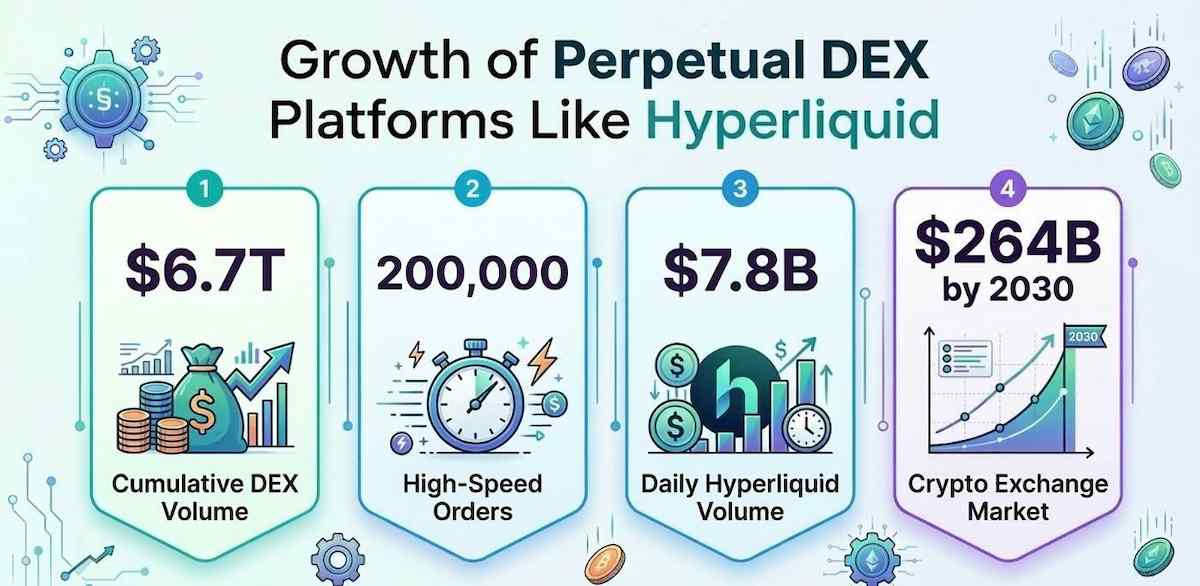
Perpetual trading has become one of the busiest segments of crypto, and the business opportunity keeps expanding. In 2025, the top perpetual DEX platforms processed $6.7 trillion in trading volume, up 346 percent from $1.5 trillion in 2024, according to CoinGecko. The ratio of perpetual DEX volume to centralized exchanges also rose from 2.5 percent to 7.8 percent within a year. Traders want deep liquidity, fast order execution, and direct control over funds. Platforms built for high-speed derivatives trading are gaining attention from both retail and institutional users. Hyperliquid sits at the center of this trend. Its documentation states that the network runs fully onchain perpetual and spot order books, records every order and liquidation onchain, and reaches finality through HyperBFT while supporting about 200,000 orders per second.
The strong growth of decentralized derivatives has created demand for Hyperliquid clone script development. Businesses want faster entry into the perpetual DEX market without building an exchange from scratch. Industry projections support this shift. Grand View Research estimates the global cryptocurrency exchange platform market could grow from $45.9 billion in 2023 to $264.3 billion by 2030, with a 28.4 percent annual growth rate. The broader DeFi sector is also expanding and could reach $78.8 billion by 2030. These numbers explain why startups, trading firms, and crypto exchanges are exploring Hyperliquid-style platforms. A clone script provides a quicker path to launch by including core features such as an order book engine, wallet integration, liquidation logic, and a customizable trading interface.
Understanding Hyperliquid and the Rise of Perpetual DEX Platforms
Hyperliquid is a decentralized perpetual futures exchange built on its own Layer 1 blockchain. The system divides its infrastructure into two main components. HyperCore manages the fully onchain order books for spot and perpetual markets. HyperEVM supports smart contract activity and applications that run within the ecosystem.
This design allows the platform to process large volumes of orders while keeping transactions visible onchain. Traders can view order books, funding rates, and liquidation activity in real time.
The exchange includes several core features:
- Fully onchain order books
- Sub-second transaction finality
- Non-custodial trading through user wallets
- Low trading fees designed for active markets
These elements give traders an experience similar to centralized derivatives exchanges but without giving custody of funds to the platform.
How Hyperliquid Differs From Traditional DEX Models
Many early decentralized exchanges rely on automated market makers. These systems pool tokens and calculate prices through formulas. That structure works well for basic token swaps but struggles with advanced trading activity.
Order book exchanges follow a different model. They match buyers and sellers through a visible book of bids and asks. Traders can place limit orders, track depth, and control entry points more precisely.
Hyperliquid applies this order book structure directly onchain. The result is a trading environment that supports leverage, derivatives, and high-frequency strategies. For serious traders, this structure often feels closer to professional trading platforms used in centralized markets.
Market Demand for Perpetual Decentralized Exchanges
Decentralized derivatives have grown quickly over the past few years. Traders look for platforms that allow leverage trading without centralized custody risk. Events in the crypto market have increased interest in self-custodial trading systems.
A perpetual DEX allows traders to hold assets in their wallets and still access futures markets. This design appeals to both retail traders and institutional desks.
For companies building new crypto platforms, this demand opens a clear path. A well-designed perpetual DEX can attract global traders, generate fee revenue, and support additional services such as liquidity programs or governance tokens. Hyperliquid has shown that this model can scale to billions in trading volume, which explains the rising interest in Hyperliquid clone development among blockchain startups and exchange operators.
Core Features of a Hyperliquid Clone Script
Advanced Trading Engine
A Hyperliquid clone script recreates the trading environment used by high-volume derivatives exchanges. The original Hyperliquid platform records orders, cancellations, trades, and liquidations directly onchain. The system processes close to 200,000 orders per second, which shows the speed modern decentralized exchanges can reach.
The trading engine handles order placement, matching, and execution in real time. Fast processing keeps traders active on the platform. A central limit order book, known as CLOB, follows price and time priority. Traders who place orders earlier receive priority at the same price level.
Low latency execution reduces slippage and improves market depth. A responsive engine allows large orders to execute closer to the intended price.
Perpetual Futures Trading
Perpetual futures generate most trading volume on derivatives platforms. A Hyperliquid clone script supports USDT-margined perpetual contracts, adjustable leverage, and funding rate calculations.
Funding payments balance long and short positions so that perpetual prices stay close to spot market prices. Frequent oracle price updates guide margin checks and liquidation triggers.
Leverage allows traders to control positions larger than their collateral. Clear margin rules and liquidation systems protect the exchange during sharp market movements.
On-Chain Order Book
Transparency drives trust in decentralized trading systems. A fully onchain order book records every trade and every order update on the blockchain. Anyone can verify trading activity without relying on internal databases.
This structure also reduces front-running risk. Orders appear publicly onchain and follow deterministic matching rules. Traders can review the order flow and confirm that the matching process follows the defined logic.
Real-time trade execution combined with visible market depth helps traders judge liquidity before they enter positions. That visibility improves confidence for larger market participants.
Liquidity Management System
Liquidity determines whether a trading platform succeeds or fails. A Hyperliquid clone script must include a structured liquidity management layer that supports several sources of trading volume.
Key components often include:
- Automated liquidity pools that support baseline trading activity
- Market maker integrations that deepen order book liquidity
- Cross-market liquidity routing that balances capital across trading pairs
Market makers supply most early liquidity for derivatives exchanges. A clone script that supports dedicated APIs and incentive programs can attract these liquidity providers faster.
Margin and Risk Management
Risk control protects both traders and the exchange. Hyperliquid-style platforms support cross margin and isolated margin modes. Cross margin uses the trader’s full account balance as collateral. Isolated margin limits risk to a single position.
Liquidation engines monitor every open position. If collateral falls below the required threshold, the system closes the position to prevent negative balances. Many exchanges also maintain an insurance fund that absorbs losses during extreme volatility.
Multi-Asset Trading
A well-designed perpetual DEX supports several asset classes. Crypto perpetual pairs form the core market, yet many exchanges expand into synthetic assets and tokenized derivatives. These instruments mirror external assets such as commodities or indices.
A broader asset list attracts traders who want exposure to multiple markets without leaving the exchange.
Wallet and Asset Management
User custody remains a defining feature of decentralized exchanges. A Hyperliquid clone script connects with multiple wallets and allows traders to keep control of their assets at all times.
Secure wallet integration supports common tools such as MetaMask and hardware wallets. The platform processes trades through smart contracts, yet user funds remain under user control. This design reduces counterparty risk and appeals to traders who prefer non-custodial trading.
Technology Architecture of a Hyperliquid-Style Perpetual DEX
Layer-1 or Layer-2 Blockchain Infrastructure
The underlying blockchain determines transaction speed and platform scalability. Hyperliquid operates on a custom Layer-1 chain designed specifically for trading throughput. This architecture supports high order volumes and quick block finality.
A clone platform can follow the same path by deploying its own Layer-1 chain. That route offers maximum control over performance and fee structures.
Another option uses Ethereum Layer-2 networks such as Arbitrum or Optimism. These networks process transactions faster than Ethereum mainnet and maintain strong compatibility with existing wallets and developer tools.
Trading Engine
The trading engine handles the entire lifecycle of an order. It creates orders, matches buy and sell requests, executes trades, and records the results onchain.
Performance here defines the user experience. A slow engine leads to delayed fills and poor market depth. A fast engine improves price discovery and keeps the order book active.
Smart Contracts
Smart contracts manage the financial logic of the exchange. They control collateral deposits, margin calculations, settlement procedures, and liquidation rules.
Each contract must undergo extensive security audits. A single vulnerability can place user funds at risk.
Oracle Integration
Price oracles supply accurate market data for the exchange. These feeds deliver external price information that supports margin checks, liquidation triggers, and funding rate calculations.
Frequent price updates reduce the risk of manipulation. Reliable oracle networks form a critical defense against distorted market data.
API and WebSocket Layer
Professional traders and market makers rely on automated trading tools. APIs and WebSocket connections deliver real-time market data and account updates to these systems.
These connections stream order book updates, trade history, and price feeds with minimal delay. A stable data pipeline supports algorithmic trading strategies and liquidity provision.
User Interface
The interface transforms complex trading data into a usable dashboard. A well-designed platform includes:
- A trading dashboard with order placement tools
- Interactive price charts with technical indicators
- Order management panels that track open positions and trade history
A clean interface reduces user friction and encourages active trading. For businesses launching a perpetual DEX, strong interface design often determines how quickly the platform gains traction among traders.
How to Launch a Perpetual DEX Like Hyperliquid
A perpetual decentralized exchange must deliver speed, liquidity, and reliability from the first day. Traders expect fast order execution and deep order books. If spreads widen or trades slow down, users move their funds quickly. This pressure has pushed new platforms to focus on strong trading infrastructure and clear risk rules.
Demand for decentralized derivatives trading has grown fast in recent years. Platforms that combine high trading speed with self-custody have attracted both retail traders and professional market participants. Hyperliquid gained attention because it processes orders on chain while maintaining fast execution. Businesses that plan to launch similar exchanges must follow a structured development path.
Step 1: Market Research and Business Strategy
The first stage begins with market analysis. A team must decide which type of traders the platform will serve.
Retail traders focus on simple interfaces and lower trading fees. Professional traders care about order execution speed and stable APIs. Market makers evaluate rebate programs and liquidity incentives before they provide capital to a new exchange.
Target markets must also be defined early. Many exchanges begin with a small group of high-volume trading pairs. These pairs often include BTC, ETH, and other major assets. Concentrated liquidity improves price stability and reduces spread size.
Token economics also form part of the initial strategy. A native token can support trading discounts, governance rights, and staking programs. The token must have a clear role within the platform. Tokens without clear utility rarely maintain long-term demand.
Step 2: Choose the Right Blockchain Infrastructure
Infrastructure determines how fast and scalable the exchange will become.
Hyperliquid operates on its own Layer-1 blockchain. This design gives the network direct control over transaction processing and order matching. Some startups choose a different path and build on Layer-2 networks that connect to Ethereum.
Each option has advantages.
Layer-1 deployment offers deeper control over performance and trading logic. Layer-2 deployment reduces development time and allows projects to launch sooner. The decision should match the company’s long-term growth plan.
Scalability must also be evaluated. A perpetual exchange must process thousands of orders each second during peak activity. Infrastructure that struggles under heavy load will damage user trust.
Step 3: Develop or Integrate a Hyperliquid Clone Script
Development begins once the infrastructure decision is complete.
Many companies adopt a Hyperliquid clone script or white-label trading engine. This model shortens the development cycle and allows a team to test market demand faster.
Customization remains essential even with a clone framework. Key areas that require modification include:
- Order matching logic
- Margin and liquidation rules
- Wallet management systems
- Administrative dashboards
- Referral and reward systems
These components shape how traders interact with the platform.
Step 4: Integrate Liquidity Sources
Liquidity forms the foundation of any trading platform. Traders prefer exchanges with narrow spreads and deep order books.
Liquidity can enter the system through several channels.
Market makers provide constant buy and sell orders across trading pairs. Liquidity pools allow users to deposit assets that support trading activity. Some exchanges connect with external platforms to share liquidity across multiple venues.
A balanced mix of these sources helps stabilize trading conditions.
Step 5: Implement Security and Compliance
Security protects both users and the platform itself.
Smart contract audits must review all trading and settlement contracts before launch. Independent security firms often conduct these reviews. Risk management frameworks define margin requirements, liquidation rules, and trading limits.
Some jurisdictions require identity verification procedures. Exchanges that operate in regulated markets may integrate KYC and AML checks to comply with financial rules.
Clear security policies strengthen user confidence and reduce operational risk.
Step 6: Launch and Scale the Platform
After development and testing, the platform moves toward public release.
Most exchanges begin with a beta testing phase. Early testers identify technical issues and provide feedback about trading performance.
Community engagement plays a major role during early growth. Active communities attract traders, developers, and liquidity providers. Exchanges often introduce liquidity mining programs to reward early participants.
These reward systems distribute tokens or trading incentives to users who provide liquidity and generate trading activity.
Monetization Models for Perpetual DEX Platforms
Perpetual exchanges require clear revenue streams to sustain long-term operations.
Trading Fees
Trading fees remain the primary revenue source. Maker and taker fee structures determine how much traders pay when placing or executing orders. Makers add liquidity to the order book, and takers remove liquidity. Lower maker fees often attract market makers.
Funding Rate Revenue
Perpetual futures rely on funding rates to keep contract prices close to the spot market. Funding payments move between long and short traders at regular intervals. Trading activity around these payments contributes to platform revenue.
Token Economy and Governance
Many exchanges launch native tokens. These tokens can provide trading discounts, staking rewards, and governance voting rights. Governance systems allow token holders to influence platform upgrades and new market listings.
Liquidity Mining Programs
Liquidity mining rewards traders and liquidity providers who support the exchange during early growth. These incentives help build active markets and attract new users to the platform.
A perpetual exchange that combines strong infrastructure, deep liquidity, and clear revenue models can compete effectively in the decentralized derivatives market. Businesses that adopt a Hyperliquid clone strategy gain a faster route to building a high-performance trading platform.
Conclusion
A Hyperliquid Clone Script gives businesses a faster path to launch a perpetual decentralized exchange with strong trading performance and modern DeFi features. Companies can reduce development time by using a pre-built framework that supports order matching, margin trading, liquidity management, and on-chain settlement. Success still depends on careful planning, reliable blockchain infrastructure, deep liquidity, and strict security practices. Teams that focus on these areas can build a trading platform that attracts active traders and market makers. As demand for decentralized derivatives continues to grow, a well-designed exchange built with a Hyperliquid Clone Script can open new revenue opportunities in the expanding DeFi trading sector.