
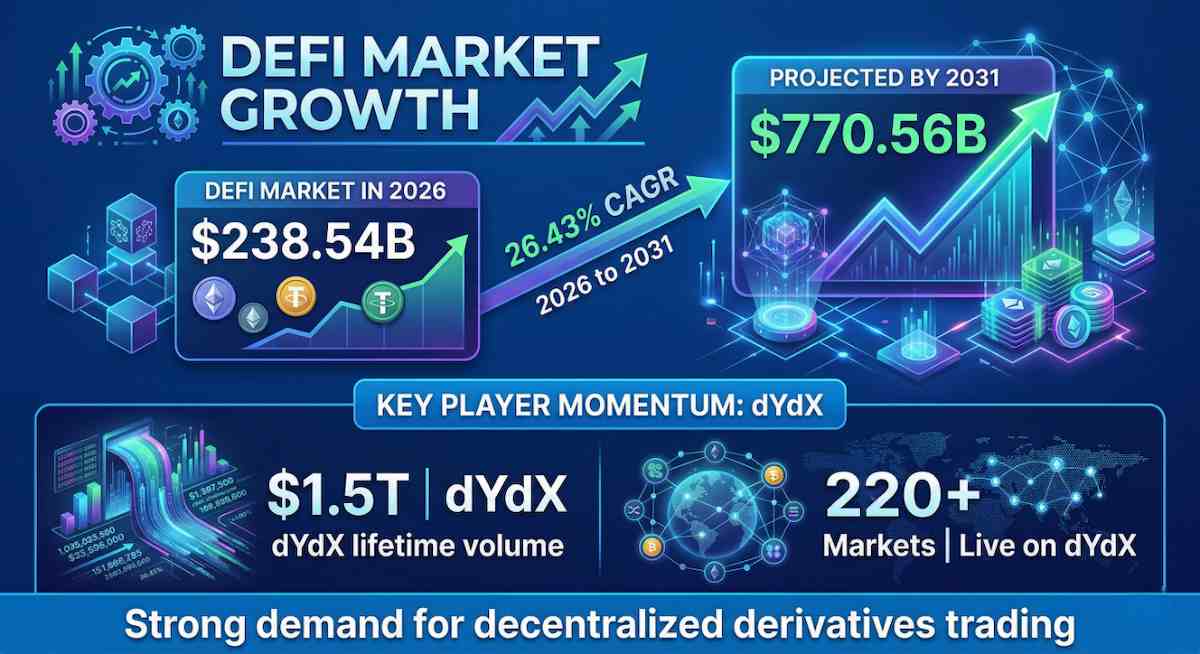
Decentralized finance keeps pulling serious trading activity onto blockchain rails, and the business case looks stronger in 2026 than it did two years ago. Mordor Intelligence values the DeFi market at $238.54 billion in 2026 and projects it to reach $770.56 billion by 2031, with a 26.43% CAGR. Those numbers show clear market expansion. More capital, more users, and more trading products now sit on chain, which makes decentralized trading infrastructure more attractive to startups, brokerages, and fintech firms.
That shift appears most clearly in derivatives trading. Traders want perpetual contracts, margin tools, fast execution, and transparent settlement, but they still want control of their funds. dYdX stands close to the center of that demand. Its official site lists $1.5 trillion in lifetime volume, $200 million in open interest, and 220+ markets. It also highlights mobile, desktop, and API access, which shows how close decentralized trading now comes to the depth and usability of large centralized platforms. For businesses, that is the real appeal of a DYDX clone script. It cuts early build time, lowers development cost, and gives teams a faster way to launch a white-label decentralized exchange in a market with proven demand.
What Is a DYDX Clone Script?
A DYDX clone script is pre-built decentralized exchange software that copies the main working model of dYdX. In plain terms, it gives a company the base code for a self-custodial derivatives exchange, then leaves room for custom branding, feature changes, token support, and business logic. This makes it useful for startups that need a fast launch and for larger firms that want a white label crypto exchange without a long build cycle.
The core idea is simple. dYdX itself runs as open-source blockchain software built on Cosmos SDK and CometBFT, and its v4 chain powers a self-custodial perpetual futures exchange with a high-performance order book and matching engine. A clone script aims to recreate that structure in a form a business can deploy, test, and adapt for its own market.
The working model rests on three parts. The first is wallet-based access. Users connect wallets instead of opening a custodial account. The second is smart contract execution. Contracts handle trade settlement, margin logic, and fund movement on chain. The third is the order flow itself. dYdX documentation states that the chain uses a decentralized off-chain order book and matching engine, with the web app reading order book data through the Indexer API and sending trades to the chain. For a clone script buyer, that mix brings a clear benefit. Traders get a familiar exchange interface with faster execution, and the platform keeps the trust model tied to blockchain records.
The software stack usually includes smart contracts, an order book trading engine, liquidity management modules, and a front-end trading dashboard. Smart contracts manage positions, collateral, and settlement. The trading engine handles order placement and matching. Liquidity modules support market depth and tighter spreads. The front end gives users charts, order forms, wallet connection, and market data in one place. Put together, these parts form the base of a decentralized derivatives exchange that a business can brand and sell with far less build time than a ground-up project.
Key Features of a DYDX Clone Exchange Platform
Advanced Trading Functionalities
A strong DYDX clone script starts with the trading tools serious users expect. The center of that model is perpetual futures. These contracts do not expire, so traders can hold positions without rolling them into a new month. That format has helped dYdX build its identity around crypto derivatives, not spot trading. A clone built for the same market needs perpetuals, clear funding logic, and risk controls that work in real time. dYdX’s public trading material and help content place perpetual trading at the core of the platform.
Margin trading matters just as much. Traders want to post collateral, open larger positions, and manage risk with precision. Cross margin and isolated margin serve different needs. Cross margin uses a shared collateral pool across positions. Isolated margin limits risk to a single position or market. dYdX introduced isolated markets in 2024 and explained that its protocol had long centered on cross margined markets, which shows how important this split is for advanced users. A clone platform that offers both modes can appeal to retail traders, prop desks, and market makers at the same time.
Trading Infrastructure & UX
The trading engine decides whether users stay or leave. dYdX documents describe a decentralized limit order book where each full node maintains an in memory book and matches trades by price time priority. That matters for a clone script. It means the product can feel closer to a pro exchange than a simple AMM. Traders can see depth, place orders with intent, and react to fast market moves with less guesswork.
User experience sits on top of that engine. Real time charting, order book depth, account data, and trigger orders all shape trust. dYdX supports market, limit, stop market, stop limit, take profit, and reduce only behavior across parts of its stack. A business that buys or builds a DYDX clone should treat these tools as core revenue drivers, not cosmetic extras. Skilled traders trade more often on platforms that give them exact control over entry, exit, and risk.
Security & Compliance Features
Security starts with custody. dYdX lets users connect a decentralized wallet, and its onboarding flow includes wallet creation paths with mandatory two factor authentication in supported flows. That model cuts custodial risk and gives users direct control over funds and signing. A clone script built for business use should pair non custodial wallet access with audited smart contracts, encrypted traffic, and admin level security rules from day one.
Admin & User Panel Capabilities
The business side needs its own control layer. Admin panels should cover user status, market creation, fee settings, liquidity rules, trading pairs, and reports. On dYdX, governance can adjust fee tiers, trading rewards, order limits, and market related parameters. That does not mean every clone needs on chain governance at launch. It does show that market controls and reporting tools are not optional in a live derivatives venue.
Benefits of Using a DYDX Clone Script for Businesses
Faster Time-to-Market
Time matters in crypto. A company that spends nine to twelve months building a derivatives exchange from scratch can miss a market cycle. A clone script cuts that delay by reusing tested trading flows, wallet logic, dashboards, and contract patterns. That gives founders room to focus on branding, liquidity, legal review, and customer growth. Pre built architecture does not remove all risk, yet it cuts early product risk in a very practical way.
Cost-Effective Development
The money case is simple. Building a full derivatives stack needs smart contract engineers, backend developers, frontend teams, DevOps staff, QA testers, and security reviewers. A clone script lowers that first bill. Your team still needs audits and custom work, but the base product is already there. That makes entry easier for startups, brokerages, and Web3 firms that want a trading product without funding a long custom build.
Scalability & Customization
Good clone platforms win on flexibility. dYdX now runs on its own chain and supports API, desktop, and mobile access, which shows how far this model can stretch past a basic web app. A business can take the same blueprint and tailor chain support, fee logic, markets, branding, referral systems, and rewards. Ethereum, BNB Chain, and Layer 2 support can widen the user base and lower friction for deposits and trading.
Revenue Generation Opportunities
The revenue side is strong. Trading fees remain the main line item. New market or token listing fees can add another stream. Governance tokens and staking programs can support retention and community growth. dYdX’s own ecosystem includes trading rewards, staking rewards, and governance functions, which shows that a derivatives exchange can grow into a broader product with many cash flow paths tied to activity and token utility.
Market Trends Driving DYDX Clone Development
Growth of Decentralized Derivatives Trading
Demand for DYDX clone platforms is rising with the growth of decentralized derivatives trading. CoinGecko reports that the top 10 perpetual exchanges handled $92.9 trillion in volume in 2025, up 64.6% from the prior year. It also says decentralized perpetual exchanges reached $6.7 trillion in annual volume after a 346% yearly increase. That shows strong demand for perpetual contracts and leverage trading onchain.
DEX market share is growing too. Grayscale says decentralized exchanges made up 7.6% of global crypto trading volume in the first five months of 2025, up from 3% in 2023. CoinGecko adds that the DEX to CEX perps ratio rose to 11.7% in November 2025.
Shift Toward Self-Custody and Transparency
More users want direct control over their assets. Non-custodial trading removes the need to leave funds with a centralized operator, which lowers custody and counterparty risk. Grayscale notes that DEXs attract users who value transparency and open market access.
This shift matters for business buyers. A DYDX clone script gives them a way to launch a trading platform that supports self-custody and visible settlement rules. That model is easier to trust for users who want more control over funds.
Institutional and Retail Adoption
Retail users still hold the largest share of the DeFi market. Mordor Intelligence says they accounted for 62.12% in 2025. The same report projects 32.55% CAGR for institutional investors and asset managers through 2031.
At the same time, user expectations are rising. dYdX lists $1.5 trillion in lifetime volume, $200 million in open interest, and 220+ markets on its platform. Those numbers show why both retail and institutional buyers now expect advanced trading tools, strong liquidity, and API access from decentralized exchanges.
Step-by-Step Process to Build a DYDX Clone Exchange
Step 1: Business Planning and Strategy
A strong launch starts with a clear market target. Some firms want a retail platform with easy onboarding, copy trading, and simple perpetual pairs. Others want a pro venue for funds, prop desks, or high frequency users. That choice shapes every later decision, from liquidity design to fee logic. Revenue usually comes from trading fees, listing fees, API access, premium analytics, token incentives, and staking rewards tied to platform activity.
Step 2: Choose the Right Blockchain
Chain selection decides speed, cost, and user reach. Ethereum gives brand trust and a large wallet base. Layer 2 networks cut gas costs and improve execution speed. App specific chains and Cosmos based designs offer more control over throughput and market structure. The trade-off is clear. Popular ecosystems bring faster user acquisition. Custom chains give deeper product control.
Step 3: Clone Script Customization
The script should match your brand from day one. That includes interface design, trading screens, fee tables, market pages, and account flows. Product depth matters too. Many teams add staking, governance voting, referral tools, and trading APIs at this stage so the platform can serve both regular traders and programmatic users.
Step 4: Development, Security, Testing, and Launch
Next comes deployment. Smart contracts go live, wallets such as MetaMask and WalletConnect are connected, and the order flow is tested under heavy load. Security work needs to be strict. Audits, encryption, rate limits, and anti-DDoS controls reduce technical and financial risk. Then the team runs QA, fixes edge case bugs, and checks latency across devices. Mainnet launch is not the finish line. Post launch work includes upgrades, liquidity support, token reward changes, and regular maintenance so the exchange stays active after the first marketing push.
Technology Stack Behind a DYDX Clone Script
Blockchain and Smart Contracts
A DYDX clone script needs a strong blockchain base. Smart contracts manage deposits, withdrawals, collateral, settlements, and liquidation rules. Most projects use Solidity for EVM networks such as Ethereum, Arbitrum, and BNB Chain. Some teams use Rust for chains that need more custom control.
Layer 2 support is also important. Systems such as zk-rollups and StarkEx help reduce gas fees and improve trading speed. For a derivatives exchange, this means faster execution and a better user experience.
Backend and Matching Engine
The backend handles the core trading process. Many DYDX-style platforms use off-chain order matching and on-chain settlement. This setup gives traders fast execution and keeps final records transparent.
The matching engine sorts and fills orders in real time. It must also track margin, positions, and liquidations. High-performance APIs connect this engine to trading apps, dashboards, and bots. Stable REST and WebSocket support is a key part of the platform.
Frontend and User Interface
The frontend shapes the user experience. Most clone platforms use React with Web3.js or Ethers for wallet connectivity. This setup supports live charts, trading panels, and account dashboards.
The interface should make trading simple. Users need quick access to balances, positions, and risk data. Mobile and web support also matter, since many traders manage positions from phones as well as desktops.
Use Cases of DYDX Clone Script Solutions
Crypto Startups
Crypto startups use DYDX clone scripts to launch DeFi trading platforms faster. Instead of building from scratch, they start with a ready base and focus on user growth, branding, and market listings. This helps reduce cost and save time.
Enterprises and FinTech Companies
Enterprises and fintech firms use these scripts to enter decentralized finance with less development effort. A white-label exchange lets them offer branded trading services, custom markets, and new revenue streams through trading fees and premium features.
Trading Communities and DAOs
Trading groups and DAOs can use a DYDX clone script to create a community-owned exchange. Governance tokens can give users voting rights on fees, new listings, and treasury use. Staking rewards can help keep users engaged and support platform growth.
Institutional Trading Platforms
Institutional platforms need reliable infrastructure, strong APIs, and market depth. A DYDX-style clone script gives them a base for derivatives trading services, data products, and large-volume execution. For these firms, it works as both a trading platform and a revenue model.