
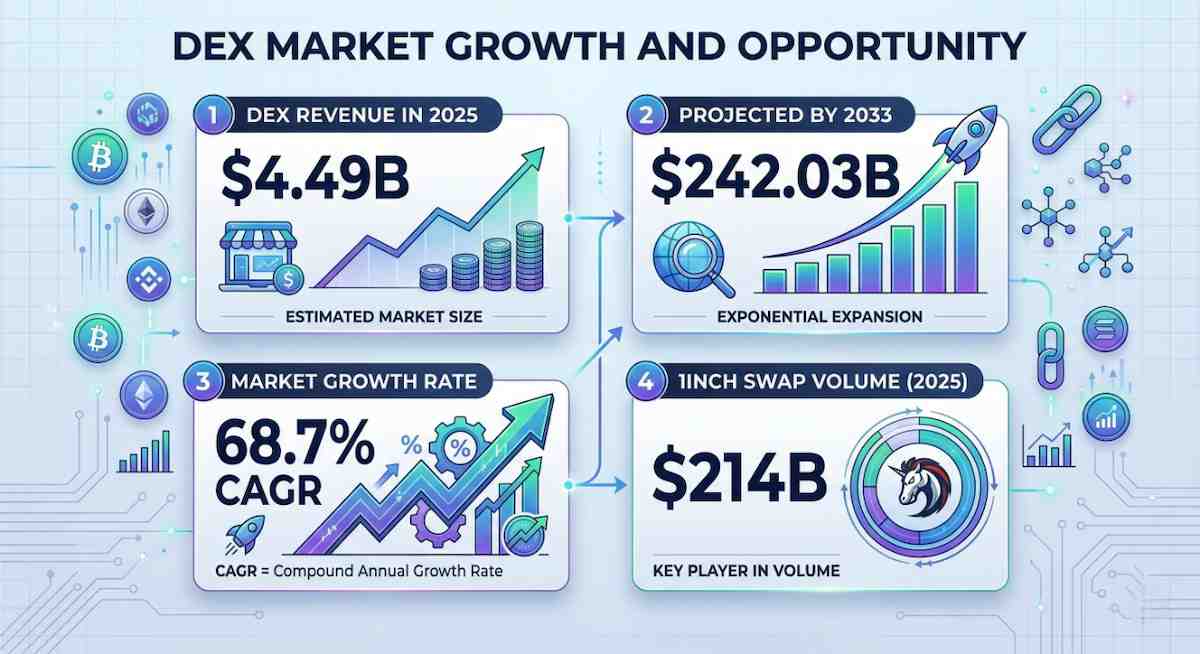
Demand for decentralized trading keeps rising, and the numbers make that clear. The global decentralized exchange segment generated $4.49 billion in revenue in 2025 and is projected to reach $242.03 billion by 2033, with a 68.7% CAGR from 2026 to 2033. The wider DeFi market is growing at a similar pace. Grand View Research values the global DeFi market at $26.94 billion in 2025 and projects it to reach $1.42 trillion by 2033. Platform-level data tells the same story. 1inch reported $214 billion in total swap volume in 2025, up 39% year over year, with 114 million swaps completed across its network. These figures show strong demand for DEX products that offer broad liquidity access, better price discovery, and non-custodial trading. For businesses that want to enter DeFi without a long build cycle, a 1inch clone script gives a faster path to launch and a proven product structure that fits current market demand.
Understanding the Basics of DEX and 1inch Clone Script
A decentralized exchange is a platform where users trade crypto through smart contracts. The platform does not hold user funds. Instead, traders connect their wallets and approve transactions on-chain. This creates a more transparent and user-controlled trading experience.
A DEX aggregator works by scanning multiple liquidity sources and finding the best route for each trade. This helps reduce slippage and can improve pricing for users. It is useful in a market where liquidity is spread across many platforms and chains.
A 1inch Clone Script is a pre-built and customizable DEX aggregator product. It usually includes swap functions, wallet connectivity, routing logic, and white-label branding. For businesses, it offers a faster way to launch a DEX platform without starting from scratch.
Market Opportunity and Business Benefits
Why Invest in DEX Development?
The market for decentralized exchanges keeps growing as more users move toward self-custody and onchain trading. That shift creates a strong business case for DEX development. DeFi activity has expanded across major regions, and DEX aggregators now process billions in weekly volume. This growth shows that traders want better pricing, broader token access, and direct control over their assets. A DEX aggregator built with a 1inch clone script meets that demand by routing trades across many liquidity sources in one place. For businesses, this model offers a clear path to revenue through swap fees, premium features, staking tools, and liquidity incentives. It also gives brands a faster entry into DeFi without the long cost and build cycle of a fully custom platform.
Key Business Advantages of Using 1inch Clone Script
A 1inch clone script helps businesses launch faster and spend less on development. It supports multi-chain trading, connects with many liquidity pools, and gives users better swap rates. This model also creates clear revenue options through trading fees, staking, and other platform services.
Why Is the 1inch Clone Exchange Preferred for Your DEX Aggregator?
Advanced Liquidity Aggregation Mechanism
A 1inch clone exchange is a strong fit for a DEX aggregator since liquidity sits across many decentralized exchanges, not in one place. The model pulls pricing and pool data from many sources in real time and builds a better trade path from that wider market view. 1inch says its Pathfinder system searches trading paths in less than a second and takes gas costs into account, which explains why this design remains popular for aggregator products. Better route selection leads to better token prices, lower slippage, and stronger trade execution for users.
Smart Routing for Optimized Trades
Smart routing gives the exchange an edge at the trade level. Instead of sending the full order to one pool, the engine can split the order across several pools and send each part through the path with the best value. This helps control price impact on larger swaps. It also improves execution speed and price accuracy. 1inch states that its routing engine accounts for gas costs and searches across many protocols, which shows why this structure works well for businesses that want a better user trading experience from day one.
Faster Time-to-Market for Businesses
A clone exchange cuts build time in a direct way. The business does not need to create the main swap flow, routing logic, wallet connection layer, and liquidity structure from zero. The core model already exists, and the product team can focus on branding, chain support, token pairs, and business rules. This speeds up launch planning and helps startups enter DeFi faster. It also helps larger firms test a DEX aggregator model without waiting through a long custom development cycle. This matters in a market where product timing often shapes early user growth.
Cost-Effective Development Approach
Building a DEX aggregator from scratch takes more engineering time, more testing, and more audit work. A 1inch clone exchange lowers those costs by giving the business a proven product structure at the start. That reduces design waste and shortens the path to launch. Lower build costs can improve return on investment once trading fees, token activity, and premium features start producing revenue. For crypto businesses that want a working product with strong market logic, this route is often the more practical commercial choice.
Multi-Chain Compatibility and Scalability
Chain support matters for user growth. 1inch’s help documentation lists support for networks such as Ethereum, BNB Chain, Polygon, Arbitrum, Optimism, Base, Avalanche, Gnosis, Linea, and Solana. That broad coverage shows what traders now expect from a serious DEX interface. A clone built on this model can reach users across several ecosystems, reduce dependence on one chain, and support lower-cost trading where demand is strongest. This makes the platform easier to expand over time and gives the business access to a wider market.
Enhanced Security and Smart Contract Reliability
Security carries real weight in DeFi. Funds move through public smart contracts, and one flaw can damage trust fast. 1inch has published recent material on contract audits, continuous code scanning, and AI-assisted pre-audits inside its development flow. It also states that audits look for bugs, logic flaws, and contract risks before deployment. That security-first model makes the clone concept more appealing for businesses that want a safer base for launch. A strong audit process, live monitoring, and careful key management support safer and more transparent transactions.
Core Features of a 1inch Clone Script-Based DEX
Aggregation Protocol
A 1inch clone script-based DEX stands out when its trading engine pulls liquidity from many sources at once. The aggregation protocol checks rates across different pools and routes trades through the best available path. This helps users get better pricing and lower slippage. It also makes the platform more reliable during market swings, where price gaps between pools can grow within seconds.
Limit Order and Swap Functionality
Limit orders and instant swaps make the exchange useful for different types of traders. Instant swaps appeal to users who want fast and simple token exchanges. Limit orders appeal to users who want more control over the price at which a trade executes. This mix helps a DEX attract both beginners and active traders. It also gives the platform more depth than a basic swap-only interface.
Staking and Yield Farming
Staking and yield farming add value beyond trading. These features give users a reason to keep funds on the platform and stay active over time. Users can lock tokens, earn rewards, and take part in governance decisions. For the business, this can support retention, boost token demand, and create a stronger user base that stays engaged after the first transaction.
Multi-Chain Compatibility
Multi-chain support is now a core part of a serious DEX product. A platform that works across networks can serve more users and reduce dependence on one blockchain. It also helps traders access lower fees and faster transactions on chains that fit their needs. This expands the platform’s reach and supports higher transaction volume across a broader market.
Admin Dashboard
The admin dashboard gives the business control over daily operations. It tracks swap volume, fee income, wallet activity, liquidity levels, and token pair demand. It also helps platform owners adjust fee settings, monitor performance, and identify weak points in the market. Without this control panel, growth becomes harder to manage and measure.
Key Business Advantages of Using 1inch Clone Script
A 1inch clone script appeals to business owners for one main reason. It reduces the time and money needed to launch a working product. The base architecture already reflects the features traders expect, such as token swaps, wallet connection, routing logic, and support for many pools. That lowers development pressure and helps companies move from planning to launch in less time. It also supports multi-chain deployment, which matters in a market where users trade across Ethereum, BNB Chain, Polygon, Arbitrum, Base, and other networks. This wider chain reach helps a business serve more users and list more assets. Access to many liquidity pools also improves pricing, which can raise user retention and trust.
Target Use Cases
This model works well for crypto startups, fintech firms, enterprise DeFi products, Web3 investment apps, and services built around liquidity aggregation. Startups can launch faster with lower upfront cost. Fintech firms can add non-custodial trading to their current products. Enterprise platforms can use DEX aggregation for treasury operations, asset access, and broader token coverage. Web3 investment apps can give users a direct way to swap tokens across many pools without leaving the platform.
Step-by-Step Process to Launch a DEX Using a 1inch Clone Script
Step 1: Define Business Goals and Requirements
Launching a DEX starts with business planning. The team needs to define its target audience, core features, and revenue model. Some platforms focus on token swaps and trading fees. Others add staking, farming, referral systems, or governance tools. This stage shapes the full product and helps the business avoid wasted development time.
Step 2: Choose the Blockchain Network
The next step is choosing the blockchain network. Ethereum offers strong liquidity and strong brand value, but gas costs can be high. Chains like BNB Chain, Polygon, and Arbitrum offer lower fees and faster execution. Many businesses now plan for multi-chain support from the start since it gives users more flexibility and spreads activity across networks.
Step 3: Customize the 1inch Clone Script
Once the blockchain base is clear, the clone script should be customized to match the brand. This includes the design, trade flow, dashboard layout, and feature set. A clean interface helps new users feel confident from the first visit. It also helps the business stand apart in a crowded market.
Step 4: Integrate Liquidity Sources
The product then needs deep liquidity. The team should connect the platform to many DEXs and liquidity pools so users can access better prices and more trading pairs. Strong liquidity is one of the main reasons traders choose an aggregator over a single exchange.
Step 5: Implement Smart Routing Algorithm
Smart routing is a key part of the value proposition. It can split a trade across multiple pools to reduce slippage and lower gas costs. This process helps users get a better outcome on each swap. It also builds trust in the platform over time.
Step 6: Develop and Deploy Smart Contracts
After the routing layer is ready, developers deploy the smart contracts that manage swaps, liquidity, fees, and governance logic. These contracts run the core functions of the DEX and need careful planning from the start. Clear contract logic supports transparent and automated trade execution.
Step 7: Wallet Integration
Wallet support must follow, with options such as MetaMask, WalletConnect, and other common wallets to make access simple and secure. Easy wallet connection reduces friction for new users and makes the platform more practical for daily trading.
Step 8: Security Implementation
Security should shape every stage of the launch. Contract audits, transaction checks, encryption, and attack protection all matter before the platform goes live. A DEX handles direct asset movement, so trust depends on strong technical safeguards.
Step 9: Testing and QA
Before launch, the team needs full testing across trading functions, wallet flow, token pricing, and transaction speed. This stage helps identify bugs, fix broken logic, and improve the user experience. Strong QA reduces the chance of failure after launch.
Step 10: Deployment and Launch
The final stage covers mainnet deployment, user onboarding, and early marketing. A strong launch does not depend on code alone. It depends on trust, pricing quality, and a product that gives traders a reason to return.
Monetization Strategies for DEX Platforms
Trading Fees
Trading fees are the most direct revenue source for a DEX platform. The exchange charges a small percentage on each swap, and revenue rises with user activity and trade volume. This model is simple, proven, and easy for users to understand. It also gives the business a steady income stream from core platform usage.
Liquidity Provider Incentives
Liquidity provider rewards help attract the funds needed to support active trading. New exchanges often need stronger pool depth in the early stage, and token rewards can help bring in that liquidity. A well-planned incentive program can improve market activity, tighten spreads, and make the platform more appealing to traders.
Premium Features
Premium features can open a second layer of revenue. Advanced users may pay for better charts, API access, smart trading tools, deeper analytics, or account-based support. This creates a business model that does not rely only on swap fees. It also helps raise revenue from users who need more than basic trading access.
Token Launch and Governance Models
A native token can support long-term growth for the platform. It can fund liquidity campaigns, reward active users, and give token holders voting rights on future changes. Governance creates stronger user participation and helps build a community around the exchange. For businesses, this can support trust, retention, and wider market visibility.
Marketing and User Onboarding
Strong marketing and simple onboarding play a direct role in revenue growth. A DEX needs more than working technology. It needs clear wallet support, easy navigation, and a user flow that helps first-time visitors complete trades without friction. Good launch campaigns, referral offers, and reward programs can bring in early users and help turn them into repeat traders.
Conclusion