
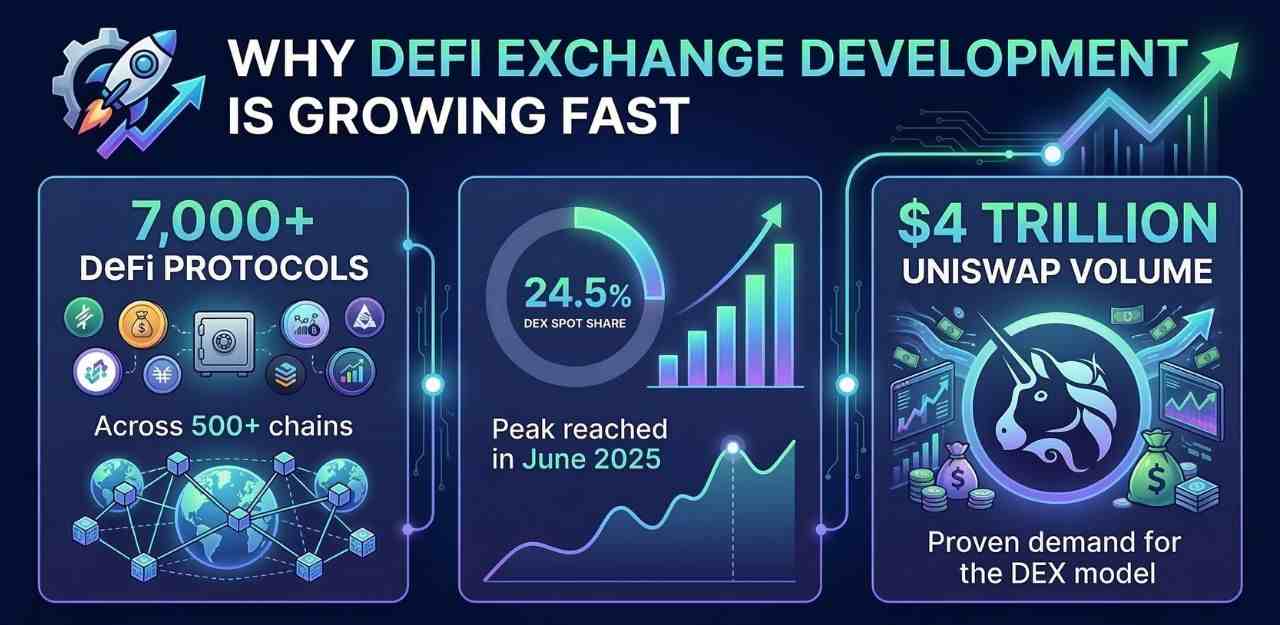
DeFi is no longer a niche part of crypto. It now supports trading, lending, staking, and many other onchain services across a large and active market. DefiLlama tracks more than 7,000 DeFi protocols across 500-plus chains, which shows how fast this sector has expanded. Within that market, decentralized exchanges now hold a stronger share of trading activity. CoinGecko reported that DEXs reached 24.5% of spot trading volume in June 2025, and their share stayed above 10% from January 2025 onward. These numbers show that DeFi exchange development is now a serious business move for companies that want to enter crypto with a product type users already understand.
A DEX lets users swap tokens from their own wallets through smart contracts, which fits the non-custodial model many crypto users prefer. Building that kind of exchange from scratch takes time, money, and deep technical work. Teams need smart contracts, liquidity pool logic, wallet connections, front-end flows, testing, audits, and launch planning. A Uniswap clone script cuts that early workload and gives businesses a ready base for token swaps, liquidity pools, and non-custodial trading. Uniswap itself has processed about $4 trillion in protocol volume, which shows how proven this exchange model has become. That is why many founders choose this route to launch a crypto exchange faster and start from a model the market already trusts.
What is a Uniswap Clone Script?
Definition and Core Concept
A Uniswap clone script is pre-built DEX software based on the trading model made popular by Uniswap. Uniswap states that its protocol is a peer-to-peer system for exchanging ERC-20 tokens through persistent smart contracts, with a focus on self-custody and no trusted intermediary. A clone script adapts that same base for a new business, brand, or niche market.
For a business owner, the value is simple. The script gives you the core exchange structure without forcing your team to build every contract and screen from zero. You still shape the product through branding, chain support, fee settings, token listings, and custom features. The base product just gets you to market much faster.
How It Works
The core engine is the AMM model, or Automated Market Maker. Uniswap explains that an AMM runs on smart contracts and uses code and math to price trades instead of relying on an order book. This lets traders swap tokens against a liquidity pool at any time.
Each pool acts as a trading venue for a token pair. Uniswap notes that a new pool starts at zero balances until a liquidity provider seeds it with both tokens. That first deposit sets the opening price, and later trades move the price as pool balances shift. This structure removes the need for a traditional matching engine.
The model is non-custodial from start to finish. Users connect a wallet and approve trades from that wallet. The platform does not hold customer funds in the same way a centralized exchange does. That design appeals to crypto-native users who want control over their assets during every trade.
Why Businesses Prefer Clone Scripts
Speed is the first reason. A clone script starts with a known DEX structure, so teams spend less time on core engineering and more time on launch work, product fit, and user growth. That shorter path matters for firms that want trading revenue soon after release.
The second reason is lower complexity. A custom build asks one team to solve pricing logic, pool behavior, wallet flow, and smart contract testing at the same time. A clone script narrows that work into a more manageable build. For many companies, that trade makes sense. They get a faster go-to-market path and a structure based on a proven DEX model.
Key Features of a Uniswap Clone Script
A strong Uniswap clone script succeeds or fails on product depth. The name alone does not matter much. Buyers care about the parts that shape trading quality, user trust, and revenue. The best scripts copy the base logic of Uniswap, then add room for brand control, fee design, and chain choice.
Automated Market Maker Integration
AMM logic sits at the center of the product. It lets users trade through smart contracts instead of waiting for another trader to fill an order. Uniswap describes this model as an automated liquidity protocol powered by a constant product formula. For a new exchange, this means fewer moving parts than a traditional order book setup and a cleaner path to launch.
Liquidity Pools and Market Access
Liquidity pools give the platform its market depth. They hold token reserves that traders use for swaps. Uniswap states that each pool is a venue for a token pair and starts trading once liquidity providers seed it with both assets. For a business, pools create a direct way to open markets for new tokens without relying on centralized market makers.
Non-Custodial Trading
Non-custodial design is a major product advantage. Users trade from their own wallets, which keeps the exchange from acting as the holder of customer assets. This setup can reduce operational burden and lines up with what many DeFi users expect from a DEX. It gives the product a trust signal from the start, especially for users who avoid custodial platforms after exchange failures in past market cycles.
Flexible Fee Models
Fees are one of the clearest commercial features in any clone script. Uniswap documents note that v3 uses fee tiers such as 0.01 percent, 0.05 percent, 0.3 percent, and 1 percent, and v4 supports flexible fees from 0 percent to 100 percent. That range shows how fee design can shape a trading venue. A business can set lower fees to attract volume or use higher fees for niche pairs with thinner liquidity.
Wallet Integration and User Flow
A usable DEX needs clean wallet support. The front end should connect popular wallets, show clear balances, display price impact, and guide users through approvals and swaps without friction. The Uniswap docs and app flow set a clear standard here. Businesses that copy the logic and simplify the interface often reduce drop-off during first use.
Security and Smart Contract Stability
Security is not a bonus feature. It is a launch requirement. The Uniswap protocol is built around non-upgradable smart contracts and a design that prioritizes security and censorship resistance. Any clone script used for a real product should go through contract review, testnet checks, and third-party audits before launch. A fast release means little if one contract flaw drains liquidity on day one.
Why Should You Launch a DEX Platform Like a Uniswap Clone?
Growing Demand for Decentralized Trading
More crypto users now prefer non-custodial trading. They want full control over their assets instead of leaving funds on centralized platforms. This shift has increased trust in smart contract-based exchanges. It has also pushed decentralized finance into the mainstream. For businesses, this creates a strong opening to launch a DEX that matches current market demand.
Faster Entry into the DeFi Market
Building a DEX from scratch takes time, money, and deep technical work. A Uniswap clone script gives businesses a faster way to enter the market. It comes with core exchange features already built, so teams can focus on branding, customization, testing, and launch. This helps businesses go live sooner and start attracting users earlier.
Lower Development Risk and Cost
A custom-built exchange often comes with high development costs and a longer testing cycle. A Uniswap clone script reduces that burden. It uses a proven trading model with tested features like token swaps, liquidity pools, and wallet integration. This lowers technical risk during the first launch stage and makes the project easier to manage.
Revenue Opportunities for Businesses
A DEX can create income through several channels. Trading fees are the most direct source of revenue. Businesses can also earn from token listings, featured placements, staking programs, and liquidity rewards. This makes a Uniswap clone script a strong choice for companies that want both speed and long-term revenue potential.
Strong Market Fit for Startups and Enterprises
A Uniswap clone script works well for crypto startups, exchange operators, and Web3 brands. It is easy to tailor for niche communities and specific trading needs. It also gives room for future growth through added features, multi-chain support, and deeper market expansion. This makes it a practical option for businesses that want to enter DeFi with less complexity.
Step-by-Step Process to Launch Your Crypto Exchange
A fast launch still needs a clear process. A Uniswap clone script saves build time, yet the outcome depends on business planning, product choices, and launch discipline. The teams that do this well treat the script as a base product, not a finished company.
Step 1 – Define the business model first
Start with the market you want to serve. Some firms target meme coin traders. Some target new token launches on one chain. Some focus on a regional user base with low-fee swaps. The product will change based on that choice. Fees, token listing policy, wallet support, and liquidity plans all depend on the audience.
This step also shapes revenue. Uniswap documents show how fees work at the protocol level. In v2, each swap carries a 0.3 percent fee for liquidity providers. In v3, fee tiers include 0.01 percent, 0.05 percent, 0.3 percent, and 1 percent. In v4, fees can be dynamic. That range shows why fee design is a business decision, not just a contract setting.
Step 2 – Choose the right clone script provider
Not every Uniswap clone script is ready for commercial use. Some are little more than a copied interface. Others include audited smart contracts, wallet flows, liquidity logic, admin tools, and post-launch support. Buyers should look at code quality, deployment history, audit status, and chain support before signing any deal.
The official Uniswap docs give a useful benchmark here. They show the core parts a real DEX must support, including swaps, pools, liquidity, routing, and smart contract interaction. A provider should be able to explain how its build handles each of those parts in production.
Step 3 – Customize the product for your market
This is where a clone becomes a real business. The front end needs your brand, your trading pairs, your fee logic, and your user flow. Some companies add staking, referral programs, launchpad access, or token analytics. Others keep the product simple and focus on core swaps.
Restraint matters here. A crowded first release slows testing and creates more places for bugs. The better path is to launch with the core trading loop working well, then add more features after real users arrive.
Step 4 – Deploy smart contracts with care
The contract layer is the heart of the exchange. It controls pools, pricing, fees, and trade execution. Uniswap’s protocol docs explain that the system runs through smart contracts and pool-based trading, not through a central matching engine. Any business using a clone script needs to review and test that contract layer before launch on a public chain.
The chain choice matters too. Ethereum offers strong network effects. Other EVM chains can offer lower fees and faster transactions. The right answer depends on your market, token mix, and user budget. DefiLlama’s DEX dashboards show that trading activity is spread across many chains, which gives new entrants room to target more than one ecosystem.
Step 5 – Test security before launch
Security checks must happen before public release. That includes contract tests, wallet flow tests, swap simulations, and third-party audits. Uniswap’s own design puts security at the center of the protocol, and any serious exchange launch should do the same. One flaw in approval logic, pool math, or token routing can drain funds and destroy trust in days.
Step 6 – Seed liquidity and launch the market
A DEX without liquidity is just an empty interface. Uniswap’s pool docs state that each pool starts with zero balances until someone seeds it with both assets, and that the first provider sets the initial price. That makes liquidity planning one of the first launch tasks, not the last. Teams often work with treasury funds, partner projects, or early community backers to create the first pools.
User growth comes after that. Once the market has enough depth, the exchange can run trading campaigns, token listing pushes, and community programs. The aim is simple. Get early users into a product that feels stable, clear, and active from the first week.
Monetization Strategies for Your Crypto Exchange
A crypto exchange needs a clear revenue model from the start. Traffic alone does not build a business. The product has to convert activity into fees, listings, or premium services. That is where a Uniswap clone script becomes more than a technical shortcut. It becomes a base for income.
Trading Fees
Trading fees are the most direct income stream. Uniswap v2 documents state that swaps carry a 0.3 percent fee that is distributed to liquidity providers. Uniswap v3 and v4 add more room through different fee tiers and flexible fee structures. A business that launches its own DEX can use a similar model, then tune fees around token volatility, pair demand, and target users. High-volume pairs may work better with lower fees. Niche pairs often support higher margins.
Liquidity Programs
Liquidity is the fuel of a DEX. No pool depth means poor pricing and weak user retention. Many exchange operators fund early liquidity campaigns to bring in market makers, token communities, and early backers. The goal is simple. Build enough depth to support trades without heavy slippage. Once activity rises, fees start to create a more stable income stream. Uniswap’s pool model shows why this works. The trading venue exists only after liquidity enters the pool.
Token Listing Revenue
Some businesses earn from token listing packages, featured placements, or launch support for new projects. This model works best in ecosystems where new tokens need visibility and a liquid first market. A clone-based DEX can turn listings into a service line by bundling pool creation, front-page promotion, and launch support under one offer. This is common in chain-specific or niche trading communities where discovery matters almost as much as liquidity.
Premium Tools and User Services
A DEX can earn beyond core trading. Teams often add premium analytics, market alerts, whale tracking, token research dashboards, or API access for active traders. Institutional users and token teams may pay for deeper data, better reporting, or branded launch support. These revenue layers help smooth income during low-volume trading periods. They can make the platform less dependent on swap fees alone.
Why This Model Appeals to Decision-Makers
Decision-makers do not just ask whether a platform can launch. They ask how fast it can earn. A Uniswap clone script helps answer that question in practical terms. It cuts early build time, starts from a familiar trading model, and gives operators several ways to turn user activity into revenue. That mix is a strong reason many businesses choose the clone path over a full custom build at the first stage of growth.
How Much Does a Uniswap Clone Script Cost and What Is the ROI?
A Uniswap clone script is usually cheaper and faster than building a DEX from scratch. Current market estimates place a clone or white-label DEX launch at around $10,000 to $50,000. A custom DEX build often starts at $25,000 to $45,000 and can go much higher once custom features, multi-chain support, and deeper testing are added. In terms of speed, a clone-script exchange can often be launched in 2 to 6 weeks, while a custom build usually takes 3 to 6 months or longer.
The lower end of the clone range usually covers a basic product with core swap functions, one blockchain, wallet integration, and light branding. Costs rise when a business adds custom UI, staking, launchpad features, analytics, or broader chain support. Cheap script packages may look attractive, but they often leave out security review and serious customization.
Security is a real budget item. Contract testing, third-party audits, deployment checks, and monitoring should be part of the launch plan. A fast build has little value if one flaw puts liquidity or user trust at risk.
There is also a second layer of cost after development. A DEX needs liquidity and users. Teams often spend extra on pool seeding, community campaigns, referral offers, and token partnerships. That spend can be just as important as the code itself.
The return comes mainly from trading fees. Uniswap’s fee model shows how flexible this can be, with fee tiers that let operators match pricing to token pairs and user demand. A clone script improves ROI by cutting build time and helping the exchange start earning sooner.
Conclusion
Launching a crypto exchange with a Uniswap clone script gives businesses a faster and more cost-effective way to enter the DeFi market with a model users already trust. It cuts development time, lowers early engineering costs, and provides a strong base for features like token swaps, liquidity pools, wallet integration, and fee-based revenue. For startups, crypto firms, and enterprises that want to move quickly, this model offers a practical path to test demand, build trading volume, and create a scalable DEX without starting from scratch. The key is to pair speed with smart planning, strong security checks, and a clear market focus so the platform can grow into a profitable long-term business.